

We incarnate on a planet whose evolution is intertwined with the destiny of humanity. The “Great Mother” is our body. We have a karmic relationship with the Earth.
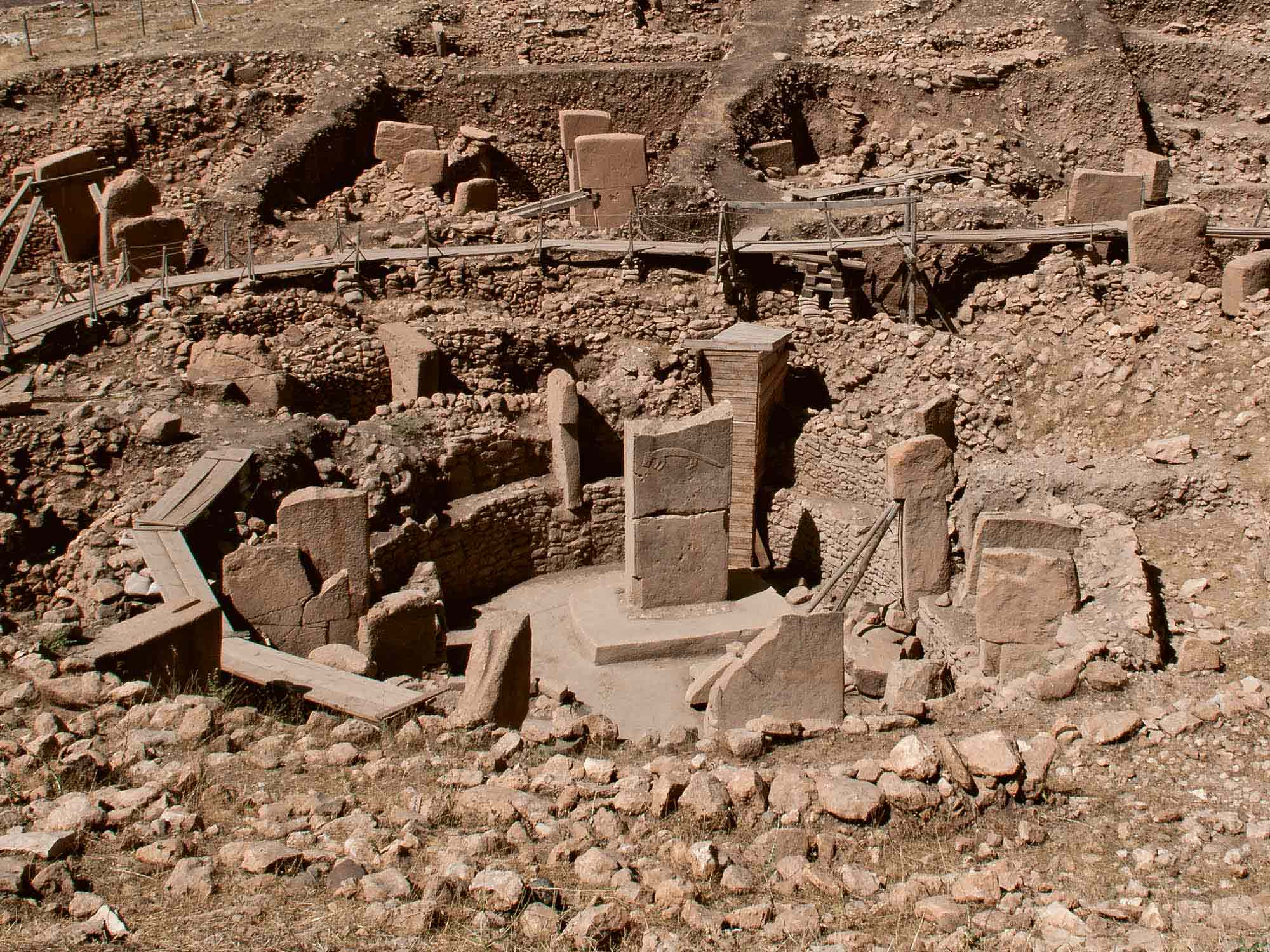
Our primary experience is unity—oneness between self and world. Gradually, duality emerges: child–mother, ‘I’–world, human–Earth. Every day—upon waking—we can try to catch that moment when the ‘I’ again falls out from the unified continuum of experience and ‘I’ and world stand in opposition to one another as separate objects. This awakening to duality occurs time and again throughout our lives; it is an archetypal experience of ourselves as conscious and self-aware human beings. I can recall, for example, how, as a child, lying in a meadow and gazing at the sky, I suddenly realized: the clouds are moving, I am not. For humanity as a whole, this transition took place during the shift from a nomadic life as hunters and gatherers to a sedentary existence approximately 12,000 years ago. An archaeological site that perfectly illustrates this is Göbekli Tepe, located on the upper tributaries of the Euphrates in what is now Southeastern Anatolia, Turkey. On a hill overlooking the plain circular structures are set into the limestone ground. Twelve stone stelae, rising vertically with broad horizontal crossbeams and forming a T-shape suggestive of a human figure, stand in a circle. Between the stelae and connecting them is an oval bench for the community to sit on. In the middle stand two larger stelae anchored in a rock slab. They give an impression that they have not risen from the Earth, but instead have been sent down from the cosmos of the gods. The entire complex speaks, “Here I stand, detaching myself from the interwoven flow of continuous horizontal life within the landscape and with the animals. I stop time and mark a point in space: I, here, now, upright, in the present. I stand and face the earthly world.”

The second stage is an experience characterized by the sense that while I evolve, the earthly world does not; it remains static. As a human being, I proclaim the end of that former initial two-foldness and follow the urge, within and without, to new horizons. “[T]hat splendid stranger with sense-filled eyes, with gliding gait and gently-closed, rich-toned lips”—that is how Novalis describes him.1 And who cannot remember having felt this way in their romantic years? Before it becomes bitterly serious and existential, we ask, “Can I find my way, my entirely individual path, in this world so set in its ways? In this sociologically conservative adult world, in this religiously created world of the Father?” And yes, we felt it can be done. The people of Göbekli Tepe domesticated the wolf and it became a dog—the wild stranger becomes the protector of the self. The multi-seeded grasses are cultivated into heavy, grain-bearing cereals. The soil is furrowed with the plow. Light and darkness, Ahura Mazdao and Ahriman, are brought into encounter. Agriculture proceeds from the Neolithic Revolution.
And how did Odysseus fare in Troy? With the first spark of individual thought, he outwitted the sacred cosmos of wisdom known to the ancients. At the heart of ancient oriental wisdom was the knowledge that the human spirit-soul is, in fact, a cosmic being and sojourns upon the Earth again and again. Through the course of time, the wheel of repeated Earth lives—bound by karma—turns relentlessly on. And freedom? Odysseus takes it for himself. Who has not been Odysseus at least once in their life? The new that I bring is a success! And then comes the journey home, with sirens, cyclopes, and rivals.
All this still belongs to the tranquil world of the Mediterranean. The Portuguese looked out toward the Atlantic, but no one sailed beyond sight of the continental shore. Then, in 1418, Henry the Navigator established the School of Sagres. New ships capable of sailing into the wind were built, triangulation for navigation on the high seas was developed, and commercial ethics were taught. Explorers set sail. The Earth became a globe. But trade degenerated into colonization. The freedom of some became the fate of others. Modernity’s freedom is not without guilt; progress creates guilt among people, both collectively and individually. Karmic relationships become complicated.
In a third stage, the Earth awakens from its astronomical and geological slumber and reveals itself to be an evolving being. “Does she, too, have a destiny and karma like us humans?” First, she begins to move. Copernicus fixes the Sun in the sky and has the Earth revolve around it and also around herself. The Moon revolves around the Earth, and the other planets, with the Earth, revolve around the Sun. Kepler calculates and—thanks to Tycho Brahe’s precise measurements—concludes that the apparent circles are in fact ellipses. The world is not centric but eccentric; there is not one single center, but at least two foci. Every being lives not only from within itself, but also from its relationship with another. The cosmos—a world of relationships, with the Earth right in the middle.
And further, the Earth itself is also evolving. The theory of evolution developed by Charles Darwin and others shows that the diverse species of the plant and animal realm are evolutionarily linked. Species evolve from simpler to more complex forms—from ferns to composite plants, from fish to warm-blooded mammals. But what of humans? Do they belong in this sequence? And if so, where and how? The creatures of the Earth demand that humans embrace their humanity and humans become uncertain of their own origins and aims. Then the ground itself begins to shift—in 1912, Alfred Wegener published his theory of continental drift. Initially ridiculed, it evolved into the now-recognized study of tectonics, which can describe with remarkable precision how the landmasses have moved and continue to move on the sea-blue planet Earth.
The soil and the Earth—and with them, agriculture—came under the influence of the Enlightenment’s natural scientific perspective and were studied, understood, and explained through physical and chemical analysis. In 1840, Justus Liebig knew that nitrogen, phosphorus, and potassium were the most important plant nutrients, leading to the development of synthetic chemical fertilizers, nitrogen fertilizer being foremost among them. This fertilizer is produced in industrial quantities using the Haber-Bosch process, which was developed during World War I. It marks the beginning of industrial agriculture, which many farmers experience as a liberation from hardship and tradition. However, industrial agriculture cannot shake off its anti-ecological approach, and, as a result, today it is a major contributor to soil erosion, water waste, and climate disruption.
Rudolf Steiner seized upon the idea of evolution and explored the development of the Earth from a spiritual-scientific perspective. He published his results in 1910 in Occult Science in Outline.2 He concludes that the Earth, too, comes and goes, incarnates and ex-incarnates. We are living in the fourth phase of the Earth’s evolution. It forms the middle of a sequence of seven Earth incarnations. The midpoint has been passed. After a turning point in evolution, the potential for a new kind of upward evolution was implanted to counteract the destructive forces affecting the Earth and humanity. This turning point was the connection of the solar being Christ with the Earth and humanity. Since this “turning point in time,” forces of resurrection have been a real presence in the Earth, the Earth’s atmosphere, and in human hearts. But these forces require active reception on the part of humanity.

During the fourth stage, both the human being and the Earth are evolving. They are no longer independent of one another, but rather depend upon each other. As human beings, we draw daily from the Mother Being of the Earth and her gifts of nature. This can easily be forgotten in a technologically infused daily life amid the accelerating stream of inventions that come ever closer to approximating an imitation of life. As annoying as it is when we have no cell phone reception when we should, it would be much worse if sleep no longer regenerated us, food no longer nourished us, springs were silent, or masses of air were obstructed. The Earth lives, and we are embraced within her life.
What does our partnership with the Earth look like? Are we still the whimsical creatures she can love like a mother with a twinkle in her eye? Most certainly, yes, and hopefully that thought crosses our minds more often, seasoned with a pinch of self-irony. On the other hand, our posturing about emancipation has long since become superfluous, and we abuse the Earth on a daily basis. This situation has an ecological dimension. We continue to exploit the Earth and her resources, pushing her to the brink of collapse. Each of us is complicit, because we are all caught up in the conditions of civilization that, as a whole, create a negative ecological footprint. What can we do? Courageously and spontaneously break free! Always keep a pair of rubber boots in the trunk, so next time you’re in a traffic jam, turn off onto a dirt road and ask a farmer, “Here I am—can I pitch in and help? Pick up rocks, pull weeds, pick cherries?”
And I realize that the Earth is waiting for my footprint. I will walk upon her and do my part for our shared future. My vision for the future isn’t about fleeing to the Moon and Mars while everything on Earth falls apart; on the contrary, it’s about giving the Earth a new vitality through our human potential—just as Van Gogh’s Sower—an image we all know—sows the seeds of heaven into the open furrow. What are our seeds? What do we have to offer the Earth as seeds of life? They are the forces of resurrection that we know and embrace, which have been available since the turning point in time as seeds to be taken in hand and heart.
In hand: At the request of farmers concerned with the emergence of chemical and nitrogen fertilizers behind industrial agriculture, Steiner responded by presenting a human-based and human-oriented approach to agriculture during his 1924 Agricultural Course. Steiner described the living soil as an organ of the diverse agricultural organism from which plants can produce healthy fruits without chemicals in the vertical space between sun and Earth. With biodynamic preparations, we can provide the soil and the Earth, the food, and the people who eat it, with regenerative forces—opening them up to the cosmos and facilitating the formation of earthly form and substance.
In heart: The Earth wants to resurrect within me. This can become a vivid inward experience. How can I carry the Earth in my heart so that she will be within me just as I am within and upon her? “Earth, isn’t this what you want: to arise in us invisibly?” Rilke asks. And he answers, “Earth, my darling, I will!”3 How can I realize this “I will”? One possibility is to take the Earth with me as I drift off to sleep, to consciously cross the threshold with her so that I may intentionally carry her in my heart on the new day. Sleep is the little brother of death. If I can take the Earth with me on my paths of shaping destiny, then she will—and this is my request to her—carry me and us further along the path of her destiny.
Translation Joshua Kelberman
Title image Göbekli Tepe, Şanlıurfa, Turkey, CC BY-SA 3.0

Footnotes
- Novalis, Hymns to the Night, translated by Dick Higgins, 3rd edn. (Kingston, NY: McPherson & Co., 1978, 1988), 11; first published in German, 1800.
- Helena Blavatskaya, among others, had previously published similar ideas in her The Secret Doctrine (1888)—Tr.
- Rainer Maria Rilke. Duino Elegies, in The Poetry of Rilke, translated by Edward Snow (New York: North Point Press, 2009), “The Ninth Elegy.”





