

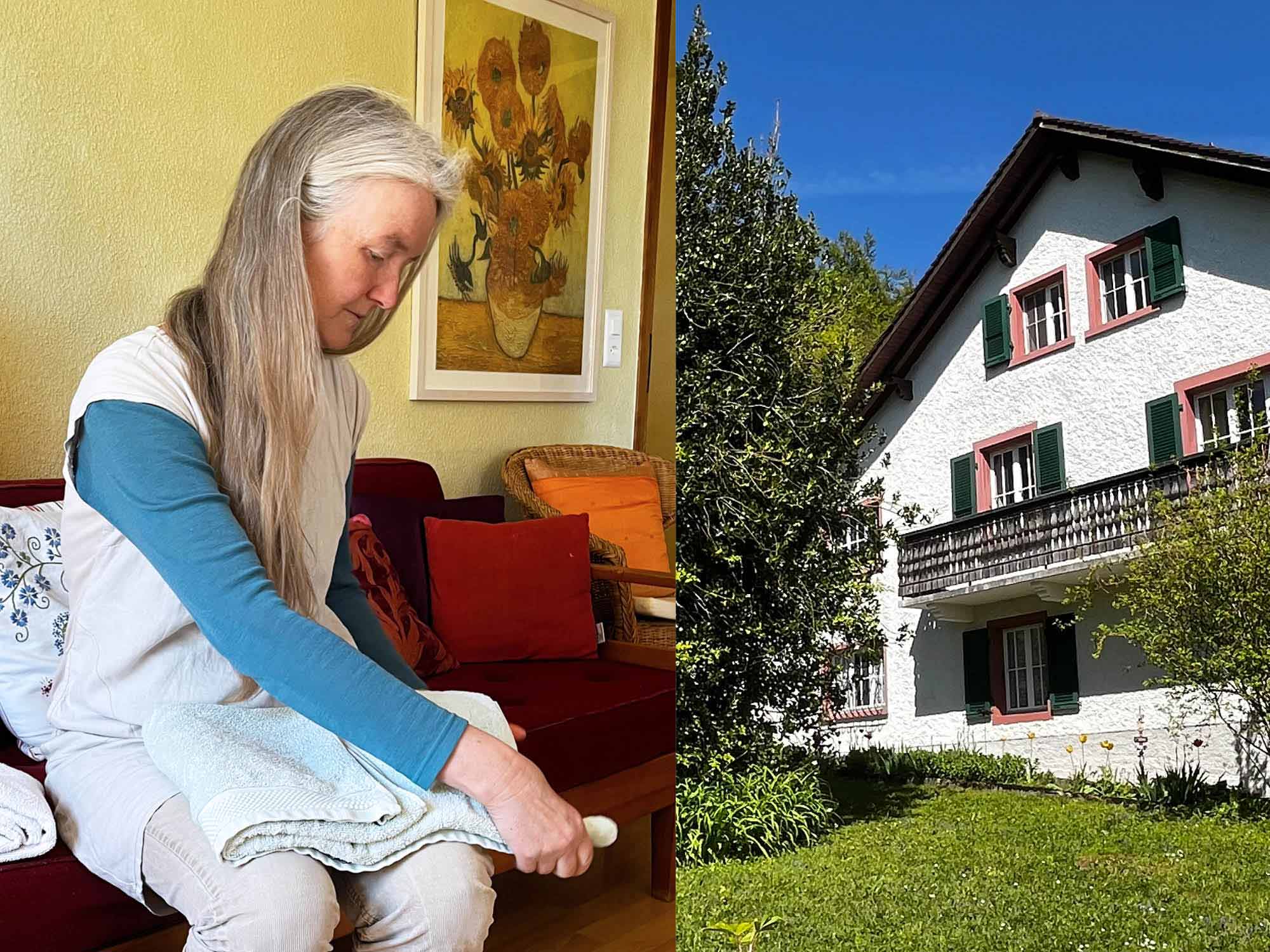
When a mother and child face a crisis, a living, supportive enclosure must be rebuilt. Katharina Guldimann describes the Ita Wegman Mutter-Kind-Haus [Ita Wegman Mother-Child House] as a protective space, a “family sheath” that envelops the mother, child, and the whole family organism. Questions by Johanna Lamprecht.
On a beautiful, sunny spring day, I arrive at the Ita Wegman Mother-Child House in Gempen, a small village up on the plateau, east of Dornach. The house is located at the edge of the village next to the forest. Fruit trees are in full bloom; goats frolic in the meadow across from the old farmhouse where the Mother-Child House occupies the second and third floors. Katharina Guldimann, the director of the facility, greets me with a warm welcome. Before our conversation, she gives me a short tour of the house, which is filled with warm colors. The second floor houses the spacious common room with a balcony and sweeping view of the gently rolling Jura hills surrounding the house. Here, women can meet and children can play. Attached are a single room, the staff office, and a therapy and consultation room. In the kitchen, which also serves as the communal dining room, the cook is still tidying up. There’s a familial atmosphere. On the third floor are three more single rooms, cozy and furnished with solid-wood beds and painted in warm colors. In the hallway, the many wool and cotton blankets on the dresser suggest that swaddling wraps and pads are offered regularly.
Johanna Lamprecht: Katharina, you are a midwife with additional training in anthroposophic nursing, as well as a family and social counselor. What led you and your team to found the Ita Wegman Mother-Child House fifteen years ago?
Katharina Guldimann: Before I started working here at the Mother-Child House, I spent eleven years on the family ward at what was then the Ita Wegman Clinic in Arlesheim [today, Klinik Arlesheim]. This ward was unique in that we were able to provide inpatient care for mothers, pregnant women, and new mothers together with their children—a concept that was quite unique at the time, designed to provide young families with long-term medical and therapeutic support. At the end of 2010, this offering in Arlesheim was shut down, which prompted some former colleagues and me, six months later, to establish the Stiftung Ita Wegman Mutter-Kind-Haus [Ita Wegman Mother-Child House Foundation]. We created a structure that allowed us to continue to offer this service as an independent entity.
What gap does this service fill?
We primarily serve mothers experiencing postpartum psychological disorders or severe exhaustion, and our goal is to provide them with relief, care, and loving support. Of course, severe psychological disorders require clinical care, which we are unable to provide. We are the only offering in Switzerland that provides non-clinical care for mothers and their children and works on an anthroposophical basis. Our interprofessional team, made up of pediatric nurses, registered nurses, midwives, a parent counselor, a social pedagogue, a physician, a curative eurythmist, and a housekeeper, aims to serve as a temporary support within a family-like setting, forming a circle around the mother and child. We started very small and remain so to this day. This is how we maintain the special support that mothers value.
Your team is made up entirely of women. How do you experience this space as one woman to another? What specific forces are needed to empower women in their motherhood?
Yes, it’s true that we’re currently an all-female team. We’ve only had one male chef work with us, and, of course, he was just as highly valued. I experience this feminine force as something sacred, where an intimate space can open up in the encounter between women. Many of our staff members are mothers themselves, although I don’t consider that a prerequisite for working with us. My experience is that you can read a hundred books on motherhood, but it is only within this particularly special feminine energy that you truly see what kind of force it requires.
Does this maternal space require special protection?
Yes, I understand our role as a team is to create a protective sheath, like an outer membrane, around the mothers and their children. To me, creating this protective sheath is a feminine force—both in giving this force and in sustaining it. And of course, this feminine, protective space, which allows us women to make a difference with our energy and potential, also needs men and fathers as well! Living within me as an image for this protective space is Mary, with her blue, outstretched cloak, symbolizing protection and, in a broader sense, embodying the motherly aspect of Mother Earth. Fathers, too, by the way, need a safe space just as much as mothers and children do; they are equally in need of it, but that’s another topic and not the focus of our particular work.
What does this safe space consist of, and what does it protect?
It’s the whole family. Every family must be able to protect its own culture and needs a sheath in order to grow and develop. I am convinced that every family has its own family culture, which is unique and encompasses its own set of values. In our work with mothers and families, we therefore do not want to impose anything specific on them. Rhythm, for example—an aspect of family culture—is something very individual. To develop and then protect this sense of self, a sheath is needed—one that functions as a continuation of the protective environment that we are all given at the beginning during pregnancy through the amniotic sac and the mother’s womb. An intact family culture keeps the family healthy. I see supporting this “family sheath” as one of our central tasks.
How do you help to grow this “family sheath”?
Essentially, this begins with the most basic needs: sleeping, waking, eating. As reliable caregivers, allowing sufficient time for these needs helps establish a daily structure and rhythm. Building up vitality is a task that requires careful planning! In practical terms, this often means that families discover the sense of freedom that arises when they pack far fewer activities into their day. Looking at the social environment, this protective family space is also supported by a “family around the family.” This can be provided by professionals or by the family and circle of friends.
At the Mother-Child House, we have the opportunity not only to offer counseling but also, because we live together to some extent, to truly support a mother when she wants to make a change. The mothers and their children usually stay with us for three to four weeks. Spending this time together—with us as a team, but also with the other mothers and children—helps the mothers stabilize and strengthen their own etheric forces. Changes must be able to become part of them, to be embodied, so that they become a kind of body of habits. We often receive very touching feedback about this. For example, before leaving, mothers tell us that they have realized they own far too many things at home—and that doesn’t just mean toys!—and that they want to start by decluttering when they return home. They realize that, deep down, they don’t actually need that many things.
In your experience, what challenges do mothers face today? How has this changed in recent years?
I can’t speak for everyone, but I can share from my experiences with the mothers who come to us. I would venture to say that nearly three-quarters of the women we see have experienced trauma. Ten to twenty years ago, this wasn’t nearly as prevalent. We work with mothers from all walks of life—whether they have an immigrant background or not and whether they come from stable family homes or were formerly in foster care. It is alarming how many of them also have a history of abuse. The women who have endured various traumatic experiences in their lives led safe, stable, and independent lives with a healthy sense of self before becoming mothers. Then they become pregnant, the child is born, and the structures they relied on no longer hold. Many women struggle with this transition. As motherhood progresses, they reach a state of physical exhaustion where soul and trauma issues resurface. They are triggered or experience flashbacks of events they thought they had already worked through. In motherhood, we relive our own childhood, whether we want to or not! Another factor is certainly media consumption. Parents are inundated with so much information from the media that they become unsettled and lose touch with their own feelings—and thus their ability to make decisions. I see a loss of presence of mind, coupled with a depletion of forces. Of course, economic factors also create significant pressure, whether in the workplace or due to material and professional expectations.
Your organization bears Ita Wegman’s name. Ita Wegman was a pioneer in many ways. Based on your experience, what did she initiate for mothers and children, and to what extent does her work influence your own?
In my view, Ita Wegman had a remarkable ability to make people feel safe and want to confide in her. She sensed what was needed in each situation and implemented it—a doer through and through. Those she worked with experienced this: here is someone who knows me and perceives me and who meets me with respect even in my moments of helplessness. At the same time, she had the ability to encourage others to take the next step.
I had a really special experience when I met one of our first mothers during her initial consultation. She was in a very bad condition: she could no longer speak to her child and had become completely silent, which was part of a post-traumatic stress symptom. Her sister had accompanied her to the intake interview because she could barely speak. At the end of the conversation, during which we agreed that she would come to us, I said to her, “I believe in you.” That was a moment when Ita Wegman was present for me. It wasn’t just me who said that. For me, Ita Wegman possessed a great ability through her encouraging care and her extensive medical knowledge. I feel connected to Ita Wegman in this, and it is incredibly important to me that we are able to bear her name with the Mother-Child House.
It’s interesting that Ita Wegman wasn’t actually a mother herself.
Yes, but she was deeply committed to receiving mothers along with their children, and she was a pioneer in this. I sense her healing power as stemming from a maternal energy; she formed a kind of chalice, a vessel, and fought just as passionately for her causes.
With her sensitivity, she served as a vessel for the other person and provided a sounding board. She then carried this sensitivity all the way into her will. Is this something fundamentally feminine?
I think so. The future unfolds within this sensitive, willful being. Something can be born from within a person—something that has long lived within them but which they cannot bring forth on their own.
She works like a midwife in the realm of the soul and spirit.
Yes, exactly. We would like to continue nurturing this ability here and, through our work—to build a bridge to Ita Wegman. I experience her profound spiritual-soul capacity as part of the star that protects our work.
You probably have to worry every year about whether the facility will remain open.
It’s clear that we operate at a loss—everyone else does too, but they’re subsidized. Our main concern is to make our offering accessible to all mothers who need it. This requires a great deal of ongoing work through various foundations. The costs of staying here are not covered by health insurance, which means we are not dependent on health insurance companies. I find a sense of freedom in that. Our work is very modern in this independence. We are still doing pioneering work, which I also see as a connection to Ita Wegman.
What are your visions and wishes for fostering maternal qualities in a way that strengthens family structures?
This is, obviously, a broad question. I can start by saying that it is, of course, a political issue and that we would need to begin by creating more political space—both inwardly and externally—that goes far beyond what we currently have in Switzerland, for example, with maternity protection and 14 weeks of maternity leave. My greatest wish is that mothers and children, motherhood and childhood—and the entire family—be granted protective spaces worldwide. But where does a safe space begin? For many people on Earth, it starts with simply having a roof over their heads.
That being said, I believe in the good. I believe that things are slowly starting to change, that people are becoming a little more humble and are beginning to realize what really matters in life. Maybe I’m being naive. As a grandmother now, I see it as my duty to pass on certain values. I dare say that all the mothers who have been with us have gained an understanding of what it means to set aside one’s own ego. This is a major practice and task these days.
It sounds as if these changes in motherhood are taking place quietly and almost imperceptibly.
Yes, just like how the circle around the family—the “family sheath”—can only grow gently and in safety.
More Stiftung Ita Wegman Mutter-Kind-Haus [Mother Child House]
Translation Joshua Kelberman
Images Katharina Guldimann and the Ita Wegman Mutter-Kind-Haus in Gempen, Switzerland. Photos: Johanna Lamprecht.






