

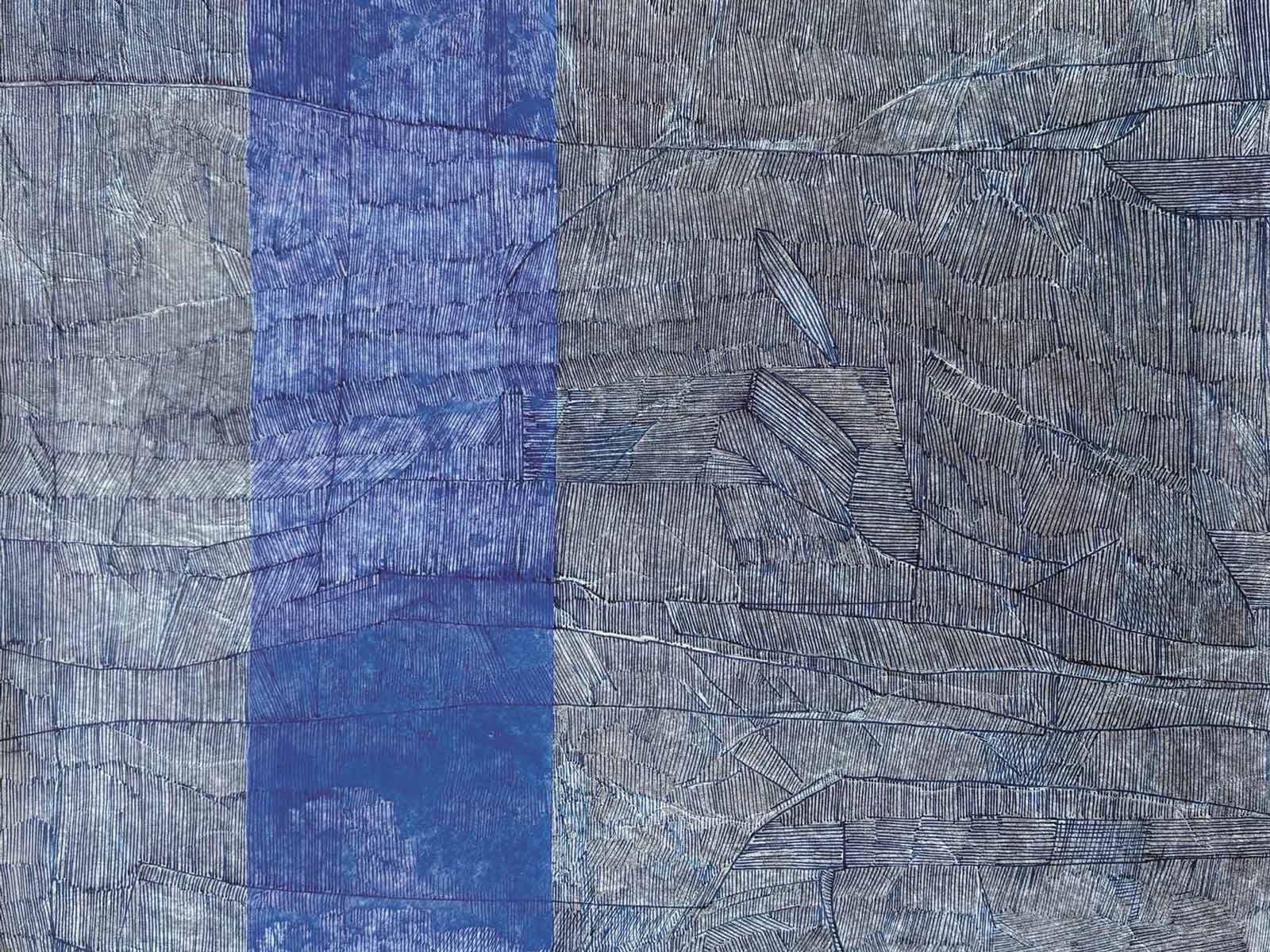
Through the use of textural elements in her drawings, artist Emanuela Assenza explores the significance of materiality in art. It’s a bold endeavor to try to comprehend the material aspect of a work of art in all its aesthetic magnitude as well as in its spiritual value. The following article is a comprehensive explication of ideas that emerged from observations of artistic processes.
But in the vision of the outer material world, the experience of the spiritual—and with it the capacity of spiritual vision—can re-enter in a new way.1
The materials an artist uses for manifesting their work are typically listed in the image data. The questions remain: What constitutes the artistic value of these materials, and how is the work created? Beyond the content of the pictorial message expressed through form and compositional design, the image’s artistic significance is determined by the color pigments, binders, thinners, substrates, layering techniques, etc. The image owes its density and permeability, its evocative impression, atmosphere, and warmth to these material aspects. Impressions of these tactile features can deepen the aesthetic experience. For example, warmth can be experienced as ensouling, density as mysterious depth, and permeability as breath. The poignancy of viewing an image, which arises from its material qualities, becomes palpable as a soul quality through the bond between the sensory impression and the inwardly experienced sensation.
The perception of an artwork’s material features and surface texture arises through a form of seeing accompanied by tactile experiences. Fundamentally, the ability to touch is inherent in seeing, yet it is employed far less frequently than the perception of an image’s form and content. Through an essentially new orientation of vision and the further development of certain perceptual capacities, one can perceive the artistic qualities that have their origin in the material, specifically, in the transformation of matter.
For forming and shaping processes, the possibility for change and reconfiguration is taken for granted; not so for the material. Metamorphosis is an event associated with form: Is there an equivalent for the materiality of art? Observations show that the starting materials chosen for an image only acquire aesthetic value in the course of the artistic work, provided they undergo a transformation. This was evident, for example, in the blue ballpoint pen drawing (see fig. Interwoven), through the connection of all lines into a painterly surface whose texture, by the end of the process, no longer exhibited any characteristics of the viscous ink.

Transformation of the Material
In at least four areas of anthroposophy, the spiritual dimension of the material world plays a role—and with it the special efficacy of material substances. Rudolf Steiner spoke about the significance of transformation processes of materials not in relation to art, but in medicine, in biodynamic agriculture, in connection with esoteric training, and in Christianity. For example, the healing effects of highly potentized homeopathic medicines, as well as certain agricultural practices, are based on rhythmic cycles of movements and specific harvest times, which contribute decisively to the healing effect. In the Christian tradition, material transformation holds especially profound significance in connection with the Eucharistic substances used in cultic acts as well as with the Resurrection of Christ.
For art, knowledge of how spiritual forces permeate materials and unfold in the material realm has yet to be developed. My studies focused particularly on the textural quality of drawing as a process where new material properties can emerge. Drawing was chosen because its more linear process lends itself better to precise observation than does painting. The way and manner in which material qualities take shape and build up in an artwork was to be observed as close as possible to their reality, to their visibility and their becoming-visible. Reducing the process to monochromatic linear sequences made it clear that the artistic qualities of the materials—atmosphere, warmth, and breath—are essentially evoked by sequences of movements that counteract the building up of form. Over the duration of the work, through continuous engagement of the attention, through the proximity and contact of the image with the act of seeing, through the complete renunciation of form-giving intentions, and in the alternation of speed, direction, and rhythm of the lines, a gradually densifying texture emerged, whose material properties underwent a transformation. In this sense, within the strict graphic reduction to a single color and technique, infinitely rich approaches were given space, if only through the various temporal modes of movement: deceleration, acceleration, continuity, interruption, and rhythm. The modes of movement and timeframes of the work allowed for an inward kinship between artistic, homeopathic, and biodynamic approaches to material transformation.

The Creative Origin of All Matter
It is not the engagement with and focus on the material world that is materialistic, but rather the concept that reduces the material world merely to its material components. The original provenance of matter is spirit. Why should it not be possible, through processes of transformation of matter, to create the conditions under which the spirit can step forward into manifestation? Rudolf Steiner speaks of matter as condensations of soul and spiritual forces. “Just as a piece of ice floating on water is material of the surrounding water [. . .] so are sensory objects material of the surrounding soul and spirit world; and they are lifted out from these through certain properties that make them sensory perceptible. They are—to speak half-pictorially—condensed spirit and soul formations.”2
The earliest emergence of materiality, at the beginning of world evolution, was described by Rudolf Steiner in a striking manner.3 On the first planetary stage of the Earth (referred to as “Saturn”), a materiality comparable to warmth forms. Within this warmth, subtle differences in temperature gave rise to movements, through which a flowing “warmth substance” as well as “warmth bodies” were formed. What was then predisposed as warmth forms the starting point for material condensation, structuring, and molding in the course of further planetary embodiments.
The material formed throughout evolution has, in recent times, been modified by humans and, through technical processes, transformed into synthetic materials, some of which are used in painting, for example, acrylics. The starting point of watercolor painting—and even more so of painting based on plant and mineral pigments—is closer to the creative origin of the material and can more readily achieve results that convey a living and ensouled material impression. Nonetheless, certain forces remain overlooked, forces that are awakened by special challenges in the artistic work with the materials. The permeability of the material is present in a natural way with liquid watercolor paint. There are significant differences between a transparency inherent to the materials and one newly formed through creative work that goes against the materials’ existing properties, meaning, one formed through material transformation. Then the material seems able to unfold its inherent potential, as if it were being reminded of its original spiritual provenance.
As the first diagram shows, artistic materials are positioned either close to or further away from the creative origin of the material. Plant colors, consisting of natural pigments and a binder, are closer to the divine creative origin than synthetic materials. Artistic work with materials derived from technical manufacturing processes calls for new creative forces in humans through the necessity of enhanced effort and enables greater processes of material transformation.

The Aura of a Work of Art
The philosopher and cultural critic Walter Benjamin (1892–1940) coined the concept of “aura” in an essay on art.4 Similar to the human aura, the aura of a work of art resides in the immediate surroundings of what we perceive sensorially as the image body. According to Benjamin, “the characteristic feature of genuine aura is ornament, an ornamental halo [Umzirkung], in which the object or being is enclosed as in a case.”5 He thereby refers to the perceptible presence, radiance, or atmospheric condensation in the surroundings—that is, in the immediate vicinity of the picture surface. One can get a rough idea of this by holding one’s palms together for a while at a distance of about one to two centimeters, so that a palpable, dense warmth forms in the interspace between them.
One of the findings of my artistic research project was that Walter Benjamin’s concept of the auratic most aptly describes the qualitative aim of the material values of drawn textures: the aura as the impression of a permeable, as it were, breathing surface of the image, a condensed atmosphere of warmth surrounding the image in the airspace near the picture surface, a perceptible presence of a non-sensorial quality that is palpable through sight. The actual boundary of the canvas or paper becomes irrelevant to this experience; it dissolves. The pictorial surface, worked over by drawing, acquires a different kind of depth that is neither spatial nor three-dimensional—that is, it does not derive from chiaroscuro nor from color perspective; it works deeply as a pure surface.
An Anthropological Viewpoint
One might ask: why does a study seeking the spiritual in art focus on the material? The following anthropological considerations shed light on another reason why the transformed material can be a place for the manifestation of spiritual qualities. In the course of human development, which Rudolf Steiner elaborated as an esoteric training path for the acquisition of higher capacities,6 the four-membered structure of our being undergoes an expansion. Through the work of the ‘I’ on the physical, etheric, and astral bodies, three higher members of the being can be formed: the “spirit self” as transformation of the astral body, the “life spirit” as transformed etheric body, and the highest member of the being, the “spirit human being,” is the transformed physical body (see diagram 2).

This development of the human being leads to a direct encounter with the spiritual world as a reality that one relates to through immediate perception. Since the soul experience (astral body) lies closest to us in terms of consciousness, the path of training begins with the cultivation and shaping of the life of feelings. Even more difficult than shaping and purifying the feelings is coming to a conscious connection with the forces of life. The initial activity of the ‘I’ in the development of the life spirit becomes evident when long-lived habits undergo a profound transformation or when an illness is overcome by the awakening of new forces. Least accessible is the work of the ‘I’ on the physical body. Only through this highest stage of ‘I’-effectivity will it be possible in the future to form the “spirit human being.”7 The physical body, according to Rudolf Steiner, is the oldest with regard to evolutionary history, which is why it has reached the most perfect degree of configuration and differentiation compared to the etheric and astral bodies.8
Artistic development follows a similar sequence. Just as the work of the ‘I’ begins with the transformation of the astral body, so artistic work usually begins with impulses arising from feeling. When asked why he painted, Matisse replied: “To translate my emotions, my feelings, and the reactions of my sensibility into color and design.”9 The fundamental question that moves the creative artist when their activity draws from the soul life (astral body) is: How does the image become ensouled? In a further step, the connection to the life (etheric) forces becomes central. Here, the main question may be: How does life come into the image? Between the ensouled and the living impulse, as well as in their pictorial implications, countless gradations and overlaps are possible. Artistic work directed toward ensouling and enlivening the image draws from two sources inherent in the human being—the soul and life forces—and also from sources in the natural surroundings, biographical circumstances, or, in the broadest sense, from the workings of the cosmos, for example, through the seasons or astrological constellations. These inward motivations and forces of the human being unite not only with forces of the environment, but also with those lying within the artistic media, the materials.
The work of the ‘I’ on the physical body would correspond in art to the work on the material. Just as the highest member of the human being arises through the transformation of the physical body, so does the spiritual aspect of art arise through the transubstantiation of the material. This takes place in stages, beginning with the individualization of the material, whereby the foreignness of the material undergoes integration into the personal creative process. A color, a sheet of paper, or the canvas loses the general foreignness of given materials. The development of the artistic qualities of a material takes a further direction when the focus shifts to modifying the given material, and when its capacity to be transformed becomes the central concern. While, in the first step, the act of overcoming the Other, meaning the material’s initial foreignness, can be described as infusing the material with a force that makes it individual or distinctive—which leads, for example, to some blue becoming “this blue, my distinctive blue” and a sheet of paper becoming “my sheet”—in the second step, through the transformation and sublimation of the given material’s qualities, something essential appears that is not brought about by me. Rather, what appears something is I could never intend myself. As I devote myself to the work, the artistic qualities of the material take shape as the image before me, and I now encounter them anew as an impression from the outside. What comes into appearance is something that has lain dormant since primordial times in the essence of the material, something given to it in its original creation.
Over the course of about 90 hours, I drew increasingly more compact layers of very fine lines as lightly as possible with a blue ballpoint pen. Achieving such lightness of line is not easy with a ballpoint pen, but it is possible through a sensitive, light touch and by tilting the pen so that the ball touches the paper as little as possible. In varying tempos and styles of movement—short, long, straight, curved, broad, detailed, slow, faster, etc.—the texture gradually approached a planar, sensorial chaos. The purpose of the varying linework was to exclude automatism and to perform the work with a wakeful and alert attention. Essentially, it consisted of many different linear movements that were freely and openly produced on the surface, that is, without any intention of design. Thus, the drawing contains a great many condensed, layered line movements that follow no order. From an activity of total self-forgetting, devoted solely to linear movement and observation, a bright, voluminous, soft blue emerged that appears as if painted. The materiality of the thickly flowing, non-permeable ink has been strongly modified toward a permeable, holistically connected, atmospheric, breathing quality.
In the last phase of the work, I brought the light-dark dynamic, with its tendency toward expansion (see the image of the penultimate phase), into a more planar impression. This resulted in a tranquil, self-contained whole. At the same time, I provided space for the linear structures that had emerged almost of their own accord due to the diffuse movements. I let them come into manifestation, and with them, a formal structure. Here, a transition took place from the materially permeable, unformed texture to a suggested compositional synchronization. While the more dynamic blue catered to aesthetic pleasure (see image of penultimate phase), the final drawing ultimately conveyed a more serious and intimate mood, as well as a greater presence of the textural impression.

On the Experience of Blue and the Revelatory Nature of Art
Inspired by the sight of the blue sky, Johann Wolfgang von Goethe developed his theory of colors based on the relationship between light and darkness. According to this theory, blue is a manifestation of light in front of the darkness of the universe; yellow, a lighter; and red, an even more pronounced obscuring of darkness in front of absolute light. In the drawing Interwoven, the light character of blue became apparent, so that the whole surface worked like a light-imbued darkness. The characteristic of light is also found in the converging linear structure, for “that which we have from light is a coming-to-ourselves,”10 while, in darkness, we lose our sense of self. Both experiences converge in blue: the coming-to-ourselves as well as the unlimiting and dissolution of self-reference.
Two contrasting experiences are possible with art. The creative deed can spring from a feeling-based and intentionally grasped motivation and be accompanied by inner soul feelings. It is something else entirely when artistic activity, similar to the inner posture of listening, is essentially an experience of being receptive to what reveals itself. Then what comes to me from my own soul life recedes; for artistic work need not be based on inner soul feelings. The more my own feelings fall silent, the more space I give to the image, the more an auratic quality develops as an appearance. The more it becomes important to develop capacities receptive to the phenomena of the image’s appearance, the more the endeavor for means of expression of one’s own soul life recedes into the background. The appearance occurs and becomes perceptible through devoted, unreserved attention and surrender to an emptiness whose filling up comes from elsewhere.

Certainly, the working through and transformation of material is only one possible path of artistic approach to the spiritual qualities of the artwork. From a different starting point, renowned artists sought the spiritual in art through formal design processes. Hilma af Klint, Wassily Kandinsky, and Kazimir Malevich were able to find a pictorial realization of their spiritual artistic impulse in the laws of color and form and in their reduction, particularly in a geometric language of form. Since the laws of color and form are also given to us as the content of mental pictures, the only question is how they can be recreated in creative processes.
In individual pictorial composition, spiritual content comes into appearance through the language of form, just as the pictorial motif creates a connection between sensory and spiritual experience through its ideational content. The great masterpieces of past eras are characterized by their use of form to transcend the merely material. To extend these shaping processes that permeate matter, the focus of my research project was to investigate the special nature of how the artist works upon the material itself, free from design intentions. It initially became apparent that within the material—presumably due to its spiritual origin—there lies an inherent potential to let a spiritual quality come forth, out of itself, into appearance. Through ‘I’-directed shaping and designing activity, the pictorial motif is expressed in free gestures and compositions, as is the expertise and stylistic uniqueness of the personality. Through the work on the materials themselves, something appears in the image that I do not create, that is more than I am.
Translation Joshua Kelberman

Footnotes
- Rudolf Steiner, Leitsätze—Leading Thoughts. Bilingual Edition, CW 26, translated by George and Mary Adams, rev. Thomas O’Keefe (Arlesheim, Switzerland: Ita Wegman Institute, 2024), 236–37, “The Condition of the Human Soul before the Dawn of the Michael Age (Aug. 31, 1925).
- Rudolf Steiner, Theosophy: An Introduction to the Suprasensory Knowledge of the World and the Vocation of Man, CW 9 (Tiburon, CA: Chadwick Library Edition, 2019), §III.5, “The Physical World and Its Connection with the Soul-and Spiritland.”
- Rudolf Steiner, An Outline of Spiritual Science, CW 13 (Tiburon, CA: Chadwick Library Edition, 2021), ch. IV., “Cosmic Evolution and the Human Being.”
- Walter Benjamin, “The Work of Art in the Age of Mechanical Reproduction,” in Illuminations (New York: Schocken Books, 1969); first published in German, 1936.
- Walter Benjamin, “Hashish, Beginning of March 1930,” in On Hashish, translated by Howard Eiland et al. (Cambridge, MA: Belknap Press of Harvard University Press, 2006), 58.
- Rudolf Steiner, Knowledge of the Higher Worlds: How Is It Attained?, CW 10 (Tiburon, CA: Chadwick Library Editions, 2020).
- See footnote 2, §I.4, “Body, Soul, and Spirit.”
- Rudolf Steiner, Universe, Earth, Human Being in Their Relationship to Egyptian Myths and Modern Civilization, CW 105 (Forest Row, East Sussex: Rudolf Steiner Press, 2022), lecture in Stuttgart, Aug. 10, 1908.
- Henri Matisse, radio interview broadcast in occupied France, early 1942; transcript sent to Pierre Matisse, New York, March 13, 1942, quoted in Alfred H. Barr Jr., Matisse: His Art and His Public, translated by Marianne Hartog et al. (New York: Museum of Modern Art, 1951), 562.
- Rudolf Steiner, Colour, CW 291 (Forest Row, East Sussex: Rudolf Steiner Press, 1992, 2005), lecture in Dornach, May 6, 1921.





