

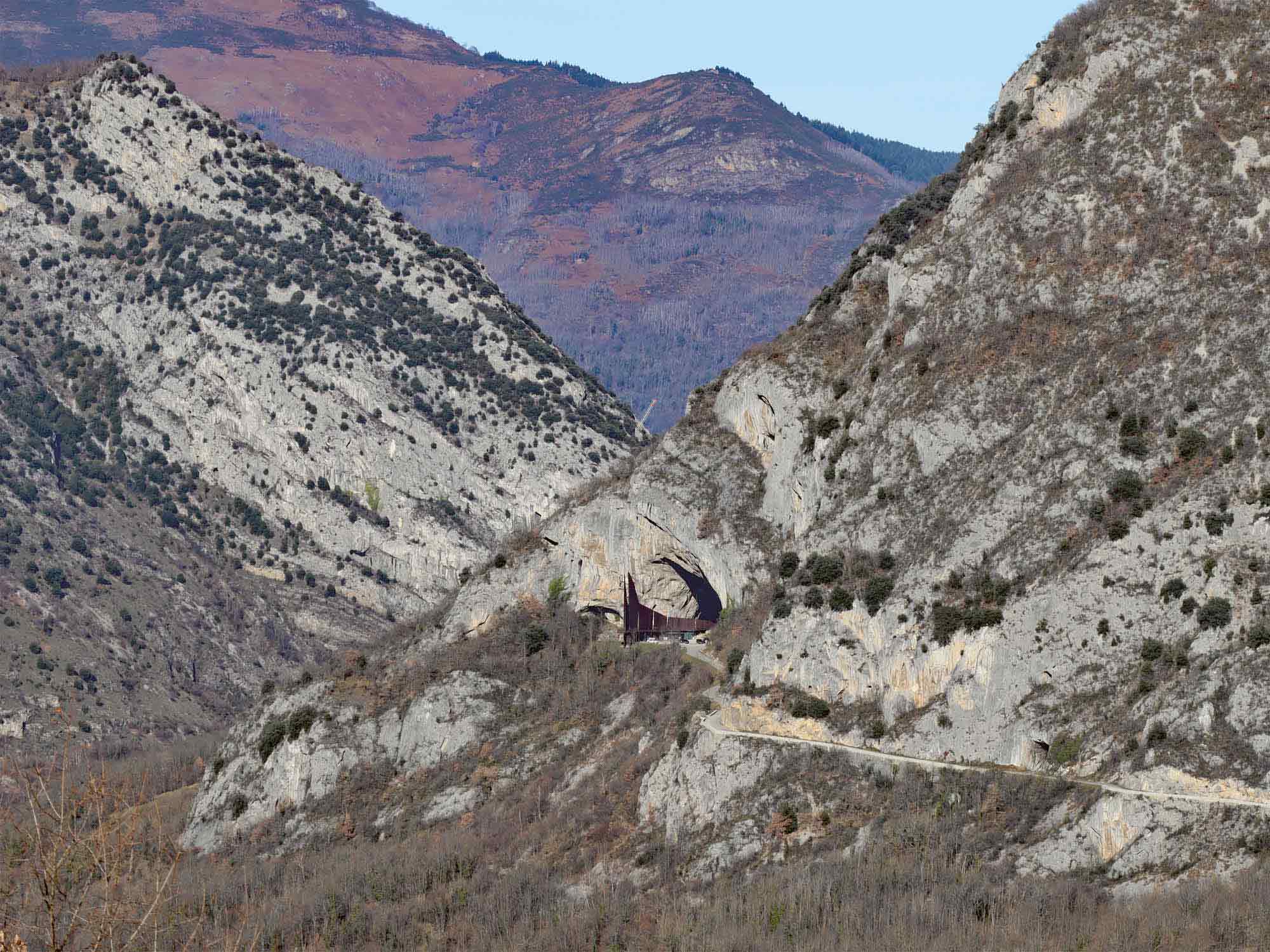
In a cave in the Pyrenees, we can still marvel at paintings dating back 16,000 years and encounter the darkness that hold the images of the world.
Behind the layers of words and images, a life remains hidden. Sometimes I feel its faint stirrings. It also appears in eyes which cannot yet speak. Or it seeps into intuitions, inconspicuous and quiet, like a dark force, velvety, timeless. This life is unpredictable and invisible. But we must entrust ourselves to it. Remember the deep black of the winter quince on your kitchen table, how it seemed to long back to Earth, to the dark material realm? It is a black that commits itself to becoming—and quite differently than the Black Scarab. This black does not create radiance but, rather, is a longing for connectedness. When we began to speak about magic, we lost it for millennia.
A massive rock overhang stands at least thirty meters [~ 100 ft.] high. There’s a group of people in front of it, each carrying a red lamp box of smooth, worn metal. The click of the switch sounds like childhood. Slowly, we walk toward the entranceway, like children anticipating the unexpected. Wonder is the beautiful daughter of darkness. Then, the Earth sucks us in. In the narrow birth canal whose entrance is firmly sealed by an iron door, the scent of the world gradually fades away. We are the only life allowed to pass through the barrier into the inner depths. In earlier times, there were torchbearers in fur-lined shoes with leather straps and stone knives, who crawled through rock crevices. Many or few? Rarely or often? No one knows.
We enter the skull of the Earth—the womb, as some perceive it—and our silence begins. Silence is also a great darkness. Inner landscapes have been sleeping here unseen for so long that my mind touches eternity. Mountains are not piles of sand, heaps of rock, layers of sediment packed tightly together. They have heart chambers where a first beat of life began. It is intimate, walking through—primal, original intimacy, barely touched. And our eyes now, on the inner side of the skin, are shy and somewhat ashamed of the nakedness. We walk along a marked-off path, about two meters wide; to the right and left is a vast expanse. The guide tells us there is no life, not even water, here. The organic nature of the forms of rock suggests otherwise. Paths, mounds, valleys, hollows, distant ridges, all shaped by the face of time. I see shapedness formed by what is hidden in the darkness. Despite the constant ten degrees [50°F], the darkness feels warm. It’s colorless, but like a substance receiving, incorporating us. I feel a desire to stay back—to approach, a little closer, the edge of the invisible. But the guide warns us to stay together. Human bones have never been found here.
In the subdued glow of the lamps, a boulder emerges. Five by five meters [~ 16 ft.] in size, broken off from the ceiling at some point. It looks like a shipwreck in a cosmic wasteland. How far have we walked? How long have we been here? These measurements belong to the outside world. 600 meters [~ 1/3 mi.], we’re told. Our “aha” moment is merely a fact that conveys no sense of proportion. At some point, we pass a “checkpoint,” some kind of meaning inscribed in ochre-red and black symbols. We don’t understand it. It marks a kind of entrance. We have to climb a sand dune on the right. Its smooth texture gives the impression that it was cast. On the way back, it will cause someone to fall. Then we reach the Salon Noir.
Almost a kilometer [~2/3 mi.] from the entrance, we turn off all the lights for a few seconds. No one speaks. Silence—physically palpable silence. We are touched by the darkness but not swallowed up by it. This darkness has no abyss. It is unconditional, like a mother. It knows it is not nothing and is therefore there for us. And I know it too. It is like the inner side of light, the very interior where everything lives that has not yet been transformed into an image, a sound, a thought, a life in the light. Our ancestral torchbearers were here to elicit the first life of light from out of this darkness. After five seconds, our guide shines a special lamp on the rock face. Light! And now they appear: quiet, gentle, delicate. Emerging from the dark cosmos, brought forth in a single moment 16,000 years ago. Their beauty is breathtaking. The usual templates of my vision dissolve. An innocence is set free, like the very first act of seeing itself. The precision of the lines is as soft as a genuine feeling and just as certain. Bison, horses, and ibex in black charcoal on brown-gray rock. Sometimes a trace of white within them, and ochre red again; side by side, intertwined. As imagery they are pure manifestation, free of pretense, naive in their lack of intention, yet imbued with a longing. They are beings summoned forth, called by desire.
We go into the center of the vault; I cannot estimate its height. The light is turned off again. Then—a sound, a clear A. For eight seconds, it echoes among us. A few tentative voices venture to join in. A sound like sand crystal, warm and clear. This echo is the reason the cave paintings are here, in Salon Noir, and not along the 1,000 meters [~2/3 mi.] before. The light of the torchbearers could never have illuminated the whole of this height, but ours does. It’s at least 50 meters [~164 ft.]. How did it sound to their ears? What did they feel? Did they sing while they painted? Did they dance to give birth to this new life? Almost everywhere in the world, rituals are performed with music. Perhaps it was Cro-Magnon youths celebrating the first acts of graffiti. They painted the animals of their world but not themselves. In some caves, such as Chauvet, there are also handprints. When all the lamps glow again, I notice our shadows on the walls. Fifteen silhouettes overlap and separate along the circumference of the Salon Noir. In this twilight, self-perception was a silhouette on the rock.
Humanity’s first canvas was a black surface, moved and streaked by the flickering light of wooden torches. It stands to reason that they danced, at least upon the walls. The atmosphere of what may have taken place here comes to life for a brief moment. The glow of fire, drums, a few people conjuring and summoning an encounter from the darkness of their being into the darkness of this skull. I don’t see ecstatic images; I feel a tentative, timid questioning, more a curious desire, rising within me—for a touch, innocent, without further intent. This longing extends from my head through my soul and into my body. Something in this flesh wants to be touched by the light of consciousness, to give birth to an image of my human existence. I am this place of creation. Within me, two spheres touch and unite. Then and now.
After twenty-five minutes, we have to leave. The images need a break from our inhaling and exhaling. This was strictly measured and regulated. Too little time to bridge the millennia. Too quickly, the embodied beauty of these images sinks back into the darkness. We make our way back to the light. Still, no one speaks. Again and again we turn, gazing into the blackness, seemingly infinite. The mountain’s sheltering substance releases us. It seems to eject us, though slowly. About 200 meters [~ 1/4 mi] before the iron door, we realize for the first time that we haven’t smelled anything for the last hour and a half. And the silence lingers on.
Translation Joshua Kelberman and Laura Liska
Image Entrance to the Niaux Cave, CC BY-SA 4.0






