

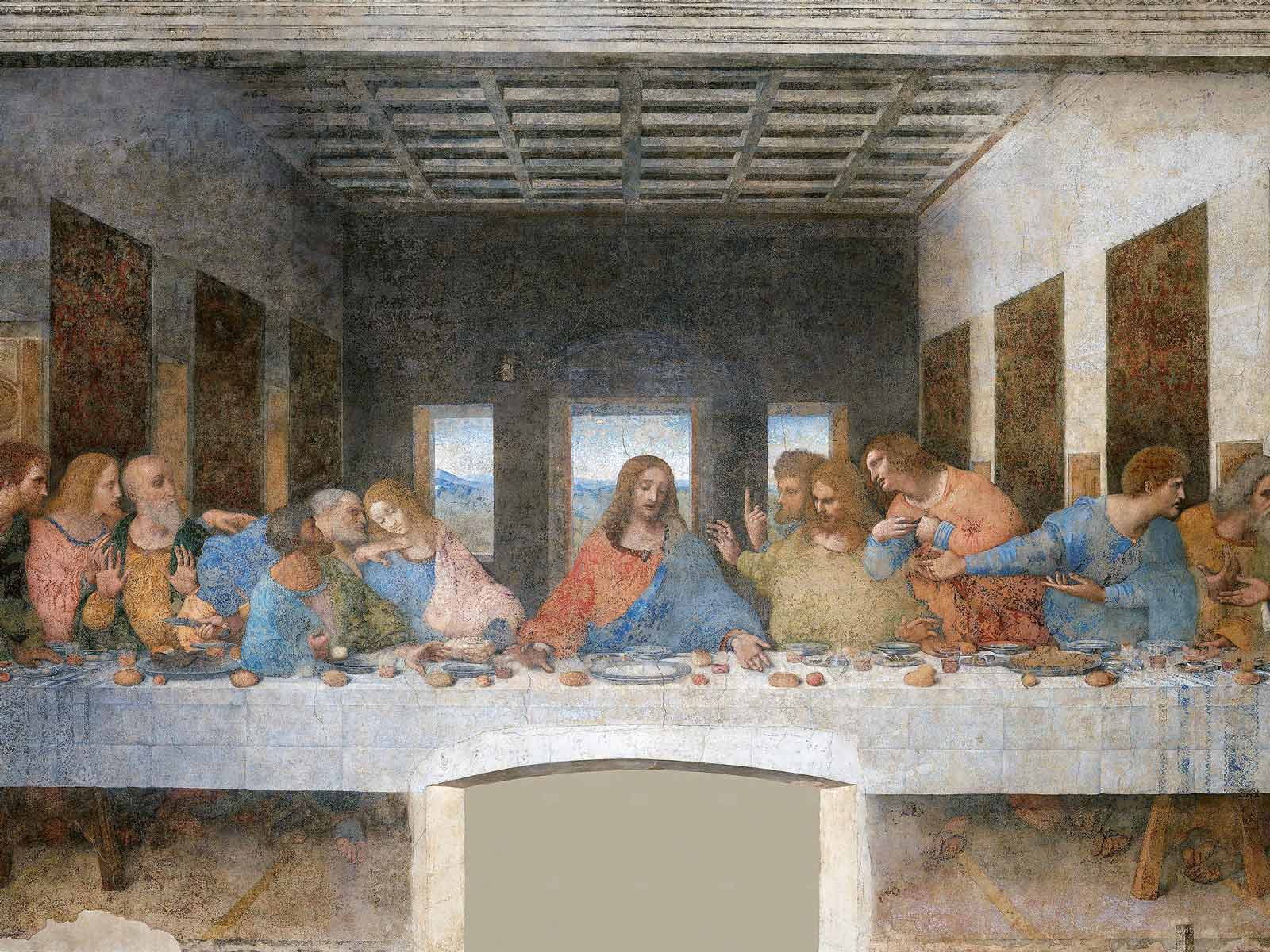
At Easter, our brother human being fully accomplished the deed of becoming flesh. For all our sisters and brothers, this act made possible a world of social life on the Earth. We sit at the Last Supper side by side.
To incarnate means to become flesh. Nowhere has this been expressed so clearly in a single word as in the prologue to the Gospel of John (1:14): “Sarx egeneto”—the Logos became flesh. From this moment on, the act of God becoming man was to be fulfilled. And this fulfillment takes place upon the Earth, in the realm of space. He descended from time into space. His spatial form is not like a garment he has put on so that he might become visible, and which he would one day take off again. He has united himself with the flesh in such a way that a new corporeality will unfold from it. That is why Vincent van Gogh called Christ an artist. In a letter to his friend Émile Bernard, he wrote that for him, Christ was the greatest of all artists: “this Christ is more of an artist than the artists—he works in living spirit and flesh; he makes men instead of statues . . . .”1
As individual human beings, we belong to the realm of becoming. But to be born means, first and foremost, becoming embodied and entering into a world already formed in space. In this world, we can stand upright. From this upright posture emerges a first articulation: high above my head, the heavens and the stars; below my feet, the Earth. The small child must first bring itself into this dimension, because we humans are not born as “vertical” beings. Wherever I then stand and walk, this above and below move with me. And soon I am accompanied by left and right, by far and near. With outstretched arms, I move toward the world or away from it. And I experience myself where the three come together within me as at a balancing point. An extremely alive point, to which I can say ‘I’—even if only in the complete innocence of a child. I have embodied myself in spatiality. I am on the Earth. For space is not an invention born of abstraction that has nothing further to do with me. Spatiality is an experience deeply connected to my earthly existence as a human being. “For we would not have the view and intuition of space that we do if we did not first experience the three dimensions of space within our earthly existence [. . .]. They belong to the pictorial laws of our earthly life.”2
On the Earth
Between his baptism in the Jordan and his final words on the cross, Christ became embodied by the Earth. And he wandered upon the Earth: He, the wanderer par excellence; though rarely alone; not a loner who kept himself aloof from the world. Others always walked with him—children, women, and men, his fellow human beings—like him, on the path to becoming human. The very thought that his feet touched the Earth is nearly impossible to bear. Beneath his steps, everything that grows toward the heavens—wild grass, dry brush, or flowers—bent for a moment under his strides and then straightened again. By then, he had already moved on. Feet leave traces. Every trace is an effect in space. And effect is presence, no matter how long ago the trace was imprinted upon the Earth. A deeply unsettling presence, given the extent of its existence, of its living reality.
Did he wash their feet for this reason, bending down as a servant, so that they might follow the traces he left as they walked the Earth?
Still, space is not yet fully permeated by his divine nature. Still missing are the final steps toward the completion of his becoming human—the full incarnation—leading up to Good Friday. At the Last Supper, in the circle of the disciples, one of them makes the way possible. A man to whom he dips a morsel and reaches out with it to him. Through these final acts, he reveals his spiritual form in his becoming human.
Side by Side
Christ became human all the way into the Earth and its spatiality. A wholly new quality of spatiality has emerged: living side by side. Things that coexist side by side in space enter into a new relationship in which the simultaneity of love can flow from soul to soul without one elevating itself above the other. In his lectures on the Mystery of the Seven and the Twelve, Rudolf Steiner cites the Last Supper as a model of people living side by side in space: “Through Christ, came the love of soul to soul, so that what stands side by side in space enters into a relationship [. . .] as the brotherly love that human beings are to show one another in space from soul to soul. Here, living side by side in space takes on its special significance.”3 No one is excluded from this, not even Judas! For “Christ came into the world to sit with the tax collectors and sinners as well. He came to embrace even that which would otherwise have to be excluded from the course of the world.”4 It is a love that encompasses everything in space such that the sequence of time can no longer influence it. The hierarchical relationship between master and disciple, which was still justified in pre-Christian times, is transformed into a new principle: the Christ principle. Through this principle, love and fellowship enter into the social life of Earth.
In Leonardo’s Last Supper, it is striking that everything in space is integrated with unparalleled perfection—except for the disciples at the table and the figure of Christ. For Christ tilts his head to the left. As a result, the central point of perspective, the vanishing point, falls on his right ear. There, the lines converge and become a single point, the kind one would expect to find on the forehead between the eyes. Was Leonardo mistaken? Did he intend to suggest that Christ’s incarnation was still in progress at that moment, that Christ would only fully incorporate himself into earthly space shortly thereafter? At the moment when divine and human forms become one, when Christ has become fully human: then is it accomplished?
The First Supper of Humanity
What hinders us from celebrating our becoming human, living side by side—whosoever may sit beside us—based on the new Christ principle, especially in these dark times? Did not the Resurrection begin in the darkest depths of the Earth? Is it not space that was first permeated with the seeds of a new corporeality? And is not every person, woman or man, someone who can invite me to coexist side by side? Are we not ultimately all invited to become seed bearers? Every human being bears an invitation within them. This radical newness has left footprints in each of us. Not as an imprint, but as an effectivity yet to be awakened, which can sprout only from within. In today’s extreme fragmentation of our lives, it is already possible that I myself invite each and every person to this “living side by side.” For the one who has invited me from the very beginning is already waiting for them.
Translation Joshua Kelberman
Image Leonardo da Vinci, The Last Supper, public domain

Footnotes
- Vincent van Gogh to Émile Bernard (June 27, 1888). See Vincent van Gogh, Vincent van Gogh: The Letters, 6 vols. (New York: Thames and Hudson, 2009), letter 633.
- Rudolf Steiner, Becoming Fully Human: The Significance of Anthroposophy in Contemporary Spiritual Life, CW 81 (Hudson, NY: SteinerBooks, 2022), lecture in The Hague, April 8, 1922.
- Rudolf Steiner, The East in the Light of the West: The Children of Lucifer and the Brothers of Christ (Forest Row, East Sussex: Rudolf Steiner Press, 2017), lecture in Munich, August 31, 1909.
- Ibid.





