

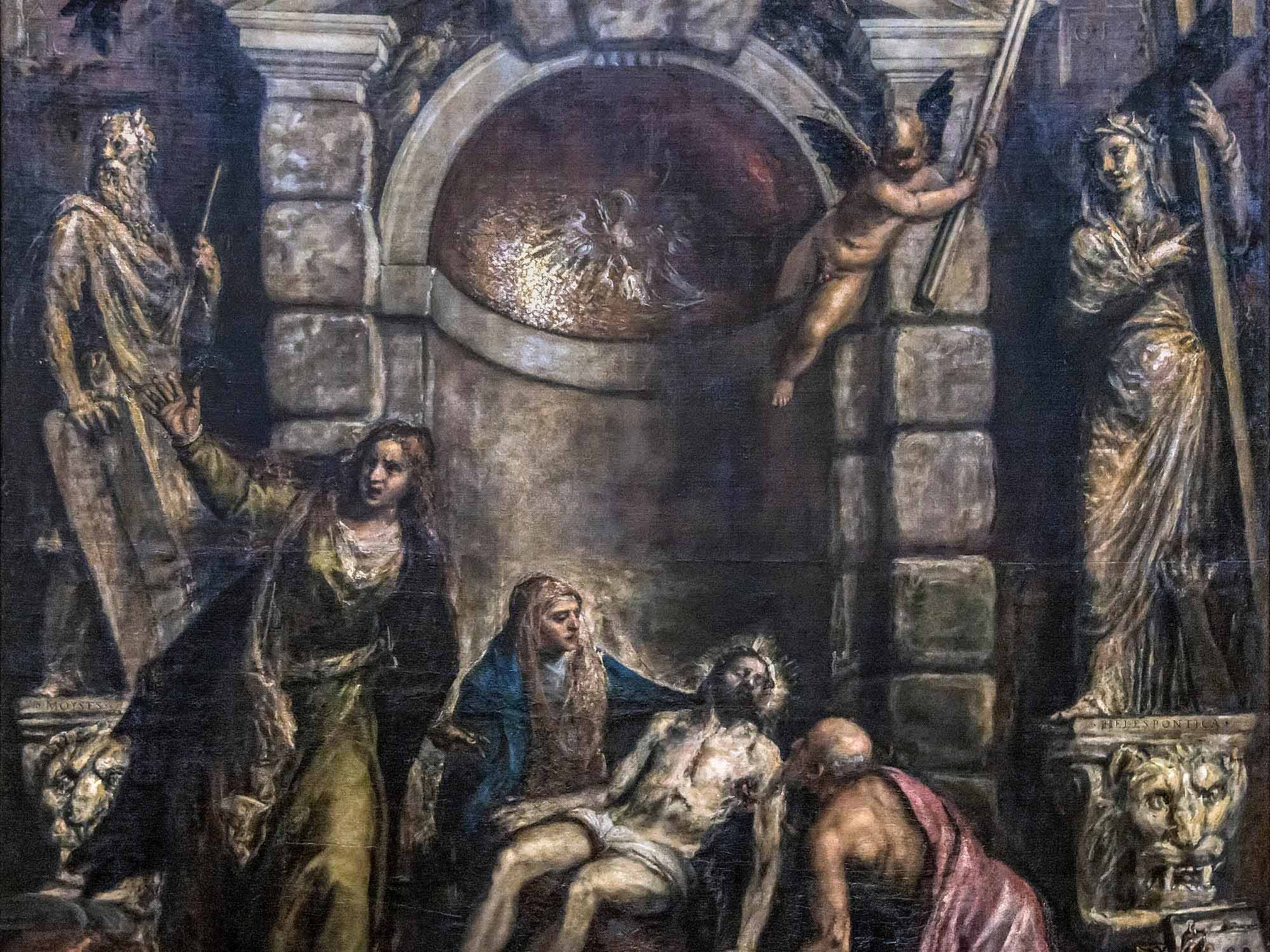
When light vanishes—like in a solar eclipse—we see in the darkness for a brief moment. Titian’s Pietà depicts this process, one which always holds the promise of a new beginning.
Through the luminosity and vitality of his color palette and his way of flooding colored forms with light, the painter Titian (1488/90–1576) opened up a new, emotionally saturated inner space. His contemporaries called him “the sun among the stars.” Almost immediately after his time, this inner space closed again. Colors were less and less guided into appearance from an inner light. Instead, they were externalized between brightness and darkness and used to create contrast. Titian began his own orbit around the sun in an era when the relationship between the individual and the community was undergoing a fundamental shift. The forces that held society together were beginning to lose their effectiveness. It’s as though Titian, throughout his entire body of work, brought light and color to their highest revelation one last time. His colors triumphed even more than the light, but, at the end of his long life, they extinguished themselves. There is no other way to see his last paintings (1575–1576) than through this lens of extinguishing. The Pietà, presumably created for Titian’s own tomb, is now housed in the Galleria dell’Accademia in Venice. Almost square in shape (3.53 x 3.49 m), this image raises endless questions.
What the scene conveys is deeply moving. We recognize it immediately. This is a story that can unfold in any life, albeit in different ways. It is about the vulnerability of each human being and how it plays out. Every figure in the painting bears witness to it. The old man (the hermit Jerome) in the lower right corner seems to have just arrived to touch the lifeless hand on the ground. On the small votive panel on the far right, two kneeling figures (Titian and one of his sons) are saying prayers that go unanswered. In the center, the mother tries in vain to lift her son so she can see his face. From this moment on, she will bear the incomprehensible as an open wound. The pelican in the niche above her has torn open its breast to feed its young with its blood. The gold still glows, but it no longer offers Mary any comfort. She is struck dumb. The cry that cannot escape her is borne by Mary Magdalene into the world, where this event is still to occur. At any moment, what remains standing of the temple could collapse. Something incomprehensible is forging its irrevocable path.

Dying Light
Against this backdrop, the drama of the fading light unfolds. We are immersed in the temporal process itself, as when viewing an icon. The colors at the boundary between the visible and the invisible reveal the event step by step. Now two figures take on meaning. At the lower left, a figure embracing a vessel leans forward, looking toward the middle. On the right of the golden dome, a winged figure extinguishes a torch as it descends. Then darkness will fully set in. The two figures—Cautes and Cautopates—belong to the ancient Roman cult of Mithras. But they now stand in a new context that is yet to be unveiled. One last time, the colors reveal themselves in the vanishing light. Their luminosity diminishes more and more. The leaden gray of the stones surrounding the niche will gradually fade into total darkness. The figures and their robes will become crumbling remnants, pale reflections of light. Every face will turn to ash—gray and white, taking on the color of absolute desolation. This is already foreshadowed in the countenance of Christ. Everything red-brown, like the afterglow of warmth, will dissolve into a gray-green. Ultimately, the gold will turn entirely to lead.
And still! Inside the cupola, where the winged torchbearer carries the torch around, a bright red spot is visible. The setting sun? Still visible? Or already visible? And does the other figure at the feet of Mary Magdalene, as she takes hold of the vessel, perhaps signify that this precious oil is no longer necessary? These are reflections from a time in which we can experience how the light of the world has withdrawn from immediate sensation and awareness. Undoubtedly, Titian, drawing on his immense creative potential and, at the same time, the foreshadowing of decline in his era, was able to foresee what would come after him. The Pietà is, among all else, also a new beginning. And to this day, both light and darkness participate in the everlasting new beginning. As do we.
Translation Joshua Kelberman






