

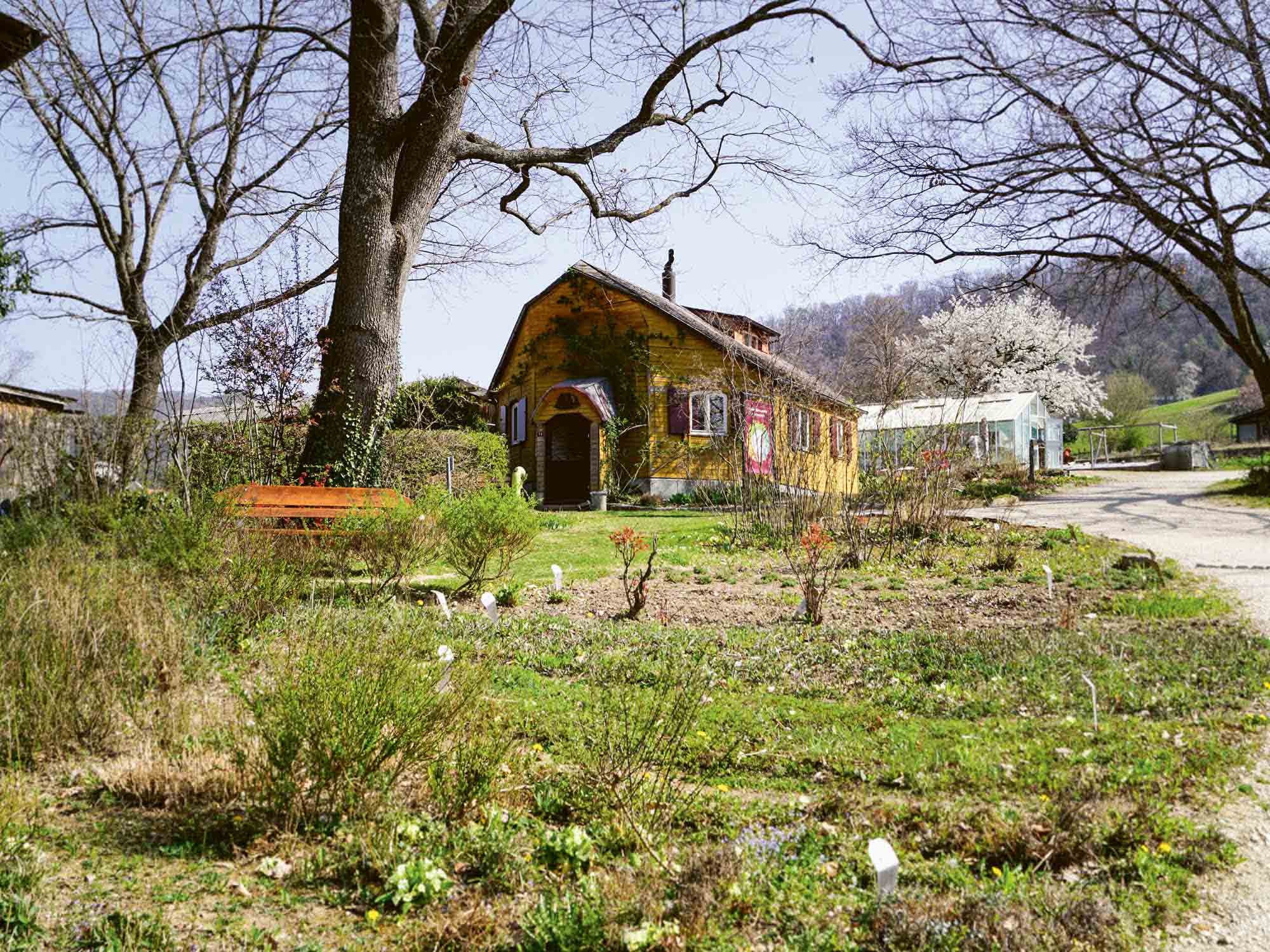
Whilst rehearsals of Goethe’s Faust were in full swing at the Goetheanum Stage, the students of the Anthroposophy Studies on Campus studied and performed Goethe’s fairytale The Green Snake and the Beautiful Lily. In June, it was presented as a site-specific promenade performance in the gardens of the Goetheanum.
Fairy tales bring people together. Regardless of where we come from, how old we are, or our individual viewpoints and attributes, most of us share the experience of having heard fairy tales, in one way or another. We are all, to a certain extent, peers in folkloric matters.
J. R. R. Tolkien, in his short but substantial “Essay on Fairy Stories” (1947), broke with the usual canon amongst folklore scholars who focus on analysing form and content. In his refreshing view Tolkien elevated fairy stories to literary experiences which take place, live, and evolve in a particular situation or instance accessible by the human soul, a realm which he called “Faërie”:
“[F]or fairy-stories are not in normal English usage stories about fairies or elves, but stories about Fairy, that is Faërie, the realm or state in which fairies have their being. Faërie contains many things besides elves and fays, and besides dwarfs, witches, trolls, giants, or dragons: it holds the seas, the sun, the moon, the sky, and the earth, and all things that are in it: tree and bird, water and stone, wine and bread, and ourselves, mortal men, when we are enchanted.”1
This is a spiritual world, a realm or a state (equally place and mode of being), where certain rules apply, just as certain laws enable us to experience the physical world. In Faërie we may enter a “secondary world” created by the author’s fantasy—a particular form of imagination that should not be dismissed as mere inventiveness. It is a specific capacity of the human spirit closely related to the gift of language.
Immersing Ourselves in Another World
In the context of the Anthroposophy Studies, the Goetheanum students delved into and met each other in Faërie through text study, theatre, music, mask work, and puppetry in their exploration of The Green Snake and the Beautiful Lily. For the students, fairy tales are stories that deal with magic, that teach us truth though archetypes, that inspire hope; narratives that touch the whole soul, that speak to us beyond reason and intellect, that build a bridge from the sensorial to the imaginal realm.
There is a certain contradiction, therefore, in attempting to stage a theatrical performance of a fairy tale, especially Goethe’s. The true gateway into the world of fairytales is imagination, which liberates thought from the confines of sensory experience. Theatre makes visible the invisible. In doing so, it suppresses the audience’s imagination to a certain extent. But in the context of the Anthroposophy Studies, the aim is not to “perform” Goethe’s fairy tale. Rather, it invites students to sink into his imaginations by embodying and exploring them from within. Through playing, we make each element of the text experienceable in a new way that leads to further contemplation and study of archetypal elements. In the sense of Schiller’s Letters on the Aesthetic Education of the Human Being,2 playing becomes a way to train the soul’s capacities; it enhances our ability to perceive spirit and matter in dialogue.
Seen in this light, the student’s performance of the fairytale is not geared towards the creation of a final theatrical piece, nor even to theatre’s most primary function of telling a story. In this context, theatre becomes a practice to refine perception through the training of our soul’s plasticity whilst engaging in the social dimension. Through this process, students develop a shared engagement of the content with their peers. They collaborate to succeed—among performers, directors, designers, musicians, and even gardeners—in living in imagination.
In his autobiography, Rudolf Steiner shared that what most enriched him about Goethe’s fairytale was not interpreting it, but how engaging with those imaginations nourished his inner life. He lived with the contents of Goethe’s fairytale since his early 20s. From that inner activity emerged in time not only his Mystery Dramas but also meditative substance and strength for future work. Throughout his written works and lectures, all the way from 1899 to 1924, the green snake and the beautiful lily—alongside all the other characters in this unique story—were referenced and used almost pedagogically to illustrate what anthroposophy is and aims to bring about culturally in the future. We may even trace the beginning of anthroposophy to that one lecture in Berlin’s Theosophical Library, or the essay he wrote on the occasion of Goethe’s 150th birthday, which he said came from a deeply esoteric mood and an impulse to bring this into his public activity.
In this spirit, the work we undertake with the students during this trimester at the Goetheanum can be seen as a seed to be planted in the soul, ready to awaken in the future as renewed enthusiasm for learning and contemplation of anthroposophy.
Image Goetheanum Garden. Photo: Sofia Lismont






