

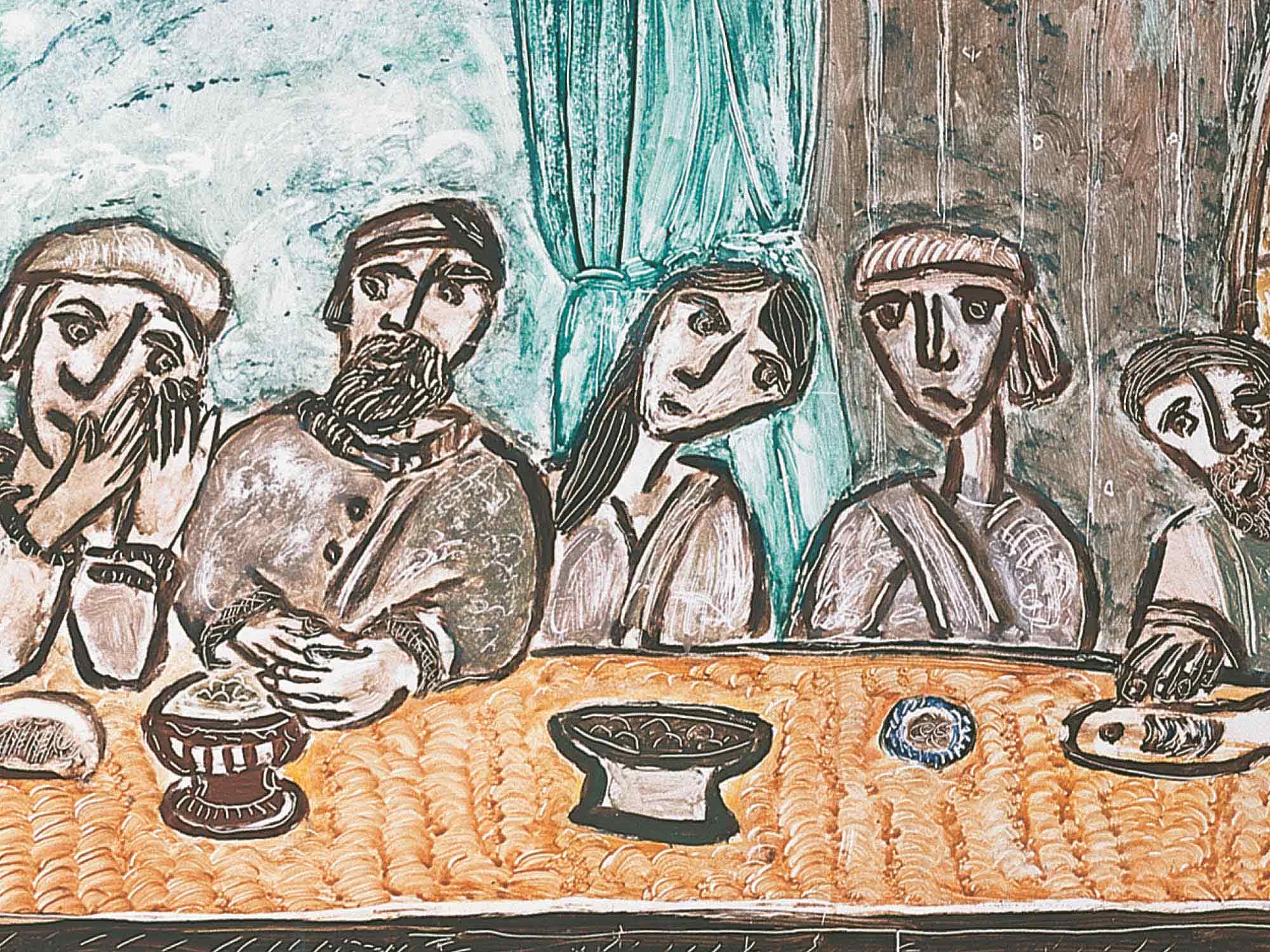
Whether in Lambaréné or in exile, Albert Schweitzer and Simone Weil drew strength from the way of Saint Francis to confront the upheaval and violence of their times.
In his letter, “To the Rulers of the Peoples” (1219/1220), written in the wake of his journey to the East and the terrible experiences he endured in the Egyptian city of Damietta (under siege by Crusaders), Francis of Assisi (c. 1181–Oct. 3, 1226) began—a few years before his death—with the following words: “Brother Francis, your little and looked-down-upon servant in the Lord God, wishes health and peace to all mayors and consuls, magistrates, and governors throughout the world and to all others to whom these words may come. Reflect and see that the day of death is approaching. With all possible respect, therefore, I beg you not to forget the Lord because of this world’s cares and preoccupations and not to turn away from His commandments, for all those who leave Him in oblivion and turn away from His commandments are cursed and will be left in oblivion by Him. When the day of death does come, everything they think they have shall be taken from them. The wiser and more powerful they may have been in this world, the greater will be the punishment they will endure in hell.”1 During a ceasefire, Francis and a fellow friar had gone on a peace mission to speak with Sultan Al-Malik al-Kāmil of Egypt, the chief Muslim enemy of the Christians. Francis saw the problem of power and the nearness of death on both sides—indeed, on all sides—among the “rulers of the peoples,” and he tried to appeal to their consciences. He foresaw that “day of death” coming which, now 800 years after his death, is once again looming menacingly on the world political stage, on a global scale and with an ominous momentum.
I’d like to remember here two human beings of the 20th century for whom Francis of Assisi was a companion and a guide in his ethics, his relationship to the world and creation, and his spirituality and disposition, but also in his shared responsibility for the world-society beyond his own brotherhood—his shared responsibility for world peace or, conversely, for world war—the continuation of the spiral of violence, armament, and destruction, the “day of death.” Two people who also addressed the “leaders of the peoples” and were, in their own way, “Franciscans,” without ever making this public. Both kept their deep connection to Francis of Assisi largely to themselves: Simone Weil (1909–1943) and Albert Schweitzer (1875–1965).

Simone Weil
Simone Weil arrived in Assisi in the summer of 1937, at the age of 28, as part of a trip to study Italian fascism under Mussolini, but also to encounter the spiritual culture of the country. She had recently departed from a Swiss clinic where she had been treated for her poorly healing burns (the result of an injury sustained during the Spanish Civil War) as well as her headaches and physical weakness following her arduous, self-imposed factory work. Her unique sensitivity and spiritual strength resulted in profound experiences while traveling through Milan, Bologna, Ferrara, Ravenna, Florence, and Rome. But she found her true “soul’s home” at the end of her journey: in Assisi—the town and countryside of Saint Francis. She told her parents that, compared to Perugia and Assisi, the rest of Italy “was wiped out for me.” “Never would I have dreamed of such a countryside, so splendid a race of men, and such moving chapels. You might indeed have lost me forever […].2 “[E]verything in and around Assisi is Franciscan—everything, except what has been put up in honor of St. Francis (apart from the lovely Giotto frescoes); so that one might believe Providence had created those smiling fields and those humble and touching little chapels in preparation for his appearance.”3 Her relationship with Francis did not begin in Assisi, but had already existed since her early youth: “I fell in love with Saint Francis of Assisi as soon as I came to know about him. I always believed and hoped that one day Fate would force upon me the condition of a vagabond and a beggar, which he embraced freely.”4 Her edition of the Fioretti [Little flowers] dates from 1926, when she was 17; she translated his “Canticle of the Sun” several times. In the summer of 1937, she didn’t come to Assisi as a vagabond, though she was greatly affected by many things, and her relationship with him deepened further. Even in her essay L’Enracinement [The need for roots] (six years after her visit to Assisi), she would describe the “Canticle of the Sun” by Francis of Assisi as a “jewel of perfect beauty.”5
It was precisely this essay, “The Need for Roots,” that served as her last major proposal in 1943 for the reconstruction of society in the face of the “Day of Death.” It was not only addressed to the mayors and consuls, the magistrates and governors, but also to everyone else. It was and is one of the most important programmatic works of the 20th century for a societal future under the sign of life, not death. Her statements focus on the reconstruction of industrial society, the media, science and politics, the social polity, and education. Despite an extensive body of secondary literature, it has not often been described just how much—in her entire life’s dedication, in her form of asceticism, her devotion to Christ, her political radicalism, and her extraordinary power of love—Simone Weil was a modern “Franciscan.” The fact that she more or less starved herself to death because the state of the world had become unbearable to her does not contradict this, but rather supports it.
Rudolf Steiner once said that if Francis of Assisi were to return in the 20th century, he would be a man severely marked by illness. In 1949, four years after World War II, Albert Camus considered the rebirth of Europe possible only if the demands Simone Weil had set forth in L’Enracinement were taken into account and fulfilled.
Albert Schweitzer
On July 27, 1950—one year after Camus’ statement about Simone Weil—Albert Schweitzer sent a letter from Gabon (Central Africa) to the mother superior of a Franciscan religious community who had congratulated him on his 75th birthday. He wrote, “When I came to formulate the idea of reverence for life as the fundamental idea of ethics, I felt I was enunciating, as a philosophical and religious idea, something intrinsic to St. Francis but in a new revelation of his thinking.”6 Five years later, Schweitzer told Nikos Kazantzakis that he had been studying the life’s work of Francis of Assisi since the age of 19, yet had felt a deep connection to his spirituality ever since childhood. “[B]ut I have never been able to speak or write about him and me together. I never refer to him. I am very reluctant to do so. He is a famous saint; I am an ordinary man. He possessed an intimacy of speech that is his alone. None of us should try to imitate that speech; no one should adopt it for himself. It was granted only to him. The rest of us must speak in ordinary words.”7 What Schweitzer achieved by establishing his hospital as a real medical village on the Ogowe River—with its own Village de Lumière for up to 200 leprosy patients, who could stay for years and bring their children with them—embodied the spirit of “reverence for life,” the spirit of early Christianity, and the spirit of Francis of Assisi. Schweitzer, who had been a professor of theology, held a doctorate in philosophy, and was one of Europe’s leading Bach scholars and organists, left everything he had achieved behind, studied medicine, and founded his hospital—following the words “You, though, follow me” (Jn 21:22) and taking Christ as his direct guide.
Just as important and “Franciscan” for the contemporary reality of our time, in 2026, is Schweitzer’s tireless campaign against a third World War, against nuclear weapons and nuclear weapons testing, his anti-war appeals from Oslo, and his extraordinarily extensive correspondence with John F. Kennedy and N. S. Khrushchev—as an “absolutely neutral person,” as he wrote to Kennedy—appealing to their responsibility in world history and to their conscience. “At a time when the Iron Curtain divided a large part of humanity into two hostile camps, Schweitzer was almost the only man […] recognized and respected on both sides.”8 In his own way, Schweitzer played a part in the conclusion of the Moscow Treaty banning nuclear weapons tests in outer space, in the atmosphere, and underwater (signed on August 5, 1963). Many other actions he took alongside like-minded friends were also effective in decisively halting the momentum of war preparations, fear, enemy stereotypes, and the impending destruction of human life and all life on Earth—including all realms of nature: “To the Rulers of the Peoples”!
Translation Joshua Kelberman

Footnotes
- Francis of Assisi, “A Letter to the Rulers of the Peoples,” in Francis of Assisi: Early Documents, vol. 1, The Saint, ed. Regis J. Armstrong, J. A. Wayne Hellmann, and William J. Short (New York: New City Press, 1999), 58.
- Simone Pétrement, Simone Weil: A Life, trans. Raymond Rosenthal (New York: Pantheon Books, 1976), 306–307.
- Ibid.
- Simone Weil, “Spiritual Autobiography,” in Waiting for God, trans. Emma Craufurd (New York: Harper Perennial Modern Classics, 2009), 65; first written, 1942; published posthumously, 1950.
- Simone Weil, The Need for Roots: Prelude to a Declaration of Duties towards Mankind, trans. Arthur Wills (New York: Routledge, 2005), 229; written in 1943; first published posthumously as L’Enracinement, 1949.
- Albert Schweitzer, Albert Schweitzer Letters, 1905–1965, ed. Hans Walter Bähr, trans. Joachim Neugroschel (New York: Macmillan, 1992), 212.
- Ibid., 262, letter of June 29, 1955.
- Walter Munz, Albert Schweitzer im Gedächtnis der Afrikaner und in meiner Erinnerung [Albert Schweitzer in the memories of Africans and in my own memory] (Bern and Stuttgart: 1991), 48.





