


“Translating” Across Chasms: Mantra Work in Japan
Kai Iruma
It took me a long time to decide to become a member of the School. Within the anthroposophical movement I had experienced several painful separations, and the way people spoke of the First Class as something sacred struck me as off-putting and exclusive. Only when I came to understand something of Rudolf Steiner’s sacrificial deed, especially through my encounters with Michaela Glöckler, Sergei Prokofieff and others, as well as through my own reading of the Christmas Conference, could I regard the Anthroposophical Society as belonging to my destiny and join the Class. I told myself: once I am in the First Class, I will work through the Class lessons so intensively that I can leave it again as soon as possible in order to travel “second class” with the rest of humanity. This attitude stays with me to this day.
In Japan, the work of the Class was carried steadily for over thirty years, from 1992, by the first Class readers, Yuji Agematsu and Tsuneo Ishikawa. In 2018, Iwao Takahashi published his translation of the Class lessons as a book, so that anyone seeking the anthroposophical path of knowledge could find it. Agematsu, by contrast, kept his translation for members of the School alone in order to preserve the seriousness and life of the Class work. Both attitudes are justified, and both could arise only because German texts had to be carried over into Japanese. Even the choice of technical terms (Geist, Seele, or Anthroposophie) has given rise to factions among us. Behind social divisions I always see a problem of language as well.
At the invitation of Ishikawa and Agematsu, the eight class holders in Japan have formed a circle that meets twice a year. Four of them work with their own translations. This is understandable: it is hard to work with someone else’s translation in a Class lesson if one does not know the train of thought that led to each expression. We are now considering working on a common standard text, from which we would depart and to which we would return, while respecting the different versions.
The mantric element is harder still. How does one render in Japanese the rhythm and rhyme that Steiner considered so essential for the path into the supersensible, when Japanese verse counts syllables, as in the haiku, rather than stresses? A class holder from Taiwan told me how differently Buddhist and anthroposophical mantras work within her. I myself have meditated exclusively in German, and it dawned on me that many people today meditate with translated mantras. My strongest meditative experience came at sixteen, when, guided by An Outline of Occult Science, I sank into the symbol of the Rose Cross. I felt transported into another world; a strong wind threatened to blow me away, and I could hold on only by concentrating on the individual roses on the black cross. Symbols can be shared across cultural boundaries; mantras must be translated.
We speak of “Asia,” yet in this part of the Earth far more than 2,000 languages are spoken, and we can mostly understand one another only in English. Would it make sense for us, in the Asia-Pacific region, to shape together a new “English translation,” one that would work less like British or American English and more like a creole?
Artificial intelligence builds on the linguistic experience of humanity. Fear of and excessive reverence for it both seem to me degenerate forms of ancestor worship. Since machines can now translate even mantras into other languages, it falls to us humans to explore how machine translation and human translation differ. Then it becomes clear that what matters is to experience the processes at work in the act of translating. Perhaps AI will one day be able to report on its own experience of translating, and an exchange between human and machine will become possible. But it will remain the human being who bears the responsibility of accompanying the birth of the word. We must prepare for this already now.
Until now, translations have made us aware of the abyssal differences between West and East, North and South. Precisely in the age of AI, we can take up the task of overcoming, out of the source of spiritual science, the conflicts and polarizations of our world, by “translating” ourselves across the chasms.
Daunting, Bewildering, Familiar
Marguerite and Douglas Miller
Like nearly everything related to the Michael School, meeting the lessons of the School for Spiritual Science—even in the course of a marriage of 50 years—is an intensely personal experience, a decision to have a role in the history of the Mysteries.
Marguerite: My earliest questions about life’s meaning were met by family superstitions. A longing for knowledge led me to two university degrees in German literature, Goethe, and Rudolf Steiner; answers became questions leading to an elusive awareness of the First Class and its lessons. The School came into focus when my husband was appointed a Class holder, bringing the books and all the seriousness that the task entailed into our life and home. I agreed then to his request to honor the discrete nature of how these materials were viewed and handled at the time. That commitment remains unchanged—despite open publication and the internet—a reminder that this is an esoteric school with its own unique needs and challenges. My own meeting with the lessons, however, occurred several decades later. An old friend who was also a Class holder was staying in our home during a conference held nearby for Class members. Thinking myself cleverly empathetic, I imagined them sharing several hours to and from the venue rekindling a friendship. She saw something else: Why was I not attending? Why had I not yet joined the School? Explanations were rebuffed as excuses. Thus, on the final morning of the conference, I met the 19th lesson, freely held—its mantra resounding across time in words known by my heart. At this end of the lessons’ sequence, I felt upside down, backwards, catching glimpses of something known yet new. Immediately after, in a plenum, a question was posed about the Schöne Wissenschaften—the faint heartbeat of a section situated where my earlier life met my next steps.
The first lesson followed months later, the path unfolded; three years would pass before lesson 19 sounded again. Those truthful words, those mantras—daunting, bewildering, familiar. Slowly, the cosmic spaces they describe and the beings who populate them became assurance that Michael pupils had heard these words before birth and carry memory of them into this life. Hearing them again rightly, with humility—enlivening them in two languages, listening and seeing in meditative quietude—became my task.
And what of the blue membership card in such a meeting? As part of the lesson, it becomes a reminder to be mindful as the community of meditants on both sides of the threshold assembles, that the Michael words being spoken need this community and our commitment to hear them earnestly. It reveals itself as a Rosicrucian signifier that the esoteric teacher has attended in both word and practice to the well-being of his pupils in these powerful spheres—a gift of trust, as we embark in freedom on this step-by-step path, that we are right to aspire to become his colleagues, striving to assure that Michaelic knowledge can continue to be situated in the Mysteries. All this together forms the framework and foundation of the Section newsletter I founded weeks after hearing that first, 19th lesson; it informed my decades-long participation in the North American Collegium of the School for Spiritual Science; it was my impetus for organizing the first conference of the 19 Lessons in North America; it pervades my method and work as a translator; it weaves throughout my life. Yet it seems so little in the face of what Steiner knew of humanity’s need.
Douglas: As a child I grew up in two very different landscapes: winter in a city, its air filled with coal dust and nature constrained by concrete; and summer on a farm in the plains of America where the palpable forces of the earth drove the growth of the crops and the night sky shone with the brilliance of countless stars. I lived between these two worlds and longed to find a bridge linking these experiences. Study of the poetry and science of Goethe in my research at university led me to discover a tentative connection, and I found a much deeper connection when I became familiar with Rudolf Steiner’s anthroposophical research. All this led me to membership in the Anthroposophical Society in America and to the esoteric School for Spiritual Science with its First Class where Steiner lays out a Michaelic path leading from the earthly to the supersensible: “An esoteric school is present only when it is the earthly reflection of what is founded in supersensible worlds.” (GA 270, p. 372).
This has been a long and often demanding road of discovery. When I entered the School and later (in 1979) accepted responsibility as a Class holder, the conduct of the Class lessons was limited to reading the text without commentary. There were challenges even here because I read in English—once again, a gap to be bridged. The rise of free-rendering and conversation in the Class offered a freer approach along with new challenges for finding an adequate language for the meaning. I had to ask myself each time: “Might my words rise to the task of bearing an ‘earthly reflection’ of the content?”
Steiner stated emphatically that the Class texts “do not exist at all.” They are there in the published lessons of the Class, but I have come to understand that the text of the lesson is mutable (seen in Steiner’s repetitions of the lessons). Only the mantra itself is virtually unchanged—the North Star of each lesson. Over the years I have discovered that the impulse of the Class is in the individual task of building this mantric meditation, while the content of the surrounding text can offer inspiration for this entry into the supersensible situation. “We must find the courage and the fire to bring activity into our thinking. When we prepare ourselves for creative thought in the right way, then the spiritual world flows into our creative thinking.” (GA 270, p. 45) This is how the bridge between two worlds may arise.
It Happens in an Intimate Setting Among Those Who Participate
Andrea d’Angelo
The quest to understand the world largely coincides with the quest for self-knowledge. Twenty-six years ago, I had my first encounter with the Goetheanum. For me as a young person, this was a unique experience in which something profound happened in my life. I pursued my studies in anthroposophy and conducted research in the Natural Science Section and the Section for Agriculture. I encountered the impulses and the quest of young people in the Youth Section. I identified myself as part of the esoteric Michael School. Over the years, this journey has become increasingly intimate, and it now wants to present itself to the world through actions and initiatives.
The landscape of my life changed both outwardly and inwardly, yet the quest for self-knowledge and wisdom knew no bounds. Today in Brazil, as a member of the Michael School and as a First Class holder, I strive to open up direct access for people through the Brazilian Portuguese language. Personal encounters that come from the heart are extremely important. Listening with an open mind and engaging in conversations where everyone feels free and inspired to express themselves and share experiences and discoveries is the gesture and encouragement I strive to foster. In the meetings held as part of the School of Spiritual Science, which can be very intimate, the warmth of love finds its fulfillment. Something happens on an individual and intimate level, but the essential also reveals itself in the “space between” those who participate.
In the Brazilian Portuguese translation, the language of the introductory texts and mantras is connected with the subtle nuances of meaning and significance. The stirring and melodic turns of phrase and the arrangement of the mantras’ compositions of imagination bring these inner sensations to life. Working with the texts helps us follow the path that leads to the richness of the mantras, nourished by their vivid imagery.
Brazilian Portuguese is a language that has been enriched by African languages and the languages of Brazil’s indigenous peoples, not to mention later linguistic influences. Its sound is fluid, and its melody evokes a great variety of colorful imaginations. This quality enhances the images that are to be internalized and meditated upon. Certainly, one of our tasks is to deepen this rich and thought-provoking quality of the Brazilian language in our Class Lessons. However, I am convinced that the true meaning and sense of belonging to the Michael School in Brazil and around the world resounds in the heart of each individual.
How can I strengthen my daily agricultural work through my experiences with the content of the Class Lessons and involve others in this process? This question is continuously evolving for me every time I encounter the realms of nature and the four elements. In agriculture, we engage with the sensory world, but also with the forces that drive this existence and its rhythms. We observe the heavenly rhythms in the movements of the sun, the moon, and the planets, as well as their working together with agricultural practice. As farmers, we are embedded in the experience of two worlds: the sensory and the suprasensible. Building bridges between them becomes a challenging task. In the realms of nature, I find what anchors me as a spiritual being. From the elements, I sense the stimulating forces that move me to transform myself, to learn to open my heart to the needs of the future of the Earth and humanity.
Working on the land is the practice of meditation-in-action, bringing about the humanization of the individual. “The farmer is a meditant!” This is a deeply moving remark by Rudolf Steiner in his Agriculture Course. The daily experience of the elements, rhythms, and realms of nature invites us to perceive subtle dimensions of life and to develop a thinking that moves between these manifestations. The sensory world becomes more transparent to the workings of the spirit, and we become an active part of the process.

Translating the 19 Class Lessons into Hebrew
Udi Levy
Anyone who has grown up in the Hebrew-speaking world in a family that was secular yet committed to anthroposophy, will nonetheless be familiar with certain mantric formulas of the Jewish rite. Such formulas are the basis of a dialogue with a God without face, without form. The Hebrew language itself creates a resonance that, in the performance of the ritual, can make spirituality present.
Translating the texts and mantras of the 19 Lessons of the First Class posed a twofold challenge. In Hebrew, any words and concepts that point to the spiritual call up connotations from the Jewish ritual tradition, which is more than two thousand years old. The language is permeated by Old Testament, Talmudic, kabbalistic, and mystical content, and by imaginations cast in language. There is, for instance, an abundance and ambiguity of terms that describe the concept “soul,” each naming different aspects of it. This makes the choice harder when the German text has only a single term that nevertheless addresses these nuances of soul. If neshamah is chosen instead of nefesh, Genesis 2:7 surfaces in the background: “He breathed into him the spirit of life (neshamah), and Adam became a living soul (nefesh).” What did Steiner mean? The more emotional soul, or the refined, “higher” one? The Hebrew language is, as it were, occupied by the Jewish spirit; rendering the Class mantras requires searching for a language that corresponds to, and conveys, the anthroposophical spirit of the twentieth century. And yet, Seraphim, Cherubim, and the names of the archangels are, after all, Hebrew names. Hebrew still has the same grammar today as in the Old Testament text. That it is a primordial language—as Rudolf Steiner confirms—is also revealed in its great elasticity, which rests on a highly structured, precise framework. The Hebrew language is economical: short sentences; words not joined together; completely different syntax from German. It is unrelated to the Indo-European languages. And yet, it is a language close to the spirit.
So there I stood: two languages and an original text that is unusual, innovative, and unique in its choice of words and word order—even for native German speakers. There is hardly a more intensive way of engaging with such texts than by translating them. I remember the first Class Lesson that Rudolf Grosse gave in a free rendering at the Goetheanum in 1976. I remember the moment when the mantric texts, enveloped in a text that had been inwardly digested, sounded completely new and, lit by a new light, became audible. Precisely these kinds of texts, poems, and mantras invite very personal and very different ways of reading and understanding.
In an Israeli social-therapeutic village community in the Negev desert, the need arose to work with the texts of the School of Spiritual Science. There was already a small group of members of the School, and the Class reader—today called Class holder—came periodically from Jerusalem. A makeshift handwritten rendering existed, but it was linguistically deficient and acceptable only when conveyed by this one person. Then all the long-standing coworkers applied for membership in the School—something of a rarity in the movement at that time. In those years (1999–2000), there was also a wish that every member could read along with the text at the meetings. As the person holding the lessons and as translator, I asked Manfred Schmidt-Brabant, then Chair of the General Anthroposophical Society, whether this was possible at a time when such a thing was still rather unusual. His answer was: “We trust those whom we have nominated as Class readers; decide for yourself.” This trust also extended to the translation work and was an additional motivation. This happened at a time when the handling of the texts of the Class Lessons was more conservative than it is today.
The process took two years and was part of the fabric of everyday life in social therapy—a daily routine of constant encounters, relationships, and communication with people, especially those who, over the course of their lives, experienced severe inhibitions in expressing their inner life and making it perceptible to others. Indirectly, the near-daily work with the text was a support in everyday life. Engaging with a concealed revelation unexpectedly seemed to become a gradual, daily way of living with the thought of karma amid the everyday. It was a risk: being allowed to perceive how what is mysteriously concealed can be illuminated from different angles and gradually become clear. Looking back on that translation after a quarter of a century, I would love nothing more than to begin it all again. Translating means releasing the texts into wordlessness and striving to gather their content into a new vessel. Vessels—vessels of language—are sometimes fragile and expendable. Actually, it would be fitting always to have more than just one rendering of the mantras.
Translation of Andrea D’Angelo and Udi Levy Joshua Kelberman
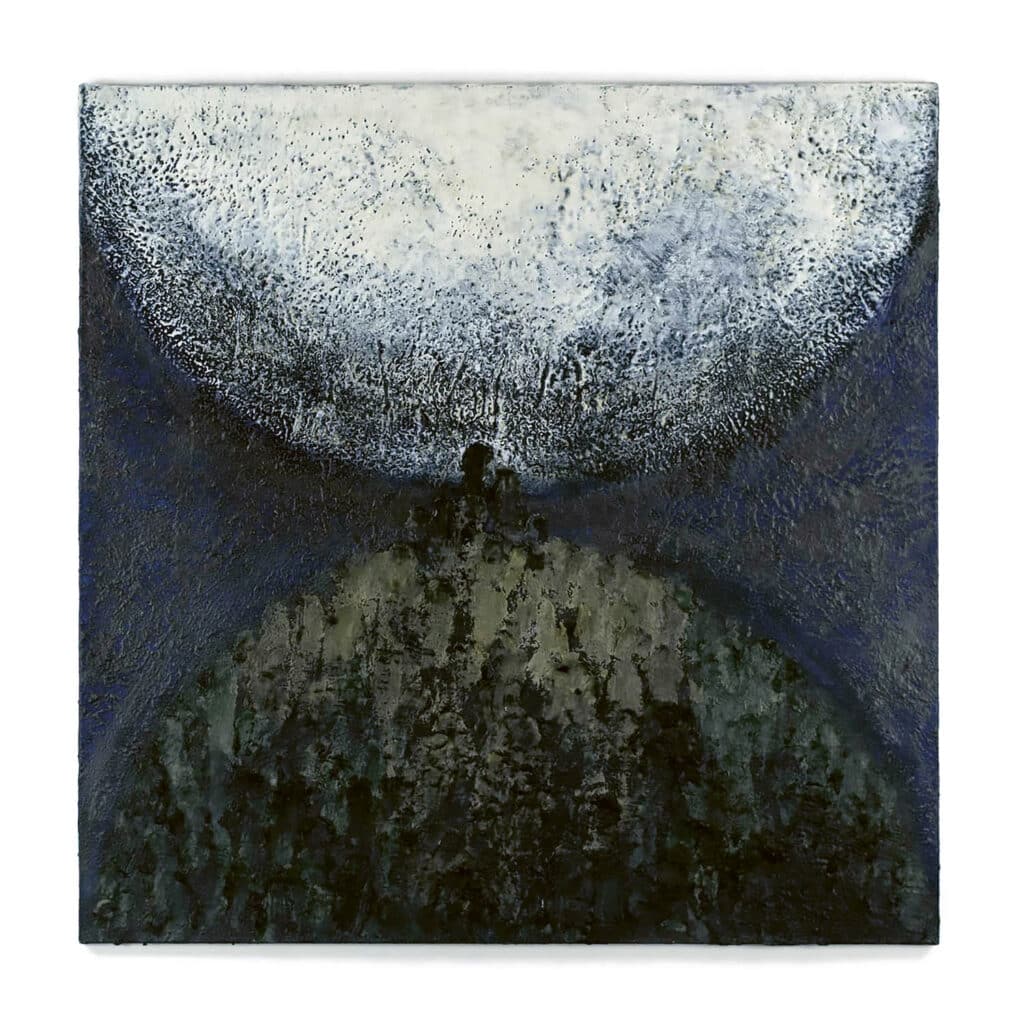
Title image Sixteen; all paintings by Helen Comerford






