


In the figure of Mary Magdalene, the triumph over death appears not as a doctrine but as an inner experience. How does our perspective change when we receive the Risen One in our souls? A brief journey to various sites explores this feminine figure.
Lalibela 2015
In northern Ethiopia, in the small town of Lalibela, women are not allowed to enter one of the eleven rock-hewn churches, Biet Golgatha, where Jesus’ symbolic tomb is hidden in the Holy of Holies. I’m told later that a relief high on the wall of the small chapel depicts His corpse guarded by two angels. I wait in the Biet Debre Sina Church located directly in front of it. I wait as Mary Magdalene, who saw the Risen One first. “So, as a woman, you are already blessed,” the deacon says to me with a slight smile before entering with the men who have some catching up to do.
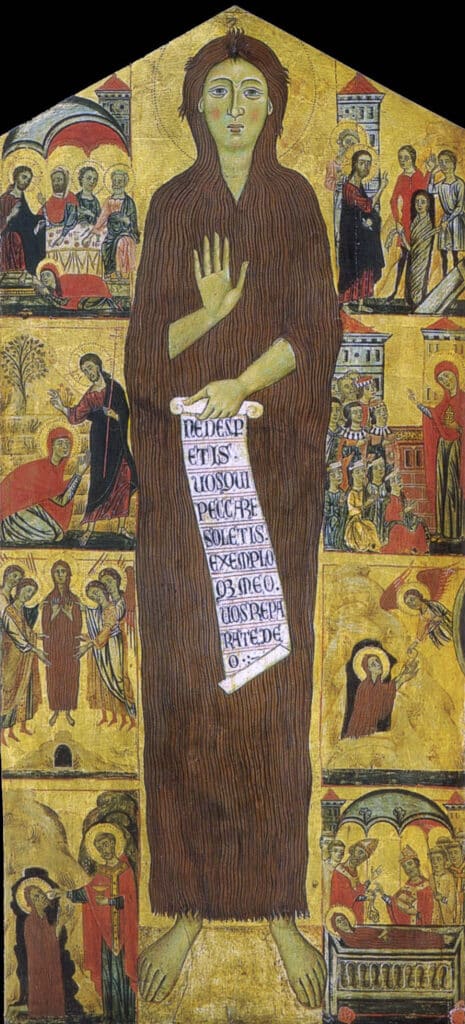
Mary Magdalene: the one who, on Easter morning, first thinks the “Rabbuni,” the Master, is the gardener. Then, with a pounding heart, she recognizes him. The vibration of the Earth resonates in her heart. At dawn, the light in the body of the Risen One meets the one who was purified by life, because He spoke to her as a brother of humanity. But she is not allowed to touch Him yet. She is the first human soul to encounter the miracle of the Resurrection. A female soul, quite different in her qualities and biography from Mary, the Mother of God, who had immaculately received Him and who is called “the Promise of Grace” in Ethiopia. Mary of Magdala came to Jesus as a sinner. She washed his feet with her tears and dried them with her hair. It was only through Pope John Paul II and Pope Francis that she received full honor as the first witness to bring the message of the Resurrection to the disciples.
An apocryphal Gospel of Mary, attributed to her by modern scholarship, is on display at the Egyptian Museum in Berlin. It contains descriptions of conversations between her and Christ. She asks Him questions about the nature of humanity. In the surviving fragments, the text begins with the question of the destruction of the material in death. The Risen One answers: “All nature (Grk. physis), all forms (plasma), all creatures (ktisis) exist within and with one another. They will pass away again down to the root. For the material dissolves only down to the roots of its nature.” Mary Magdalene also asks: “When one has a vision, does one see it with the natural soul or with the Holy Spirit?” Christ answers: “Not with the soul and not with the Holy Spirit, but through understanding. This lies in the middle between the two.”1
Rennes-le-Château 2025
In the Aude department of the southern Occitania region of France, countless tales circulate about Mary Magdalene. The Holy Grail is said to be hidden here. Arriving by ship from the Promised Land and landing at Saintes-Maries-de-la-Mer, she is said to have spent the rest of her life in a grotto below what is now Rennes-le-Château. The bookstore in this small medieval village of 150 inhabitants is full of New Age books, crystals, and incense sticks—a hub of esoteric tourism. Many years ago, I was warmly invited to lunch there by a Templar couple who live not far from the church dedicated to Mary Magdalene and have the Templar cross mounted on their house.
The landscape of the Corbières is like a tender womb, vast and mild in its ruggedness. Rennes-le-Château sits upon a hill where the view roams freely in all directions. An astounding variety of butterfly species play along the roadside in summer. A mild glow hangs in the air—a sweet and serene atmosphere. A child may be feeling a similar magic, seeing the candles burning in the little church with her father and wanting to light one herself. The water-blue vault is inhabited by stars. Viewed from above, we dive through the stellar sphere into the mother’s womb, into the sensory world, into the experience of the body.
Against a pink background, stretched like a curtain before the vastness of the cosmos, reddish-golden “islands” float like blood cells, like germ cells, like circles of eternity from which life swells and springs forth. They hover in the darkness of the altar backdrop, only dimly lit and seen through a blurred gaze. They do not originate from the Earth but from the soul itself, which senses a premonition. Mary Magdalene, as a solitary figure to my right, holds a cross as large as herself. Her robe is pink within and gold without. At her feet lies a skull. She carries a silver vessel over her heart. Her face is gentle, with large eyes and long hair. She gazes into the distance and has a loveliness that is not intrusive. She stands on her own. She is presented as pure, as if she had never had dirty, battered feet, in the time after being a prostitute, when she had become Jesus’ companion.
In the altarpiece, she nestles against the robe of the Lord, who will heal all, as the inscription states—as if she senses that spirit lives within matter. While the midday heat smolders at 35 degrees [95°F] outdoors, I spend an hour in the cool twilight of the church. I ask myself: what would I ask this woman for? For beautiful love, for the ability to prepare my soul so that I may forgivingly acknowledge the beauty of the other, because the human soul itself is beautiful. I sense that my heart moves to other rhythms, more vast and not so corporeal.
Basel 2026
After the darkness, this wild, dirty, dark, beautiful world is once again my refuge. It is what belongs to me. My first anchor after encountering the spirit of the flame is two seagulls squabbling. Their screeching, a stone chant, is as genuine as breathing. In a somewhat shabby, seemingly French café where only men sit, I find my way back—hidden for a time—to myself. Hidden from high culture, from the masters, from wonderment. And still the tears come to my eyes in the face of the unspeakable that we are and that we hurt, even when we don’t mean to, in the face of darkness and light. Heaven in the heavens is lonely. Is it this loneliness that Jean Genet felt, in his sense of the absolute equality of all? Has heaven made me lonely?
The waiter (who might have Algerian roots) knows about the secrets of the human soul. He sees me and leaves me in peace. He polishes the glasses, puts the cutlery away; Dire Straits from the stereo; his quiet singing along; on the walls, black-and-white portraits of men like memories of the deceased. One single woman is among them—for her, a ceramic butterfly on the frame. The Algerian’s movements seem impaired—slow, attentive, and yet with a certain distance. He reminds me of the “stranger.” His “bye” after a departing guest is affectionately impersonal; there is no need to be remembered. I only have enough cash for a coffee, but I settle in for longer anyway. Eventually, I ask him where the nearest ATM is. Leaving all my things at the table, I want to take a chance; I want to believe that I can trust. I play this game for the sake of the human soul. Everything I am is contained in my computer, which I leave here to go look for the ATM. When I return after about fifteen minutes, everything is still there. I order a second coffee.
Easter Morning, Jerusalem, 33 AD/2026
On the threshold of the new day, Mary Magdalene is the dawn, the moment when light appears as a rosy glow before it has risen high enough to illuminate everything. She receives the new light in her soul, not in her body. Within her are mirrored the interplay and togetherness of light and matter. She is the first breath of warmth after the dark night. She seems naive, for she has no questions. Her innocence knows no doubt. She becomes the first herald. Is she the soul who recognized the Son of Man in love? In a new world that comprehends itself through me, Mary Magdalene is the prepared soul who believes in the miracle. In her, the gentleness and love of Christ have already woven a certainty that is like a sound, not a knowing.
What Christ accomplishes in the spirit is mirrored in the soul of Mary of Magdala. She feels the miracle. From this inner sensation and capacity for inner sensation, the great artists created their works. Their means of expression are nourished by this ability to feel and sense within. A force has appeared on Earth. In heaven, it is splendor, but on Earth, it is creative beauty. Beautiful is the soul that is ready to greet the heavens. Can my gaze become graceful? Can I gently caress the world with my gaze? Can I receive the world, as Mary Magdalene received the Risen One who lives within us all? Could it be that this force is the center of sentience that learns to breathe in a spiritualized Earth, and breathes in and experiences a realm of consciousness that makes the spirit of life perceptible because it is sensed?
When one countenance touches another, a seeing emerges that moves beneath the surface. When things begin to speak, their language melts away my old form. The knowing from the wellspring of the heart cannot be captured.
Translation Joshua Kelberman






Mary Magdalene is so important. Gratifying that she is discussed at length in this edition. And at Easter time.
words cannot describe the beauty of what Gilda has captured ..