

The individuality and life of Francis of Assisi (c. 1181–Oct. 3, 1226) mirror the way, the truth, and the life of Jesus Christ. Even today, anyone who is touched by Francis can be moved by his spirit, reorient their values, and experience the beauty of creation. Francis was an “eternal lover.”
Every poet and every saint needs his own climate, wherein his soul can open to the sun. Francis without Assisi—one of Italy’s oldest cities—is unthinkable. He was the son of the wealthy merchant and landowner Pietro Bernardone, and he was expected to follow in his father’s footsteps.1 He made money quickly already at a young age—and spent it lavishly. People loved him immediately. He was charismatic, filled with enthusiasm, and loved life and all its joys. He traveled with his father to the courts of the French nobility, intoxicated by troubadour songs and the heroic deeds of knights. His fantasy burned with a longing for great, true, passionate love—a love to which his heart could serve faithfully and devotedly. A woman was for him the ideal to help him lead an honorable, chivalrous life. His playful soul was like a butterfly in a meadow—intoxicated by beauty, the Italian sun, life, tranquility, and a deep longing.
Francis was the leader of the Assisi youth. A gifted singer and natural-born poet, dressed in magnificent troubadour garb and holding a flute in his hand, he captured the hearts of young women who trembled like olive branches. But shadows soon fell over this enthusiastic, carefree, exceedingly gregarious, and joyful soul. He was young during a turbulent time. Emperors fought popes, princes fought kings, and cities fought cities. In 1202, when he was seventeen, a civil war was raging; the city’s population was rebelling against the nobility. Francis also fought, was captured, and then imprisoned for a year in the city of Perugia. Yet even there, his cheerfulness never left him. “How could I not sing? Don’t you know that a great future lies before me and that one day the whole world will speak of me?” He heartily comforted his desperate fellow prisoners and told them about true chivalry, which knows how to preserve an independent spirit and a free heart.
After his return, he fell seriously ill and remained bedridden for a long time. The illness hit him harder than prison had. All his youthful illusions were shattered. He came to see his life up to that point as folly and a waste of time. Pleasures seemed to him like flowers that bloom and wither. “True life must lie beyond these fleeting illusions […]. What dies is not life. The truth lies beyond the misty veil.” This was the first step in his great transformation.

Naked and Helpless
Francis was convinced that he was called to greatness. But only those who stand out—who are famous, respected, and wise—are considered great. Unease began to hold sway in his once-carefree soul. Then, under Pope Innocent III, war broke out again. Francis enthusiastically volunteered and rode out of the city on a magnificently decked-out horse. “I will return as a prince!” he called to his comrades as he took his leave. But a fever seized him once more, and he was forced to turn back. Dreams of glory vanished like clouds. A sadness took hold of him. Had life conspired against him? He fell silent. Even when among his friends, his heart no longer sang; he grew estranged from those closest to him. He encountered the poor on the street, shared his clothes with them, and a sense of injustice gnawed at his heart. The first notes of God’s melodies were born in this silence.
Francis had no higher ideal than freedom. Are we free if we cannot live like the birds in the heavens, if we do not trust the Father who cares for the deer in the woods? True chivalry meant freeing the soul from violence, power, privilege, greed, and every kind of desire. Belief in another kind of life was born within him—in the message of Christ, wherein one gains by leaving all behind. But this requires a radical change in outlook. It was not enough for Francis to call upon God while maintaining his current way of life and thinking. He knew that greed for material goods enslaves spiritual forces and slowly drives God away from the world. He knew that poverty was the only true chivalry and the way to true freedom. The sincere wish that everyone else might have more than he, that everyone else might be more important: this was for him the only way to Christ. To love God and one’s neighbor more than oneself became a bond of love for him with God and with every human being. Francis radically embraced this with all his thoughts, feelings, and will. Christ had no home, no possessions. He wandered, taught, and lived like the birds of the heavens.

The Last Chains of Blood Relations
Francis entertained the idea of becoming one of these poor. His parents grew increasingly concerned. He traveled to Rome and, at the church entrance, exchanged clothes with a beggar. Something within him broke apart. He felt ashamed and wondered if he was crazy. When he overcame the final obstacle, kissing a leper, he broke through the last wall within himself and was seized by a sense of grace-filled joy. Although he was something of a rebel, he harbored no destructive thoughts or criticism toward anyone. He destroyed neither society nor the Church; he did not accuse or defame anyone. He simply and faithfully followed his ideals, without deviation. All that once was sweet had now turned bitter, and vice versa.
But Francis’s soul now experienced beauty ever more intensively. He saw in nature the goodness and tenderness of the Father, who enlivened all creatures with His breath. And yet, his love brought not only unity but also division. Francis became an embarrassment to his family. In 1207, he publicly confronted his father in the market square while the bishop was presiding over a debate among the dignitaries. Naked, with only a piece of cloth around his hips, the son disowned his father before the latter publicly disinherited him. The final chains of his long captivity were broken, and a journey into the unknown awaited him. Francis sought refuge in nature, where a song was born from the depths of his soul—an expression of freedom and boundless grace.
He wandered about and initially found refuge with the Benedictines. There he followed the law of his heart: he was the least, the last, unworthy; all others had a greater right. In the ruined church of San Damiano, Christ, hanging there on the cross, spoke directly to him as if in a vision and revealed the Mystery of the Incarnation and the boundless love of God. Francis decided to rebuild this little church and began begging among his fellow citizens. They knew him from before and were offended and cursed him. Former friends mocked him, children threw stones, and his father cursed him whenever they met on the street. He appeased them with song, thanked them from his heart, and asked so gently for God’s blessing that it softened their hardened hearts.

Spiritual Development
Francis was uneducated and always rejected learning. He said, “I thank you, Father, for hiding this from the great and the wise and revealing it to the little ones.” People learned with deluded souls and thereby became more arrogant instead of more humble. Knowledge drifted further and further away from love, light from warmth, and prayer from learning. Francis knew there were other ways, but faithfully following the life of Christ was the most natural path for him. He dwelled in silence and quiet contemplation, in dialogue with God and in the certainty of His omnipresence. For him, a prayer was only a prayer when one wholly became prayer itself.
While he was restoring the Church of San Damiano and the Portiuncula, God strengthened his soul and his will. There, it was finally revealed to him that he was destined to be a knight and the leader of a special army. He would be the messenger of the one true King and was called to restore the mystical body of the Church, which had rotted to its foundations. Francis found the courage to deliver his first sermon in the main square of Assisi. With his graciousness and inward fire, he drove out evil and spurred souls on to virtue. Without any education, he proclaimed the Gospel of love from the depths of his heart. His first disciples joined him: the wealthy merchant Bernardo da Quintavalle of Assisi and the learned jurist Pietro de’ Cattani.
From that moment on, his community would be the heaviest burden for Francis, for he wanted to live alone and in freedom. He divided them into two groups: those who preached and those who helped wherever they were needed. Francis’s brothers did not just beg; they worked hard. When twelve brothers had gathered, a harsh winter descended upon them. Many challenges followed. Francis began to compile the Rule of the Penitents of Assisi. It was only later that they took the name “Friars Minor.” He wanted to travel to Rome to present his community and its ideals to the pope and to protect them from suspicion. First, Cardinal John of Saint Paul received the group and advised them to retreat to a monastery, with discipline and supervision. Francis, however, wanted neither to enter a cloister nor to found a religious order. He sought official approval only that they might live according to the Gospel to prevent anyone from regarding them as opponents of the Church, which was powerful at the time. The cardinal knew their great spiritual force and the potential that the Church wished to use for itself. Francis had no idea that he would soon be forced to compromise his life’s ideal. Pope Innocent III was an outstanding pope and statesman, a shrewd realist, and a sagacious spirit. So, in 1209, two very different but significant human beings met face-to-face. Although the Pope initially refused to grant Francis and his disciples formal approval, he did authorize them to preach. Thus began Francis’ official ministry in the church of Assisi. The Word of the Gospel penetrated their souls and filled their hearts with beauty, sublimity, and warmth. He spoke not in a scholarly or rhetorical manner, but directly from the heart.

A Woman Is a Divine Creature
A woman had entered his life at an early age. Without her, Francis’s journey is unthinkable. She was his exemplar, a divine creature, a source of inspiration, and a reason for sacrifice. From the moment Francis began to preach, Clara faithfully accompanied him. His words were an echo of her heart, and what he said was as if he were drawing from her soul. This is the mystery of hearts that remain eternally united in love. Clara was the daughter of a count. She began to secretly slip away from home to visit Francis at the Portiuncula. Francis was not afraid of the soul of a woman; he knew that women were called to God just as men were. Therefore, he accepted her as his sister, cut off her lush, wavy hair himself, and she took her vows. This caused yet another scandal in Assisi. Her sister Catarina followed her, later joined by a third sister, and after the count’s death, her mother as well.
Francis gave Clara his first love: the Church of San Damiano. There, many other women from Assisi joined her. For a time, the brothers and sisters lived together in harmony, sharing their thoughts and caring for one another. But some of the brothers began to care too much for the sisters, and Francis had to expel them all in 1219 and send them to their own cloister. This broke his heart. Yet the bond between him and Clara remained close despite their physical separation. In the early Middle Ages, there was debate over whether women even possessed a soul. Church scholars and dignitaries, including Thomas Aquinas, did not regard women as equally divine beings. In this sense, Francis was remarkably progressive for his time.

Responsibility and Guilt
Francis carried a responsibility for all those who had left their homes and families. This was the time of the Crusades. He decided to proclaim Christ’s teaching of the universal brotherhood of humanity—not only to Christians, but also to pagans. He wanted to travel east to Syria, but the wind drove his ship to the coast of Croatia. He had to turn back. His journey to Morocco also failed. Meanwhile, however, the teaching spread rapidly throughout Italy.
At the Fourth Lateran Council on November 11, 1215, he met St. Dominic, the founder of the Dominican Order. Francis remained skeptical of worldly education. He saw it as a diversion that led away from simplicity and humility, that hardened the heart and resulted in useless wisdom. Nevertheless, he and Dominic immediately recognized each other’s spiritual greatness. Soon afterward, Cardinal Ugolino visited the Franciscan brothers and would later integrate the ‘order’ into the stream of the Church like healthy blood into an ailing body. This cardinal later became Pope Gregory IX.
In 1217, when the Franciscan movement had already grown quite large, Francis decided to cross the Italian border and venture into Hungary, Croatia, and Slovenia (both part of Hungary at the time). The brothers split up and preached in France, Spain, and also in Germany, where they suffered a severe defeat. They were cruelly flogged, tortured, and driven back across the border. Francis felt guilty about the victims and asked Ugolino to take charge of and organize his group. In this way, he freed himself from this burden and entrusted his brothers to the cardinal as his greatest treasure.
Francis then withdrew to the solitude of the mountains, where he was subjected to temptations. After a long fast and an inward struggle, he returned strengthened. In 1219, the annual assembly of his fellow friars took place, with over 5,000 participants, including Dominic, who sincerely admired Francis. Once again, it was decided to travel east. And once again, there were sacrifices. The whole group that set out for Africa perished. When the bodies were brought back to Portugal, Anthony of Padua joined the order.
In the Middle East, Francis met Sultan al-Malik al-Kamil who granted his brothers permission to move freely within Muslim territory. Francis did not convert any of the Muslims, but he showed them that there were also good people among the Christians. He was deeply impressed by the religious tolerance of the Muslim world.
In 1220, exhausted and suffering from a serious eye disease, Francis arrived in Venice, seeking peace and rest. Within his order, there had already been instances of betrayal of their way of life, and the rules of the order were changing. Francis experienced inner turmoil when the brothers began acquiring land and establishing cloisters. His original impulse to renounce everything had died. The new rules demanded strict obedience. Thus, the once-sublime freedom, representing his highest ideal, was abolished. Francis suffered because, for him, every law and every rule that entailed punishment embodied the Old Testament: a time of fear and coercion, not love.
He sent his fellow brothers once again into the “land of horror,” to Germany. Among the volunteers was Thomas of Celano, Francis’s first biographer. This time, they were well received by the official Church hierarchy. Cardinal Ugolino now sought to unite two powerful spiritual forces: the Dominicans as the “order of intellectuals” and the Franciscans, whom Francis shepherded like “little fools.” Francis rejected the proposal, withdrew, and, in solitude, composed a new rule for the Friars Minor—a loud cry from his wounded soul, an echo of deep concern. But the brothers were already divided and refused to accept his guidelines. Brother Elias, who had worked successfully in the East for many years, loved Francis but was at the same time obedient to the Church. He did not consider it a betrayal to propose St. Dominic’s guidelines to the Friars Minor. Francis felt defeated. From then on, the Friars Minor were to share a common house, common possessions, and a book as a guide in their search for truth and light.
Francis warned his brothers against pursuing learning, but scholarship was enticing to many. They breathed-in the spirit of the times. In the first half of the 13th century, a feverish thirst for knowledge arose. During that period, seventeen universities were founded in Europe, eight in Italy. The first Franciscan theological school was founded in Bologna without Francis’s consent. Francis wanted brothers who were perfected in spirit, not scholars. Most importantly, he believed preaching was to be done through deeds, through life itself, not through words and theory.
Francis felt that the search for truth and knowledge was also a service to God. But he knew human beings all too well. As soon as they gained recognition, they became blind and deaf to the voice of God. Francis was an ideal for his first disciples, but later, he became more and more of an obstacle. Against his will, the large Franciscan cloister on the outskirts of Paris became a university with 240 students. The rules governing the brothers’ activities were changed. Also contrary to his wishes, only educated brothers could be invested with higher positions in the order. The wounded idealist, who wished only to follow the life of Jesus Christ—wandering freely among people, preaching and healing, without a book, without a home, and without possessions—now suffered, prayed, and wept. Soul distress weakened him bodily to the point of exhaustion. Whoever rises to such perfected love and freedom finds it difficult to understand that this is not possible for everyone. The refuge of the individual is not the way of humanity.

Radically Faithful to Ideals
Francis continued to preach in his own way, developing new ideas and tirelessly winning over new adherents. He made it possible for ordinary people to follow the path of the Gospel without joining the brotherhood. In this way, he circumvented the Empire and the Church and rejected all social structures. He wrote a guidebook for lay penitents. A new wave of evangelical life spread among the people. This sparked a rebellion against him. There was great resistance in ecclesiastical circles, but Pope Honorius III protected Francis and his adherents and granted them independence from the bishops.
Francis spent his last Christmas in Greccio,2 where he built the first nativity scene and, at midnight, sang the Gospel so sweetly that grace and goodness spread throughout the valley. Since he was no longer in charge of the brothers, he withdrew and began to write. He was extremely self-critical, publicly chastising himself for every trace of selfishness, confessing his sins down to the smallest detail, and considering himself the greatest hypocrite; he was radical in his poverty. He even loved the animals that did not stockpile winter provisions more than others. The lark was his favorite, for it trusted that the forgetful farmer would leave some grain in the field. It spent the rest of its time singing freely under the sun.

Accompanied by Divine and Demonic Beings
Francis was conscious not only of the nearness of God, but also of the devil. He heard mysterious footsteps behind him, saw monstrous heads, heard voices, and was at times tormented by demons of fear, doubt, and apathy. Even his closest brothers were tempted by the devil. Brother Rufin had visions of the devil in the form of Christ. Together they overcame these temptations, guided by three things: obedience, which was their way of life; prayer, which gave them inner strength and steadfastness on the path; and joy. For Francis, an open, joyful smile was a sign of a pure heart. A face beaming with pure joy was more beautiful than the blue of the heavens.
Two years before his death, he returned to Mount La Verna, where he prayed and fasted for forty days to honor the Archangel Michael. In the midst of his fervent prayer, he encountered a seraphim with flaming wings, who, because of Francis’ ardent love for Christ, branded the indelible seal of divine love on his hands, feet, and side (the stigmata on September 14, 1224). On his way back, he healed people and performed numerous miracles. Nearly blind, exhausted, and ill, he returned to the Church of San Damiano, to Clara and the sisters. Under intense pain, he sang the “Canticle of the Sun”—a hymn of praise to creation. It was the fruit of his entire life. The “Canticle of the Sun” flowed from his heart as he stood on the threshold of death. Subsequently, he received a vision of Christ, who announced to him that the Kingdom of Heaven awaited him after death. He was transferred to his Portiuncula, where, after three days of preparation, at the age of 45, he died singing.
Francis Today
Francis gives the world today nothing or everything. We can forget him, because practically everything has changed since his life on the Earth. Science and technology are accelerating time and alienating human beings from nature and their fellow brothers and sisters at an explosive rate. Civilization strives for comfort and progress, global networking, and material possessions. Who today still sings freely under the sun, without anything? An unregistered life is prohibited by law. We have built ourselves cages in which we struggle with our last breaths to survive spiritually.
Francis reminds us that, regardless of all knowledge—whether academic or anthroposophical—we must remain modest and humble; therein lies the kernel of his freedom. Through our own nothingness, our spirit grows in the sense that Paul described: “Not I, but Christ in me.” Thus we can immerse ourselves in the sea of His love and know Him in nature and in all creatures. Blessed are those who can consciously be small, humble, and lowly, and who feel rewarded for it in a world that is moving ever more in the opposite direction. That, too, is knowledge; that, too, is wisdom. In Francis, we can know the way of the shepherd; in Dominic, the way of the king. Only when we unite the two can we become a perfected expression of the Divine.
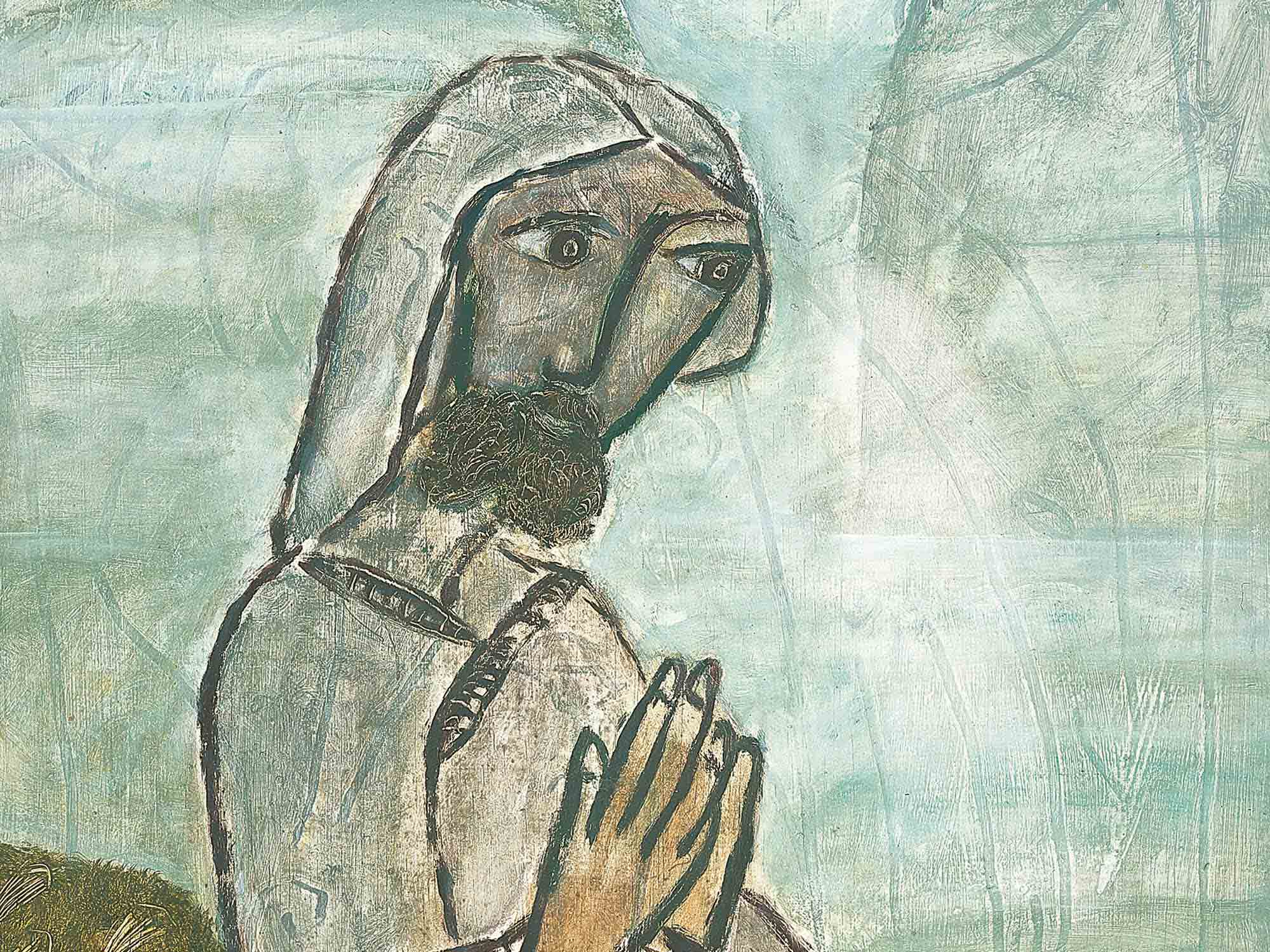
The images: Artist Greg Tricker (*1951) provided pictures from his series on St. Francis of Assisi to mark the 800th anniversary of his death. With the exception of the stained-glass piece (2011), all other pictures shown above were created before 2005. Some of the works are on display until Advent at the Christian Community in Wangen, Germany, as part of an exhibition organized by the Karl König Institute and will then travel to other locations. On October 3 and 4, commemorative events honoring Francis of Assisi will take place at the Christian Community in Wangen, featuring a lecture by Greg Tricker.
More Christengemeinschaft Wangen and the Karl-König-Institut
Translation Joshua Kelberman

Footnotes
- All the events described in this article are taken from the Slovenian translation of a biography of Francis by Yves Ivonides, a Croatian Franciscan friar and hagiographer, who based his work on the first biography by Thomas of Celano. See Yves Ivonides, Večni zaljubljenec: Sporočilo sv. Frančiška Asiškega bratom in sodobnemu svetu, trans. Jakob Emeršič, 2nd rev. edn. (Ljubljana: Slovenska minoritska provinca sv. Jožefa, 2005); first published as Vječni zaljubljenik: Poruka sv. Franje Asiškoga braći i suvremenom svijetu (Zagreb: Hrvatska provincija sv. Jeronima franjevaca konventualaca, 1976, 5 rev. edn. 2019); Thomas of Celano, The First Life of Saint Francis, in Francis of Assisi: Early Documents, vol. 1, The Saint (New York: New City Press, 1999).
- Historical note from the editorial team: The original text incorrectly identified Bethlehem as the site of the first Nativity scene. However, it has been documented that Francis built it in Greccio, Italy, in 1223.





