

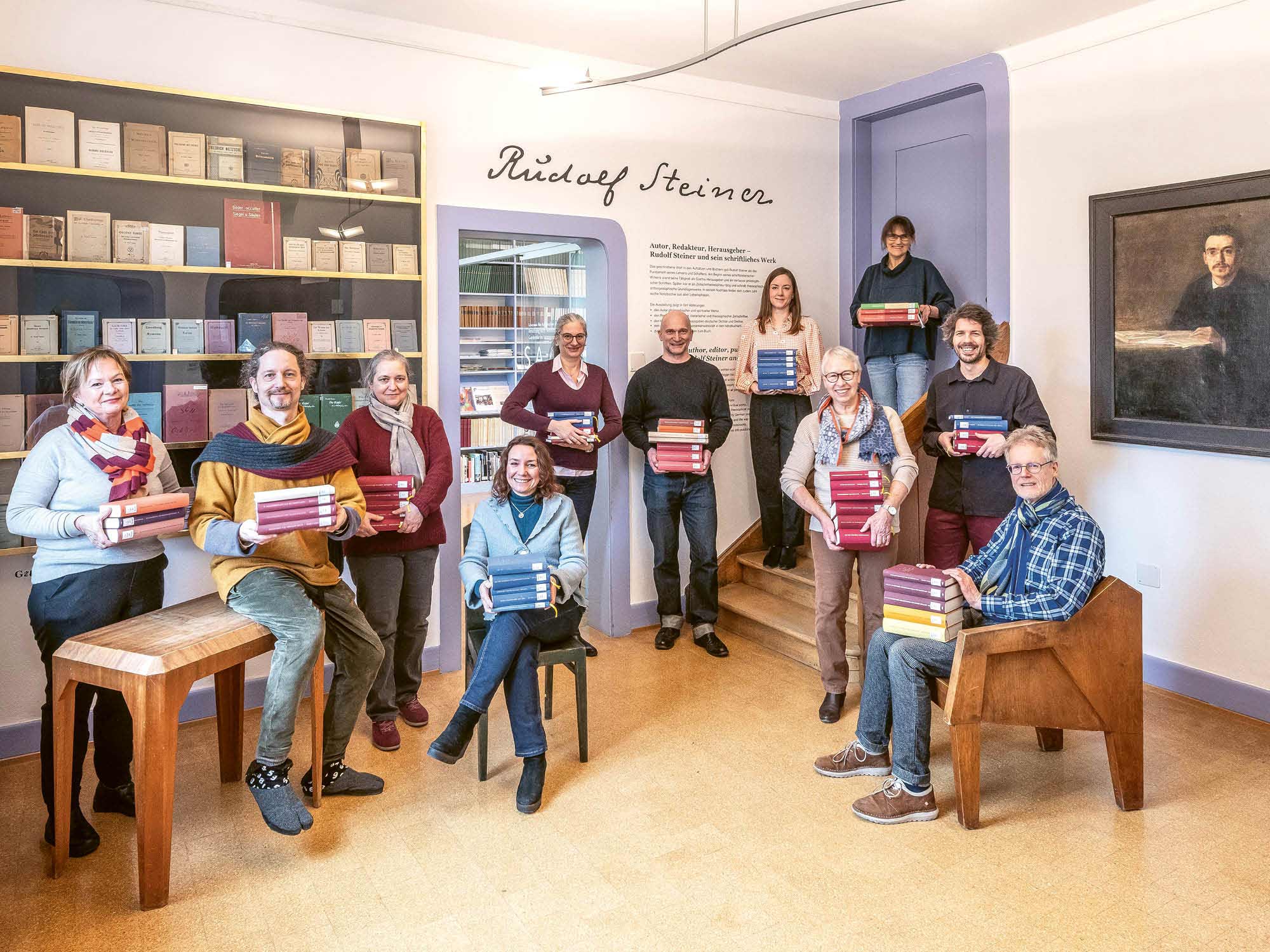
Angelika Schmitt and Philip Kovce have been directing the Rudolf Steiner Archive since 2025. A look back and ahead with Wolfgang Held.
The ceremony marking the completion of the Rudolf Steiner Gesamtausgabe (GA) [Collected Works (CW)], comprising over 450 volumes, is just around the corner. You both have been heading the Rudolf Steiner Archive for about a year now, since the 100th anniversary of Steiner’s death on March 30, 2025. What has been the focus of your work so far?
Angelika Schmitt: First, Philip and I spent six months assisting our predecessor, David Marc Hoffmann. This gave us the opportunity to observe and familiarize ourselves with everything. Then, two days after the 100th anniversary of Steiner’s death, we took over as directors of the archive. The transition was seamless and went surprisingly well. David Marc Hoffmann handed over more and more responsibilities to us. So, we were leading meetings soon after we started. After we took office, things got rather turbulent, because within just a few months, several important administrative foundations crumbled. First, our IT service provider passed away and literally took many passwords with him to the grave. Then the building superintendent quit. And finally, our bookkeeper died quite unexpectedly. So, it was a dramatic year with enormous challenges—we had to fill the gaps as best we could and train new staff in tasks that we ourselves didn’t fully understand yet.
And all this while you’re in the home stretch of finishing the Collected Works.
Schmitt: That was the real challenge, yes. Seven GA volumes were completed in 2025, and at the same time, Philip and I were thinking about the future of the archive. Fortunately, the GA volumes had been in process for some time, so we only had to provide editorial support and resolve some final issues. It was more difficult to define the future and develop a vision and strategy. This was done in collaboration with the large Board of Trustees of the Rudolf Steiner Nachlassverwaltung [Estate Administration].
An eventful year!
Philip Kovce: Yes. I would add one more thing: there were three very different phases of experience during the onboarding period. Phase one was marked by fascination. Every day, David Marc Hoffmann guided us through the archive, so day after day, we could explore the collections further. That was wonderful, but of course it couldn’t last forever. Phase two was rather sobering personally: The place is already running smoothly! What do they still need me for? Am I superfluous here? In phase three, this feeling reversed: There are gaps everywhere! We’re needed everywhere! What should we tackle first?
What defined Steiner’s commemorative year 2025 for you?
Schmitt: For me, the exhibition on Rudolf Steiner’s written works, which we opened at House Duldeck in March 2025, is one of the defining events of the commemorative year. It also marked our successful start at the archive. We were involved in planning the exhibition, which allowed us to engage deeply with Rudolf Steiner as an author, editor, and publisher. And we were able to embark on our own journey of discovery within the archive: What archival materials do we actually possess? How are they organized? Where are they located? What makes sense to display in an exhibition? For me, it was a wonderful introduction to come into such direct contact with the archival materials.
The exhibition space at House Duldeck is quite modest.
Schmitt: Yes. Of course, one could dream of a large Steiner Museum with plenty of space. Limited space means you have to make a limited selection. But that’s exactly what I find most rewarding about exhibitions. If you display too much, visitors quickly get lost. With a small selection, it’s easier to grasp the connections and get the essential aspects.

What else stood out during the Steiner commemorative year?
Kovce: I found it striking that Rudolf Steiner was portrayed in the media quite differently in 2011, the 150th anniversary of his birth, than he was last year for the 100th anniversary of his death. In short, there was a shift in the media’s attitude toward anthroposophy. While many articles on Steiner in 2011 were just as uninformed as those in 2025, the overall tone was different. In 2011, for example, the philosopher Peter Sloterdijk regarded Steiner as a “perfectly normal genius,” who had a lasting influence on art and culture in particular. By 2025, Steiner was portrayed as controversial at best; or even dismissed as a textbook racist, anti-Semitic science denier, or anti-democrat.
Yes, in 2011 Steiner received a kind of communications consecration: it was said that anthroposophy was the only reform movement to have passed the test of praxis. And Peter Sloterdijk emphasized that Steiner had created “a kind of antenna anthropology” that enables a new connection with the spirit.
Kovce: Interestingly, the shift in media discourse does not correspond to the academic development of Steiner research. In academic circles, Steiner has been viewed in a much more nuanced way in recent years. The 2025 Steiner conferences at the Goethe and Schiller Archive in Weimar and at Harvard University in the United States are prime examples of this; likewise with the critical edition of Rudolf Steiner’s writings, published by Frommann-Holzboog since 2013, where Steiner appears alongside Fichte, Schelling, and Hegel. In this respect, we could say that the media discourse on anthroposophy has become less scientific. Although, a certain anthroposophical “wagon fort mentality” also obscures a clear view, of course.
What sets the Rudolf Steiner Archive apart from other archives?
Schmitt: As the archive of the Rudolf Steiner Nachlassverwaltung [Estate Administration], we’ve been publishing the Gesamtausgabe [Collected Works] since the 1950s. So, for some 70 years now, we’ve primarily been functioning as a publishing archive. Now that the German Collected Works project has been completed, we have the opportunity to focus more on conventional archival tasks in the future. In any case, we’re consulted as a center of expertise for questions regarding Steiner and his work. In doing so, we aim to convey a positive image of Steiner, which for us includes making the archive publicly accessible. We do everything we can to make it clear that we are not hiding anything, but that anyone can view and research the archival materials here. That was not the case in the past.
Kovce: Public access to archival materials fosters a kind of “second order” positive image of Steiner. I wouldn’t say that, as an archive, we’re responsible for shaping a positive image of Steiner, but that we’re responsible for ensuring the rich palette of our archival materials is available to anyone who wishes to form their own image of Steiner. In a very practical way, by treating Steiner’s estate as a public cultural asset and welcoming everyone to our archive, we refute the suspicion (which is, admittedly, not entirely unfounded) that the anthroposophical milieu is a closed Society. Friends and foes of anthroposophy can pore over the very same document here and argue about it to their hearts’ content. That is our diplomatic mission. We are a place of the greatest possible interpretive neutrality, if you will: the Switzerland of anthroposophy.
It’s being said that the Gesamtausgabe [Collected Works] is now completed. Are there any reservations in this statement?
Schmitt: Yes. Between 2016 and 2025, a total of 54 new GA volumes were published as part of the GA 2025 project. A milestone! However, two gems are still awaiting the finishing touches: the last three of six volumes in the edition of all letters (GA 38/4–6) are much more labor-intensive than anticipated and have not yet been published; and, in the digital edition of the notebooks and notes (eGA 47/48), only 182 of 637 notebooks and 708 of approximately 7,000 notes have been published so far. The notes in particular are a treasure that still needs to be unearthed over the next few years. There, one is very close to Steiner, in the midst of his workshop of thought, where he records in writing the insights freshly grasped by his spirit.
Kovce: We’re also publishing a handbook for the Gesamtausgabe (GA HB) [Collected Works (CW HB)], which, in addition to statements on the history of the Collected Works and the editorial guidelines, also contains various lists and indexes as well as a bibliography of the Gesamtausgabe. Incidentally, the handbook will be available digitally at no cost—making it a financially accessible working resource. Otherwise, virtually all material, as things stand, that can be attributed to Rudolf Steiner’s work is published in the Gesamtausgabe. Individual supplements will be included in new editions.
To what extent do you expect to reprint out-of-print GA volumes?
Kovce: Experience has shown that 10 to 20 titles go out of print each year. Depending on editorial needs and financial resources, a new edition is then produced in the form of a reprint, a newly typeset and corrected volume, or even a completely revised edition. Since the currently available GA titles span every decade of the edition, the need for revision is, in some cases, enormous. Our goal is to republish out-of-print volumes in accordance with our editorial guidelines and the current state of research. However, we will only be able to achieve this if the GA, as one of the largest collected works in the history of the humanities, continues to find friends and supporters who wish to keep this total-work-of-art edition alive as a reading and study edition.

What were some of the surprises you encountered in your first year?
Schmitt: I was surprised by the incredible support from our donors. For one thing, more than twice as many unrestricted donations were received in 2025 compared to the previous year. For another, we also received substantial contributions in 2025 from two foundations that have been generously supporting the GA program for years. We are, of course, very grateful for this, and this support gives us courage and confidence for the future. I was also pleasantly surprised by how warmly we were received at the Goetheanum. We meet with the Goetheanum leadership as needed, and a shared campus consciousness is already developing. For example, we not only planned the GA completion ceremony together but also jointly organized the exhibition on Steiner’s stenographer Helene Finckh, which will open shortly in the Finckh House.
Did you expect a less friendly welcome?
Schmitt: Well, historically speaking, the Nachlassverwaltung [Estate Administration] and the Goetheanum were bitterly hostile institutions that fought in court over Rudolf Steiner’s legacy and refused to have anything to do with one another for decades. I find it all the more gratifying that these old rifts have now finally been bridged. Ultimately, we share a common cause, albeit in different ways: to defend Steiner’s legacy against an extremely critical public. As an archive, we have a statutory assignment to preserve, research, and publish Steiner’s estate. The Goetheanum, on the other hand, represents anthroposophy as a worldview and supports the anthroposophical fields of work.
Kovce: What surprised me most of all was how long and rocky the path is from a freely held lecture by Steiner to a printed GA lecture that Steiner himself neither transcribed nor reviewed. Sometimes there are no stenographic transcripts available, only notes taken by participants. Or there are several stenograms that differ from one another. Or the transcriptions made by the stenographers differ from their own stenograms. One must realize that a large portion of the GA volumes do not actually contain any direct text by Steiner. Rather, they reconstruct how some 6,000 of Steiner’s freely held lectures took place at specific times and locations. A cloth-bound, gold-embossed GA volume with a ribbon bookmark standing on the bookshelf is a performative contradiction to this. Even a sensitive, transparent approach to the lecture corpus, as we have long practiced in our editorial work, cannot resolve this contradiction.
What does this mean for reading Steiner?
Kovce: That in most of the GA-volumes, Steiner’s work presents itself to us in a much more uncertain, much more fluid—we could even say much freer—way than many are accustomed to reading it. The written form fosters the belief that this is an authored text, which actually it is not. The Steiner authority that people like to quote does not exist on a textual level, despite Steiner’s hesitant consent to transcription and publication. The GA editors of recent generations have dealt with this in very different ways. And in their search for a Steiner text that is as authentic as possible, they have likely raised false hopes. But anyone who denounces certain GA lectures by claiming that they were demonstrably quite different—more precisely this way or that—is actually doing a disservice. Once again, they create the impression that there is an authoritative Steiner text—which, in fact, there isn’t.
How does that work with the writings?
Kovce: That was the second thing that surprised me: how extensively Steiner revised many of his writings when they were republished. Of course, we have the author’s text here, which we do not have in the lectures. But Steiner treated his own writings with surprising freedom—nothing is set in stone; all texts undergo a metamorphosis. It is interesting to note that, regardless of the extent of his later revisions, Steiner mostly emphasizes a philosophical-anthroposophical continuity and a theosophical-anthroposophical break. Here in the archive, we are very fortunate not to have to limit ourselves to Steiner the philosopher, theosophist, or anthroposophist. With us, Rudolf Steiner enjoys our undivided attention. And it is precisely this undivided focus that makes the grand whole of his life and work visible in its infinitely many small parts.
What has changed regarding Rudolf Steiner after a hundred years? Is he now viewed in the same historical context as Goethe?
Schmitt: Of course, there are no longer any people alive who knew him personally. At the same time, I meet young people who haven’t read much of his work, who perhaps don’t even speak German, but still feel a deep connection to Steiner’s ideas.
Kovce: Rudolf Steiner was born 29 years after Goethe’s death—he is a latecomer to the Goethe era and, in that sense, has long been a historical figure. At the same time, Steiner’s work remains as relevant as ever. There are kindergartens, farms, schools, hospitals, and universities that explicitly draw on this work and would not exist without it. The peculiar tension between temporality and timelessness is especially palpable in the archive: all of our archival materials, which we cherish and care for as best we can, are part of a decaying world. They are, in fact, dead, but they can be brought back to life through the spirit, through the questions we ask of them. As an archive, we want to be a place for this: for current questions in dialogue with Rudolf Steiner’s estate.

Was Rudolf Steiner himself the first director of the archive?
Kovce: No. Marie Steiner was the first director, decades before the Nachlassverwaltung [Estate Administration] was even established in 1943. It is largely thanks to her that so much material has been preserved from their time together in Berlin within theosophical circles. Steiner had more the present and eternity in view than his estate. Rudolf Steiner’s estate, as we know and can research it today, has been painstakingly compiled over time by many people—bit by bit.
Schmitt: We have entire book manuscripts only from 1910 on. None of the earlier manuscripts are available to us, at least not in their entirety. We originally came here expecting that, following the completion of the GA and the critical edition of Rudolf Steiner’s writings by Frommann-Holzboog, a historical-critical edition of Steiner’s works incorporating the manuscripts would now be in the works. But we had to conclude that many manuscripts are missing. As I said, they are only complete starting in 1910, that is, beginning with Geheimwissenschaft [Occult science] and the fragment Anthroposophie [Anthroposophy].
Does that mean there are no manuscript copies of the 1894 Philosophie der Freiheit [The Philosophy of Freedom], or 1904 Theosophie [Theosophy]?
Schmitt: No. Only a very few manuscript pages and proofs have survived.
Why were the manuscripts lost?
Schmitt: We don’t know. In a letter, Marie Steiner writes that they had to throw away baskets full of paper because there was no more room for on Motzstrasse in Berlin. They simply couldn’t keep it all.
Let’s look ahead, what are the archive’s next projects?
Schmitt: Through many conversations with friends, supporters, and the Foundation Advisory Board, two flagship projects have emerged. One is a permanent exhibition on Rudolf Steiner’s life and work. People who come to the Dornach hill should be able to learn who Rudolf Steiner actually was, what he accomplished, and what impulses he brought into the world. The current Steiner exhibition at the Goetheanum shows that there is great interest in this. Incidentally, the Executive Board at the Goetheanum has also indicated that it would be very pleased to have such a permanent exhibition at House Duldeck.
And the other project?
Schmitt: For the past 70 years or so, we have primarily published the Gesamtausgabe [Collected works] in book form. What has been neglected so far is the digital realm. As an archive, we want to have a stronger presence there in the future. Currently, GA-online is available as a paid offering, and there are various pirated copies circulating online—mostly of older editions of the Collected Works that are editorially outdated. This is unsatisfactory. We want to build a digital infrastructure where the GA is freely accessible as an open-access product featuring the latest edition and can be researched worldwide.

Now that’s some news!
Schmitt: And that’s not all! We also plan to make our archival holdings more and more freely accessible in a digital reading room. This includes manuscripts and letters by Rudolf Steiner, as well as pages from his private library—which comprises some 9,500 books—bearing traces of his reading. And, of course, we are continuing work on the digital edition of his notebooks and notes (eGA 47/48).
So, there are two developments: the digital infrastructure brings the archive to the world, and the exhibition makes visiting in person more appealing. More for the periphery and more for the center?
Kovce: That’s it. The two flagships symbolize these two movements. And they signify that, with the completion of the GA, the archive’s focus will shift toward research and outreach. For 2026, incidentally, that means with a smaller team and a tighter budget.
Which brings us to the financial aspect. Securing funding for the GA project was probably easier than it is now for ongoing operations.
Kovce: The fact that the archive was able to secure a total of around 18 million francs between 2016 and 2025 is nothing short of a small miracle. Despite the attractive prospect of completing the GA, it was by no means a sure thing. But as a nonprofit foundation without regular public funding or any significant assets of its own, securing funding is never a sure thing. We must continually win over new friends and supporters and work together to achieve small miracles. In 2026, we will need a total of around 1.2 million francs. This amount is also large enough to require a small miracle.
Even within the anthroposophical community, there are still misconceptions that the archive is self-financing, yes?
Kovce: Anyone who actually holds these conceptions is being deceived. The truth is: nothing happens on its own. Everything must be taken in hand.
And what are the ways there?
Kovce: These, too, must be reestablished time and again. For the GA project, we received a few large donations and many small ones. In the future, we want to secure the archive’s core funding through a sort of “donor middle-class”: through binding, regular contributions at the donor’s discretion. After all, we don’t just want to carry out exciting new projects but also handle day-to-day operations: preserving and cataloging archival materials, advising and assisting archive users, and answering questions from media representatives. For this alone, we need around 250,000 francs annually. It is precisely these routine tasks that are far from self-financing. But as the saying goes: miracles do happen.
Translation Joshua Kelberman
Title image Staff of the Rudolf Steiner Archive, Dornach, with the GA volumes published from 2016 to 2025. Fourth from the left: Angelika Schmitt; second from the right: Philip Kovce. Photo: Photo Basilisk AG.






