

Inner development as a response to the AI transformation.
In light of the unimaginably rapid developments in the field of AI, there is talk of a “transformation of society” just around the corner. Agriculture’s transformation is not around the corner; we’ve been in the midst of it for decades. Today, buzzwords such as “structural change,” “farm closures,” and “rationalization” refer to developments in agriculture that have been affecting farming families more severely and more rapidly than almost any other sector. For them, “transformation” usually does not mean a new beginning, but rather a permanent struggle for survival in response to the pressure of pricing and competition, land concentration, and technological upgrades. They have seen how ever-larger machines are replacing more and more people, how political conditions are driving them from one subsidy period to the next, and how farming knowledge is being replaced by standardized procedures. What the rest of society is only now beginning to realize with the rapid development of artificial intelligence—with entire fields of activity and ways of life slipping away—farmers have been experiencing for a long time: the experience of being replaceable.
I didn’t grow up on a farm. I stumbled into agriculture in my early twenties through an internship; then, in my mid-twenties, I consciously decided to pursue agricultural training, with naïve conceptions that as farms were dying out, they would become available, and someone would take them over. Surely it must be possible for a committed, trained young farmer to find a farm. Reality caught up with me pretty quickly. Unless you inherit a farm or happen to have access to a few million euros, it’s almost impossible to take over a farm in Germany today. Land has become an object of speculation for nonagricultural investors, and anyone who comes to agriculture as a career changer faces a wall of ownership structures and profit-driven logic.
I only really understood this system when I ended up at the Luzernenhof near Freiburg—a community-supported farm with shared ownership. Up to that point, having been socialized in economics, I tended to think in neoliberal terms. At the Luzernenhof, I was able to experience real living commons. I saw what happens when a community takes responsibility and supports a farm collectively. At that time, we launched a campaign and collected around one million euros from about 200 people to bring the farm into community ownership.
This experience shaped me and ultimately led me to the Kulturland cooperative, where I worked for eight years to free farms from the logic of land utilization and develop non-family farm succession. It became increasingly clear to me that the crisis in agriculture is not an isolated, marginal phenomenon of a “problem industry.” It is a magnifying glass for a much larger social upheaval that is just gaining momentum—and whose most visible accelerator at the moment is artificial intelligence.
In my everyday life, applications of artificial intelligence have long been ubiquitous. I’m currently witnessing how entire fields of work are undergoing radical change. In agriculture, what we’re seeing is just the beginning: autonomous tractors, robotics, drones, and data-driven management. It’s likely that in two generations, we’ll see 90–95 percent human-free agriculture in the fields.
You may find this fascinating, frightening, or both. For me, the key point is that AI is a turning point for civilization. It is not only affecting production processes, but our most intimate relationships, too. There are young people today who describe an AI persona as a “close friend.” According to a recent survey, 52 percent of 13- to 17-year-olds in the U.S. said they have an “AI companion” with whom they interact regularly and have emotional relationships. We know from psychology how easily we tend to confuse speech with consciousness. And now let’s imagine a system that can simulate a perfect, empathetic, always available “counterpart” without its own vulnerability, without its own limitations, without bodily presence. I don’t believe that we humans are evolutionarily equipped to make a clear distinction between this kind of “relationship” and others. And certainly not a 13- to 17-year-old.
Emotional Growth
So, if agriculture has been transformed for decades by mechanization, market logic, and digitalization, and AI is simultaneously disrupting the way we work, communicate, and even experience friendship, I don’t think it’s enough to adjust another funding guideline or appoint the next “future commission.” The answer that individuals can give to these upheavals lies elsewhere. It lies within.
In recent years, I’ve repeatedly found myself returning to Erich Fromm—The Art of Loving or The Fear of Freedom. Fromm describes how modern societies tend to press people into functional roles, emptying them inwardly and then filling this void with consumption, work, and entertainment. At the same time, we in Central Europe live on soil that is riddled with transgenerational trauma. This is not a historical footnote; it lives on in almost all families—in the way we regulate closeness and distance, how we deal with fear, conflict, and power.
When I talk about “inner transformation,” I don’t mean a little app for attentiveness or resilience coaching to help us better endure the status quo. I mean a truly profound movement: that we begin to perceive, name, and mourn this inherited trauma. That we practice forms of relationship that are not based on power, devaluation, and conformity, but on dignity, freedom, and connectedness. In this context, Marshall Rosenberg’s Nonviolent Communication is not just a nice communication tool for me, but a radical practice: it invites us to step out of the old patterns of blame, attack, and justification and to look honestly at our needs and vulnerability—in ourselves and in others.
Rudolf Steiner repeatedly emphasized that human beings are capable of placing themselves and their own development under self-observation—that we are not merely products of our biographies and our drives, but creators of our inner journey. In biodynamic agriculture, this view of human beings is closely linked to the work on the farm: Agriculture not only as a technique, but as a field of practice in which human beings develop in relation to the living world—with attentiveness, responsibility, and consciousness of being part of a larger context.
In a world in which machines are taking over more and more of our thinking and routine work, I believe it’s becoming a matter of survival whether we as human beings become emotionally mature. Whether we learn to treat ourselves with love, not to constantly overwork ourselves, not to retreat into cynical detachment. Whether we manage to live in gratitude and humility—grateful for what sustains us, humble in the face of what we cannot control. Both are the opposite posture to what our current systems reward: optimization, growth, and constant self-improvement.
The Closed Circle
And this is precisely where, for me, the circle closes back around on agriculture. If AI takes over large parts of the technical and organizational work in agriculture, then the remaining islands will no longer be primarily about productivity, but about humanity. About the question: In this highly automated world, where are the places where people can truly connect with the Earth, plants, animals, and other people with their bodies, hands, and senses?
I believe that places where agriculture is practiced can become refuges for humanity in the best sense of the word. Places where algorithms don’t play the central role, but people do—with their stories and their longing for meaning and belonging. Farms where children can still experience how a calf is born, how rain smells, and how soil feels after a dry summer. Farms where living, work, learning, and social relationships do not fall apart, but intertwine.
So, it’s not enough to write “organic” on a sign and plant a few strips of flowers. We need community-supported farms that take their inward relationships seriously: How do we treat each other? How do we make decisions? How do we distribute money, responsibility, and risk? How do we deal with conflicts? How do we deal with power? If we think of a farm as a refuge, then it’s not only a place of climate-friendly production, but a school for a different way of being human.
I don’t think we can stop AI Evolution. Nor do I believe we can resolve the structural crisis in agriculture through political measures alone. But I do believe that we can decide how we respond to these processes inwardly—and what kind of places we build where people can still feel what it means to be alive in 20 or 50 years’ time. For me, this means taking inward transformation seriously, not viewing trauma healing as niche work, and not dismissing love and gratitude as sentimentalism, but rather as skills we must cultivate.
And it means understanding agriculture not only as a profession, but as a responsible practice: an agriculture that puts people at the center and turns a farm into a refuge—for us, for our children, for a society that is in danger of losing touch with itself.
Translation Joshua Kelberman
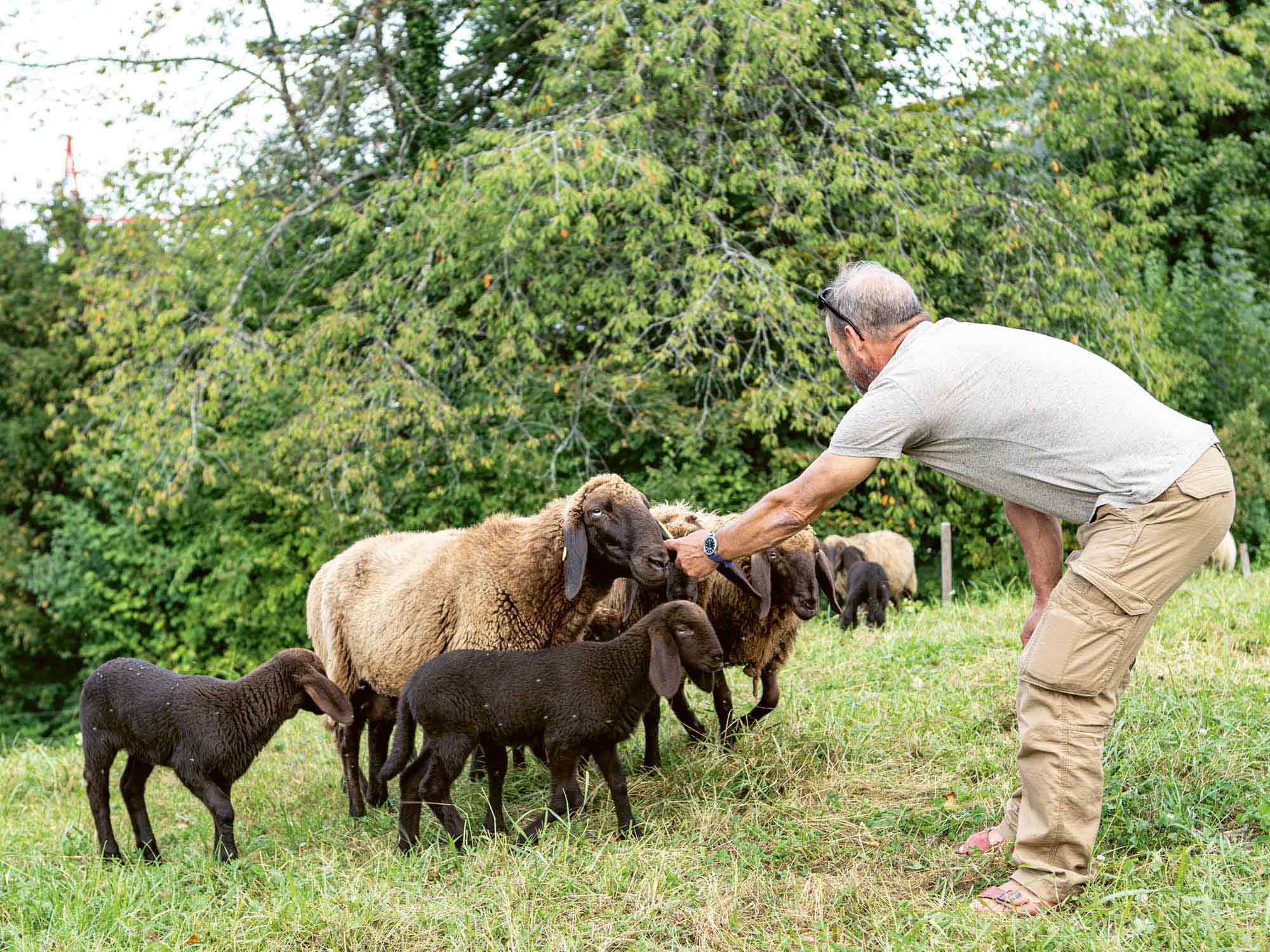
Image Sheep on the Goetheanum Campus. Photo credit: François Croissant.






