


In August, a triad of cosmic events occurs that can be interpreted as a call to unite love and knowledge.
We sometimes speak of the rising sun as “making an appearance.” The sun “reveals itself” in its dignity. What we attribute to our main star also seems to me to apply to the constellation appearing in the eastern morning sky in August. In July, Jupiter frees itself from the sun’s radiance and can then be seen on the northeastern horizon. The second act unfolds two weeks later: the stars of Gemini begin to appear around the bright planet, starting with the brightest ones, Castor and Pollux, and soon after, the entire rectangular-shaped star formation shines forth.
Two Houses in the Zodiac
Only two images in the zodiac can form a starry space around the planets: Gemini and, almost opposite in the sky, Capricorn. The other zodiacal images are either linear and therefore cannot create an inner space, such as Taurus, Aries, or Libra, or they lie outside the ecliptic so that the planets do not pass through their interior, as in the case of Leo and Virgo. It is different with Capricorn and Gemini—when the planets move through their image, the infinite expanse of the cosmos is transformed into a closed space. All of a sudden, the boundlessness in which the planets move becomes a dwelling, and the outside becomes the inside. Astrology speaks of “houses,” the circle of twelve segments, starting from the rising point in the east, that make up the zodiac. In the case of Gemini, we could also speak astronomically of a “house,” as the rectangular image frames the wandering star.
Love and Wisdom, Together
The third act in this constellation concerns Venus. In the second week of August, the morning star Venus also moves into Gemini. What a spectacle, as the two brightest lights—Jupiter and Venus—approach each other day by day! On the 12th of August, the two wanderers, the planet of wisdom and the planet of beauty and love, are united. This conjunction is always a celebration in the night sky. The framework of Gemini gives the union special expressiveness.
It is worth feeling our way into this planetary meeting, because it reflects a fundamental question: How do love and wisdom, heart and head, come together? Whether in the Magi and shepherds traditions of Christianity, or in the hundreds of tales of kingly light and queenly warmth, it is about two sides of human experience: the world and the self. The core question in the myth of Parzival is how to understand suffering—how to unite compassion and knowledge. When I understand, I am inside the situation, just as now, as you read this, the thought goes in and with the lines of text. When I love, the situation, the being to whom my love is directed, is in me. In this way, knowledge and love, Jupiter and Venus, mirror the breathing of our ‘I’ with the world. Knowledge creates distance, love creates closeness. In the interplay of the two, perception becomes understanding, and sympathy becomes love. There may have been times when a clear mind or a warm heart alone were enough to understand oneself and one’s world and to feel at home in it. Today, every question calls us to unite the opposite gestures of love and knowledge, to be near and far at the same time.
Inspiration from the Beginnings
The conjunction of the two brightest planets, Jupiter and Venus, will be joined by two other celestial events. The close proximity of Jupiter and Venus will be visible on August 12th in the early morning, around 5:45 am. Anyone who looks up again in the late evening hours, especially after midnight, will be rewarded with another spectacle: shooting stars darting across the sky. The Perseids meteor shower also reaches its peak on August 12. Every year, the Earth’s path intersects that of the comet Swift-Tuttle, which visits the solar system every 133 years and leaves a trail of dusty cometary debris behind. On August 12th, as the Earth sails through the cometary path, shooting stars flash across the sky almost every minute. This cometary dust burns up in the atmosphere and mixes into the rain, eventually ending up in the food we eat. Something from the furthest reaches of the cosmos comes to us in a very material way. This applies to time as well, because the comet substance originates from the earliest history of planet formation—it did not take part in the condensation of the celestial bodies. The astrophysicist Gustav Tammann called comets the “firstborns.” So, on August 12th, substance from the beginning of time comes to Earth. As ancient as it is, it is still fresh and unspoiled. This might be the inspired power of cometary substance that can be used in a homeopathic remedy such as Ferrum Sidereum (Meteoric Iron).
“All of Heaven Intervenes”
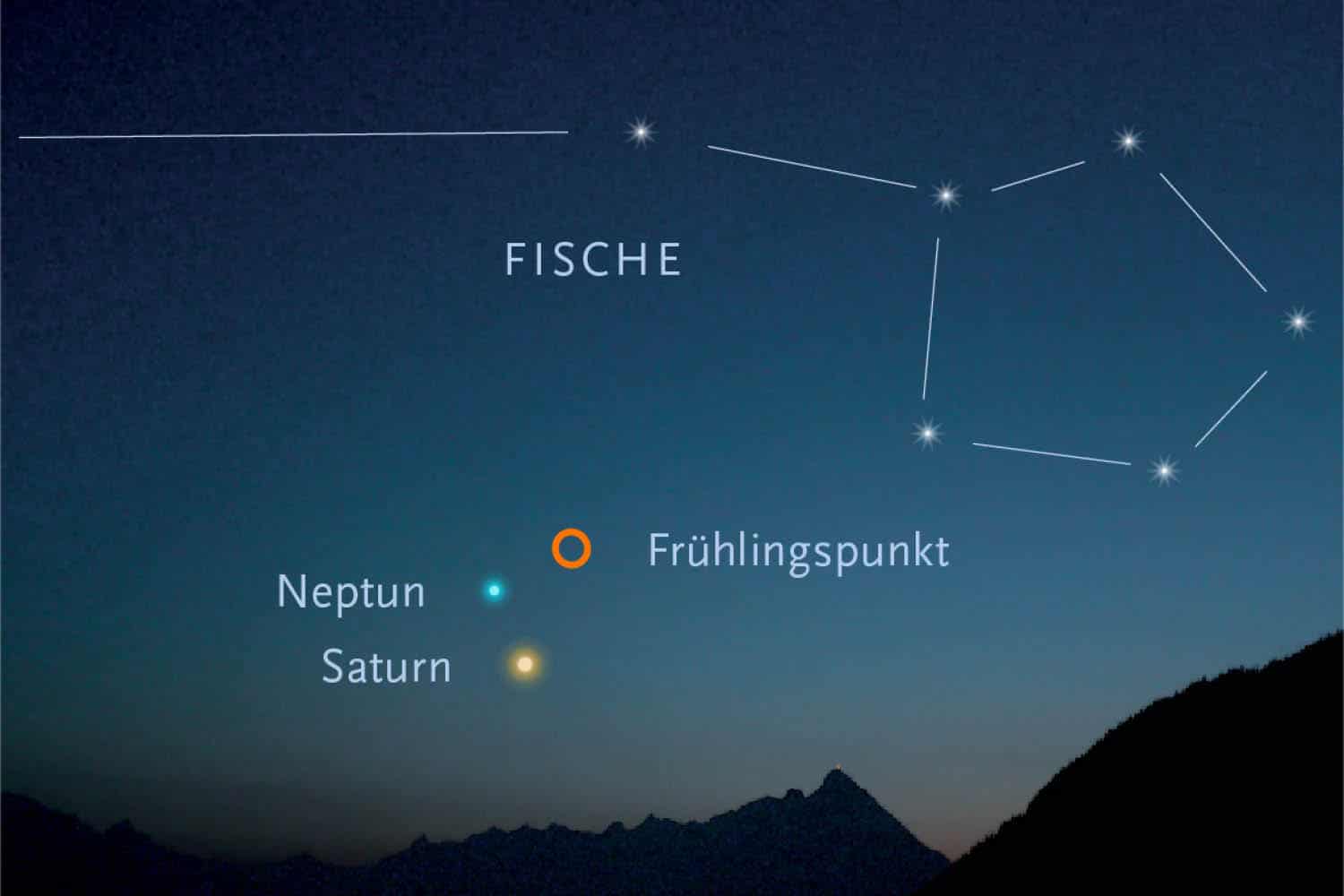
Taken literally, this quote by Goethe’s Faust, when Mephisto invokes a war spell, fits well here. Because in addition to the conjunction of Venus and Jupiter in Gemini and the peak of shooting stars, there is a third celestial event: Neptune, the most distant of the planets, aligns with Saturn. This happens every 36 years, but this time the two come together at the point of the vernal equinox—the place where the Sun stands when it heralds the earthly spring. What does that mean? The vernal equinox is the earthly position of the Sun in the zodiac. When Saturn is there with Neptune, Saturn builds a bridge from Earth via the Sun to Neptune. This constellation seems to take in the whole expanse of the solar system. Just as the comets carry the cosmic expanse to Earth in terms of substance and time, Saturn, a border crosser between the planetary and starry worlds, connects the distant edge of the solar system with Earth—the whole of the heavens gets involved. But in what? I think in the call of Venus and Jupiter: to let love and thinking become one.
See Wolfgang Held, Sternkalender Easter 2025 to Easter 2026, Dornach 2024.
Translation Laura Liska
Image Wolfgang Held






Thank you!!