

Many young people are calling for a different economic model. When communities work together more, this creates fertile ground for change. Andrea Valdinoci (CEO World Goetheanum Association) and Elias Bartel (aspiring entrepreneur) discuss how to counter the profit-driven mindset.
Elias Bartel: Do you remember when I tried currency trading as a teenager? That pyramid scheme promised quick, big money. In the end, all I had was an empty savings account.
Andrea Valdinoci: Pyramid schemes are a good example of an economic system where some individuals become very rich while others remain poor—because that’s how they work. I stand there and deceive others, nature, and ultimately myself, to make money. I can also stand there with the attitude that I want to build trust and trusting relationships. I believe that peaceful coexistence is only possible when we truly care for one another. These are the two worlds. The cliché of the manager who acts coldly in business but is very kind at home just doesn’t hold up. I believe it’s about becoming whole and incorporating a little care for the community into every action.
Are you referring to a positive, associative attitude that can be applied to the whole of life and to social contexts? Is that why you chose “Association and Dissociation” as the title for the next forum?
This is our offer. In the Western world, there is a clear need for greater relationship and emotional competence. As a company, you can use this to identify what your customers will need in one or two years, through a process that is associative, social, and ecologically conscious. Your attitude can be one of genuine care: What do my suppliers need? What do their children need? What do my employees really need? And what does the company need? An attitude that inspires your employees and customers to support one another because it fosters more genuine points of contact and interest.
Do you believe that this kind of attitude has a future in the economic world? That it’s possible to stand up to the profit-driven logic of the commercial, global economy? I’m thinking of the giants of capitalism. It’s easy to get the feeling that change is impossible.
These are, of course, huge topics. At the World Goetheanum Association, we’re working hard on these pictures. And we ask, “What actually defines a sustainable economy for everyone?” It would be a huge improvement if universities didn’t focus solely on capitalism and neocapitalism, but if students, even high school students, were introduced to socialism, communism, and Buddhist-inspired economics—in other words, to a plurality of approaches—they might then create something new. Right now, they’re learning about economics in a very one-sided way. We’re all stuck in this system because, in a sense, we don’t know any better. And it’s not easy to break free from it. But I believe that, first and foremost, it depends much more on one’s own general attitude than on just economic models. How do I deal with others? How can genuine trust develop between people, and what does it take to make that happen? These basic skills are incredibly important. Do you know what I mean?
Yes, I know what you mean. Start right at the very, very beginning, where it’s all about what attitude you want to take toward life in this world and in this society, at the most fundamental level. Where else would you even start?
You asked, “How can we stand up to the really big trends and corporations?” I have great hope in this regard. There are many examples of people coming together to build promising new initiatives, for example, in Sekem, where we held the forum last year. There, you can see that it’s possible to build a farming operation, practically on sand, where two to three thousand people now work. But I also have great hope because of another issue. Back in my youth, there was a boycott of Shell. At the time, Greenpeace had called on people to stop filling up at Shell to prevent them from letting their old, unused oil platforms just sink into the sea. For over two weeks, a huge number of people in Germany stopped filling up at Shell gas stations. The losses were so great that they had to properly dismantle the old platform and clean the components. This shows just how effective we as consumers can be when we approach an issue in a coordinated manner. We underestimate this! If we, as a mass movement, decided that we wouldn’t buy from Amazon for a month, things would very quickly become really difficult for the company. We are much, much more powerful than we think. But the corporations are organized. We, as civil society, however, are hardly organized at all.
Are we, in that sense, individuals—dissociated from one another?
Yes, but it will become increasingly important for us to relearn how to work and manage our affairs through relationships. If you look at politics, where more and more cuts are now being made, it becomes clear: it’s a fallacy to think that money can solve everything. That’s just not so! When I joined the WGA—where our mission is to support, accompany, and help everyone who wants to do things differently as they take new steps toward a different economy—several young people approached us at an assembly. They said, “Well, if you really want to make a difference, then you have to let yourself be open about your own vulnerability.” Only when we practice truly acknowledging our wounds do we enter a space where we can heal and not need to compensate, for example, through consumption. We reach a different level of our being, where we can find a different kind of fulfillment and a different connection to ourselves, to our fellow human beings, and, above all, to nature.
After all, what makes us happy as human beings isn’t buying and accumulating goods, but rather taking a walk with friends in the evening light, and you can do that even in secondhand clothes and just a bottle of water. But this also raises a new question for me: Isn’t it a privilege just to be able to think this way at all? It requires a certain degree of freedom. When trying to envision a sustainable economy for everyone, the issue of the customers’ financial circumstances is very complex. You need customers who can afford and are willing to buy fair-trade products, customers who are interested in paying local farmers fair prices for their produce. How do you ensure that, in the end, it’s not just the wealthy who can purchase your products and be part of a new economy?
Yes, that’s right, this is truly an important issue, and it’s no easy task. I want to mention how extraordinary the partners we have are. Many of them have been working in the mainstream economy for decades and are now trying to do things differently. Actually, we have to be grateful that there are people like this who stick with it, because as the owner of a company on this path of change, you face setbacks time and again, at every level. It’s incredibly complex to try to change everything within this economic system.
That’s a mammoth task.
Exactly. And I hope we can make it happen. We’re trying to be transparent about the small steps we take to show, honestly, “Here, I really did a good job. But I just couldn’t take care of these other areas so well.” Not from mal intent, but because one has to survive, keep their books in order, pay salaries, make compromises. I have the utmost esteem for anyone who tries to make a difference. I see young enterprises that take a different approach from the very beginning, and they also don’t feel the need to broadcast it to the world. They simply show it openly on their website: This is how much a farmer in Mexico gets for a kilo of coffee; this is how much a farm in Spain gets for a kilo of tomatoes. This raises consciousness among customers about what food is actually worth and how it benefits the people at the other end of the supply chain. Through this kind of education, we have the chance to wake up and develop an appreciation for these people and for those who are trying to build these kinds of companies. We can make a conscious choice to buy from them, which, in turn, enables these kinds of initiatives to grow.
Every step in the right direction counts, no matter how small. We try to support this as best we can through our network. As for the question of whether only wealthy people can afford this, there’s one example that always annoys me immensely. It’s when people buy into the narrative that the food industry has been pushing for decades: that organic farming simply can’t feed everyone. Now, finally, a study has been published proving that if everyone practiced organic or biodynamic farming, we could feed at least 15 billion people! And it would actually be much cheaper. Studies from major accounting firms show that conventional agriculture in Germany has a turnover of 40 billion and causes 80 billion in collateral damage through soil degradation, water pollution, and so on. In other words, looking at it this way, it’s simply not honest. We really need to take a close look at whether what we’re doing even makes sense. As a society, we need to be honest and look again.
What does a farmer need to be able to practice organic farming? Do we take the attitude that this operation stands alone and we simply buy from it, or do we need a new kind of community to support it? These questions are quite complex. What would a farm of the future look like? What would need to happen for more young people to take up this rather special profession again? In other words, we have to rethink things anyway; otherwise, at some point, there will be nothing left to eat.
This dialogue can be expanded and leads back to the question of attitude, of association and dissociation. How do we want to build our society of the future? I believe a key lies in reconnecting with one another in regional groups and discussing what we need and what we can do to see where it’s possible to support one another in these necessary steps toward change. And above all, it’s important to be honest about it. When you sense even a glimmer of hope for the future, it becomes much easier to get young people on board. It’s about creating a space where people don’t have to think in traditional ways, where young people can help shape their own future.

Is collaboration in small, regional groups the key to being more flexible and personal? Is decentralization the way to create room to try new things?
Yes. And yet, as a society, we need to make a few major decisions. For example, about 30 years ago, the Stiftung Edith Maryon began buying up land to keep it out of the hands of speculators. This applies to residential land, but especially to agricultural land. Speculating on agricultural land is a losing proposition for everyone in the long run; it literally means that the very basis of our existence follows today’s money logic rather than the logic of what is needed to enable vibrant and healthy processes. I believe we have to make some tough decisions. As a society, there are a few fundamental questions we cannot avoid. If we were to ensure, as a matter of principle, that it is no longer possible to speculate on land, it would no longer be interesting for ordinary investors to get involved in that market.
You mean we should change the fundamentals that give money so much power?
Yes, because otherwise this logic of money, which has taken root in many people’s minds, will destroy nature, our relationships with one another, and ultimately ourselves.
In order for us, as a society, to make such fundamental decisions in a globalized world, it would be important for people to come to this realization at the same time and organize themselves. A great many people would need to gain a deep understanding of these issues and know the vital importance of the necessary changes so that society’s power can unfold. Social media would actually be perfect for this, but I suspect it will still be very difficult.
We’ll have to take action eventually, one way or another. If we don’t take action now, we’ll still have to act later—and under much greater pressure and with much less leeway. It’s easy to fall into a state of passivity. But understanding that you can always do something, even when circumstances seem dire, is very, very important to me. I hope we’re wise enough to bring about change before the pressure becomes overwhelming. My wish is that many young people will get involved with these many initiatives, see what they’re doing, and start new ones of their own. So, there really are some very, very inspiring things happening in the world. Let’s focus on those.
I attended the first World Child Forum in Davos. It was intoxicating to have so many young people from so many countries and continents together in one place. Everyone knew a little English, and we talked and dreamed together about ideas for the future. By the end, everyone was beaming and ready to get started. There was an energy there; I left feeling inspired. I experienced something there firsthand that was very important: We need each other. You can’t do it alone. This energy only arises when you’re part of a community, when you’re a group of people who kindle the flame of hope in one another and pursue a common, or at least a similar, goal. Because that unleashes a tremendous amount of energy.
That sounds like a nice point to end on. It’s about changing our attitude, understanding ourselves more as a community without neglecting our individuality. And then drawing on that to generate the energy we need for major changes in society. It’s a very special feeling in life when you work with a group of people toward a common goal and then experience just how effective you can be, despite incredible resistance. We can all do something. And we actually have to.
To close, could you say a few words about the concepts of association and dissociation? Why did you choose this narrative arc?
Without a doubt, people need both qualities. To put it generally, take the Brothers Grimm fairy tale “Mother Holle.” When the bread cries, “Get me out, or I’ll burn,” the two girls make different decisions. The question is, however, “Are we still able today to hear that cry at all, and if so, to act courageously?” On the economic level, this open and fair dialogue among all stakeholders is the space for listening and seeking a meaningful path that truly includes everyone. There, we can learn together what a real economy can achieve as a social force. In agriculture, this is called “The Round Table.”
Thank you very much for the interview, and I wish you much success!
Translation Joshua Kelberman
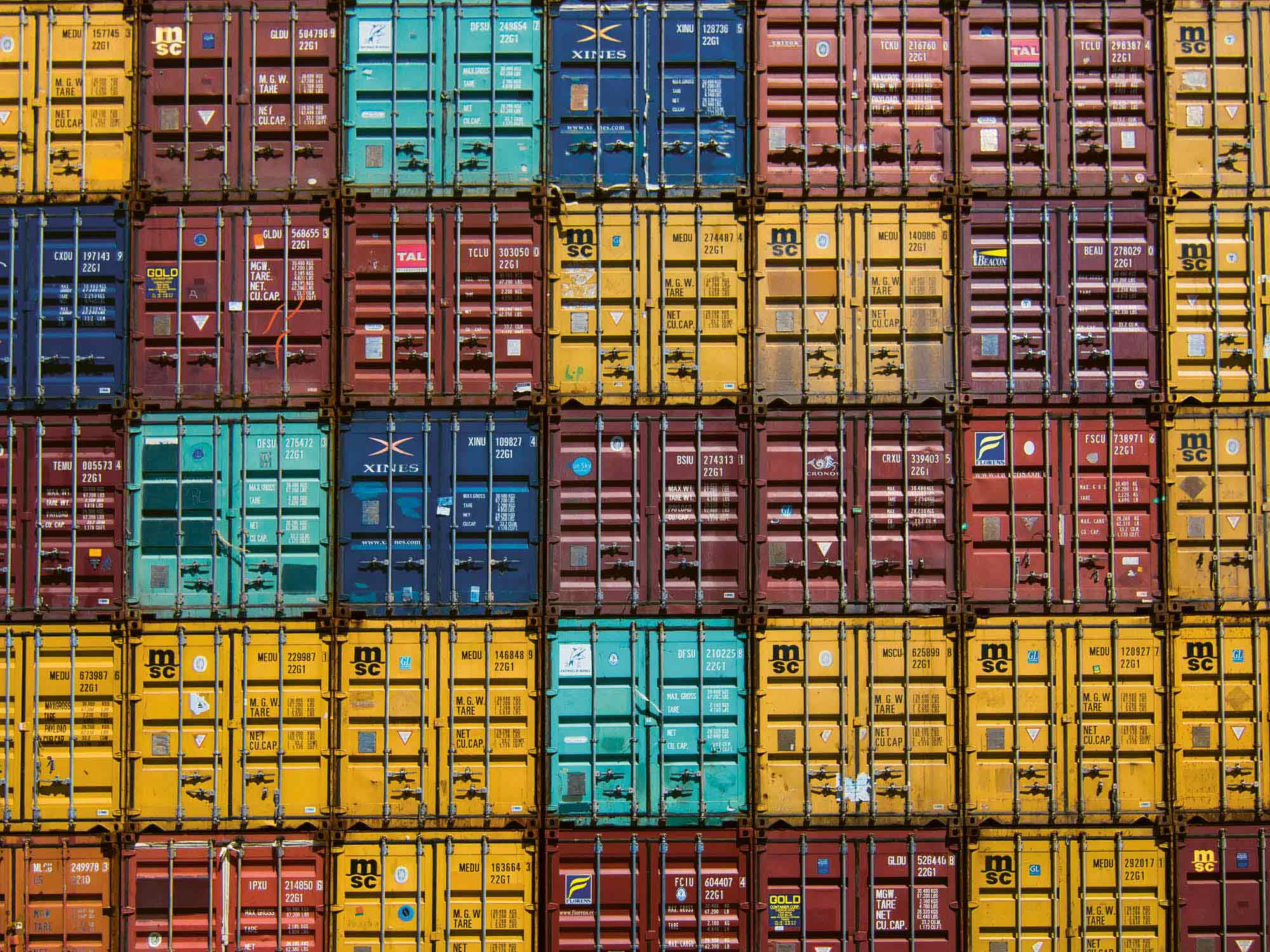
Title image Containers at the port in Montreal, Canada. Photos: Guillaume Bolduc/Unsplash






