

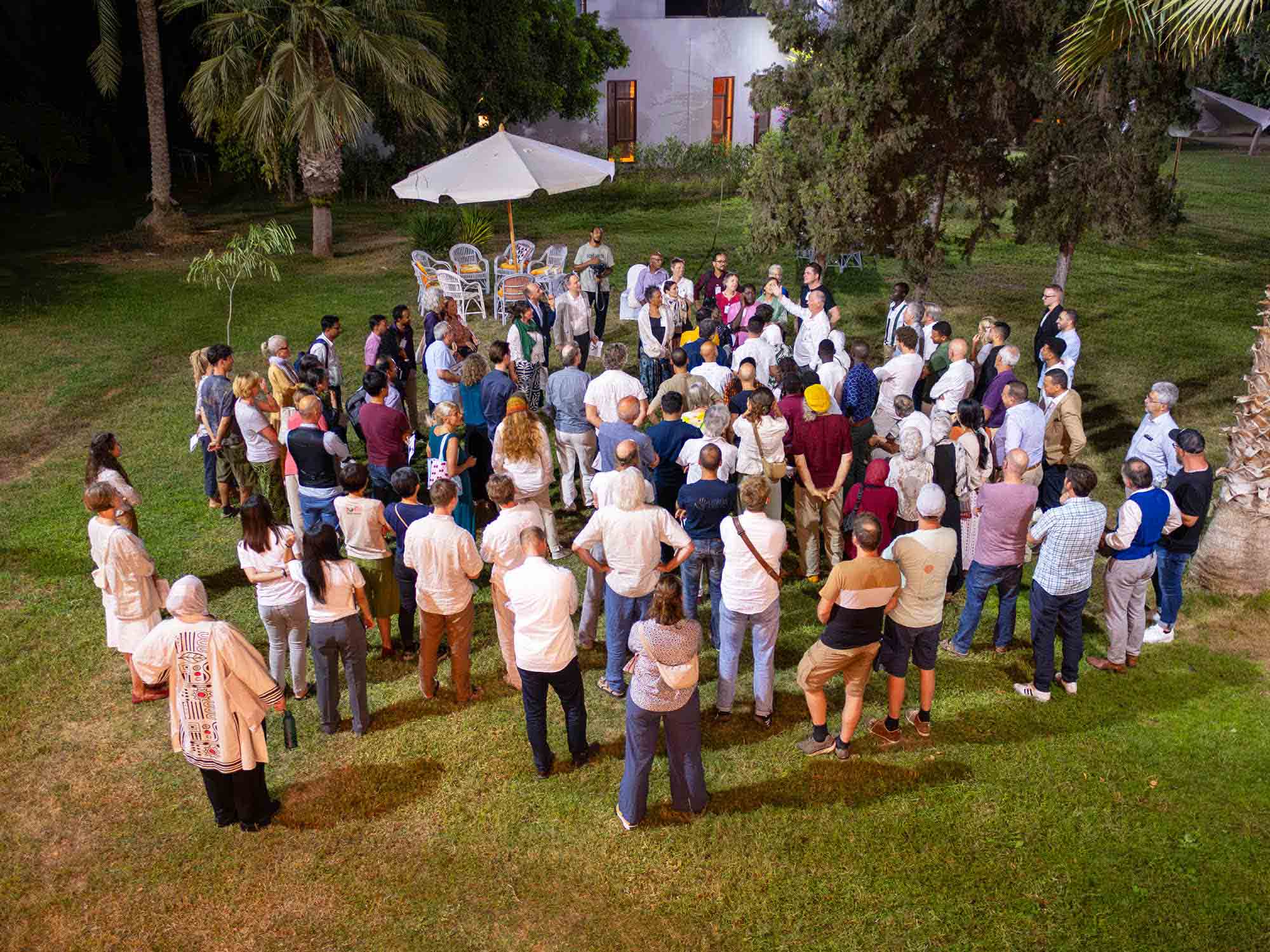
The Sustainable Development for Global Impact (SDGI) conference took place at Heliopolis University immediately prior to the WGA Forum. Participants included professors, scientists, students, politicians, and a range of guests. In line with its parent organization, Sekem, Heliopolis University considers that human development occurs in the cultural sphere. Scientific analysis highlights the necessity of this component. Sekem illustrates it as a living example. Andrea Valdinoci spoke with Naglaa Ahmed, Ahmed Elshazly, and Helmy Abouleish about the scalability of this example.
Does the so-called Global South need a green transformation or not?
Helmy Abouleish: Yes, and I say that not just to relieve my friends in the global North. I believe that sustainable development is something that the Global South needs just as much as the Global North, West, and East. The whole world needs sustainable development. It is not a luxury but a catalyst for greater efficiency, higher productivity, greater profitability, a better life, greater justice, and human and community development as we understand it.
Transformation in the Global South (and probably everywhere in the world) often begins with a seemingly unattainable mission, with new ideas and new initiatives. And in this sense, Ibrahim Abouleish was the first person I know who had these ideas in Egypt. Forty-eight years ago, contrary to all expectations, desert land in Egypt was made arable through biodynamic agriculture. We were able to show that there is no better method for this. All of this was developed systematically. Today, thousands of farmers are part of the Egyptian Association for Biodynamic Agriculture. I think we’ll manage to support 40,000 farmers in the transition to biodynamic agriculture by the end of the year.
Without the Economy of Love (EoL) behind it, we would not be able to use biodynamic raw materials and collaborate with all those responsible in the supply chain so that everyone would be able to develop their potential. With the EoL, everyone can live, everyone can lead a meaningful life with enough security to truly unfold. That would make a miracle possible. The Economy of Love gives everyone, from the farmer to the end consumer, the chance to develop, lead a meaningful life, calculate the true costs, and measure the impact of their actions. It also required us to focus on human development. That was our most important task from the very beginning and remains our most important activity to this day.
How would you describe that, Naglaa? What is the basis for your being able to develop such powerful scalability in regard to agriculture?
Naglaa Ahmed: The continuous development of each individual community member is very important because this major transformation will probably only succeed if it involves society as a whole. We are creating places of shared responsibility. On many levels, we have developed a vision for this process for Sekem and, in a certain sense, also for Egypt in various areas until 2057. In the agricultural sector, it essentially means that the 7 million Egyptian farmers will cultivate their land biodynamically or at least organically. Heliopolis University is and should become a place where we can all educate ourselves on this path. How do you get from a vision to research, prototyping, upscaling, and reaching the tipping point, the critical mass of 20 to 25 percent? We are trying to bring about this systemic change and have built structures to support such a process.
Helmy Abouleish: For us, developing our vision was the turning point. We want to be a center of innovation, a center of excellence for social change, where we as citizens spread ideas and models of sustainable development in society. We want to make it possible for more farms to convert to biodynamic agriculture. We hope that our model will reach the whole of Egyptian society and that every single member of society will come into contact with biodynamic agriculture—with the Economy of Love, integrative health, holistic education, and research.
What do you think is necessary for this transformation to succeed?
Helmy Abouleish: It was crucial for us to understand the true costs of agricultural production. We were very pleased to see that the FAO (Food and Agriculture Organization of the United Nations) published a report in Rome in 2023 that clearly showed that the hidden costs of conventional agriculture and food systems amount to $11.7 trillion per year. By comparison, the global economy is worth $101 trillion. That is 11 percent of the global economy. What does that mean in concrete terms? Every cheap tomato in the consumer price index that costs $1 actually costs $3, and every expensive organic tomato that costs $2 is much cheaper than the very cheap conventional tomato. The FAO has announced this worldwide for two years in a row: organic is more efficient and cheaper. Good to know, but what can we do? No one wants to change prices. No one wants to integrate this. That’s why we were glad that the IPCC [Intergovernmental Panel on Climate Change], another United Nations organization, presented a report in 2019 that essentially said that farmers could potentially sequester 40 or 50 million tons of CO₂. “Conventional agriculture contributes significantly to climate change. A large proportion, 27 percent of emissions, is attributable to agriculture and forestry.” The question is, how to pay them for their ecosystem services? We developed CO₂ certificates and give them to farmers, who in turn can sell them in Egypt to companies that want to improve their carbon footprint. Biodynamic farmers in Egypt can generate about 35 percent of their total income through these certificates and thereby actually sell their products, or tomatoes, for $1. The quality is higher, and the customer is doing something good for the environment.
Naglaa Ahmed: So agriculture is part of the problem, but “organic and biodynamic agriculture have the potential to solve the problem of climate change. Done right, gigatons of CO₂ can be sequestered in soils and trees.” This gave rise to the idea of emission certificates for our long-standing Economy of Love program. Together with Heliopolis University, we have developed methods for measuring CO₂ emissions in soils, trees, etc. After prototyping in Egypt, we developed a calculation that is essentially in line with the IPCC. Our 7 million Egyptian farmers emit 20 million tons of CO₂. This cooperation with the nearly 40,000 farmers today, which we want to expand to 250,000 in the coming years.
Helmy Abouleish: Once we have achieved this—and there are still many steps to take, and we’ll continue to rely on strong outside support—we’d like to invite you back here to a conference to see whether the system change has been successful. Even today, in India, where more than 150,000 biodynamic farmers are active, and also in Kenya, with over 10,000 biodynamic farmers, we can see the impact this is having on families, communities, and the Earth.
You’ve already achieved a great deal and continue to pursue ambitious goals. How did the focus on scalability and dissemination of biodynamic agriculture come about?
Ahmed Elshazly: We can only achieve the vision anchored in the Economy of Love by these methods. At the same time, our expertise and the substance we’ve created give us a responsibility to continue working on this. But it takes a lot to follow this path—above all, our creativity, our judgment, and our values—to ensure that it can succeed. One of the most powerful messages repeated throughout yesterday’s and today’s events at the Forum was that sustainable development does not mean sacrifice. It’s about moving forward together. It’s not about restriction but about redistribution; not about limitation but about unleashing potential, possibilities, and imagination. We were called upon to give young people a seat at the table, to build intergenerational trust, and to show the world that sustainable development is not a loss but a gain in meaning, in quality of life, and in the joy of being connected to the Earth and to each other. So what happens next? We take what has been presented and developed here and bring it back to our laboratories, classrooms, farms, ministries, and boardrooms. We’ll try to translate research findings into national policies, workshop lectures into start-ups, and conference discussions into cross-sector collaborations. We want to transform institutions, but also the culture they need to support transdisciplinary, transformative, and truly inclusive innovation. This is not the end of our commitment to sustainable development goals with global impact. It’s the first step in an ongoing, vibrant process of renewal, experimentation, and impact. We look forward to revisiting the narrative of sustainable development with our partners and friends from around the world in the coming days at the WGA Forum in Sekem.
Contacts Naglaa Ahmed: naglaa.ahmed@ebdaegypt.org, Ahmed Elshazly: ahmed.elshazly@hu.edu.eg, Helmy Abouleish: helmy.abouleish@sekem.com
Translation Joshua Kelberman
Image Getting to know each other in the evening. Photo: Samuel Knaus






