

Nature is in full bloom, so the bees are also celebrating! We need their work to make it possible for nature to bloom again. With our sincere gratitude, we dedicate two articles to our hard-working and generous fellow creatures.
“The bee’s life is like a magic well: the more you draw from it, the more it fills with water.”1 These words from Nobel Prize winner Karl von Frisch, discoverer of the dance language of bees, are absolutely true. Since I started beekeeping some thirty years ago, every time I’m with the bees, I’m deeply touched in a new way by the magic they bestow. I’ve supervised many research projects with bees over the years. But it’s not only questions about their colonies that fascinate me; much more, it’s the aesthetics and harmony that seem to envelop me during the process of extracting the honeycombs. I’m completely immersed in their world, forgetting time and all that’s happening around me. It’s not a spell but a story about friendship.
For me, this story was only made possible with the help of Rudolf Steiner’s thoughts and images. I know other beekeepers who share my feelings for their colonies, but sometimes, they seem to lack a certain depth that Steiner was able to open up for me. For example, when he tells the workers at the Goetheanum that the bee colony is a “head without a skull,” I can literally sense this vulnerability. When he relates the hexagonal cells that bees build with incredible precision and care to the crystals of rocks and the formative forces of silica, a substance of light, I experience something of the essence of light and its polarity, “pitch black.” Isn’t it magical that freshly built honeycombs are as white as snow? According to Steiner, they’re the skeleton of the bee colony, without which it wouldn’t survive. When I then read how Steiner describes the queen as the organ of unity, as the heart of the bee colony or the hive, and I again meet her in her work, I sense a gentle warmth in the region of my own heart. To put it more poetically: drawing from the magic well fills and refreshes my soul and inner life.
Becoming Science
In 1923, Rudolf Steiner gave eight lectures to the workers at the Goetheanum on the nature of bees.2 It had been a dramatic year. The Johannes Building [the Goetheanum] was destroyed by arson; the Anthroposophical Society was in danger of stagnating and called for a complete renewal; and there was not just a slight headwind blowing within and without—a violent storm was raging. It all makes the light and cheerful mood found in his bee lectures even more astonishing. When Marie Steiner decided it was important to publish the workers’ lectures (even though Steiner initially didn’t even want them written down), she wrote in the preface about where this lightness may have come from: her husband confided in her that he intended to introduce the workers to the new “science of becoming,” as a contrast to academic science (which to this day continues to work only on what has already become). This new science has two special qualities. The first is to understand that every form and every shape arises through processes, through formative forces that are invisible and therefore usually overlooked. Steiner indicated what the painter Paul Klee later sketched out as his way of working: “I’m more interested in the formative than in the ends of form.”3
The second quality is actually a provocation, presented to the audience without pathos. Steiner summarizes its essence using the example of bees: “So, one has to say that bee life must be studied with the soul.”4 Imagine if such an indication were to appear in laboratory journals and manuals on biological methods. There would be a storm of indignation. Steiner explained this idea by pointing out how in the beehive, only the queen exhausts her love in sexuality and reproduction, while all her daughters, the worker bees, renounce sexuality, although they do possess reproductive organs. The beehive is permeated through and through with love. This quality of bee life cannot be understood solely through rational observation. One must make use of the perceptions of the soul, such as feelings and inward sensations, to discover this knowledge. The processes of becoming are invisible to the physical senses. They first disclose themselves to the soul and then to the spirit. What emerges in me as a mood or image may also appear in the world of the senses, but it is always an open question of how or who or where, etc.
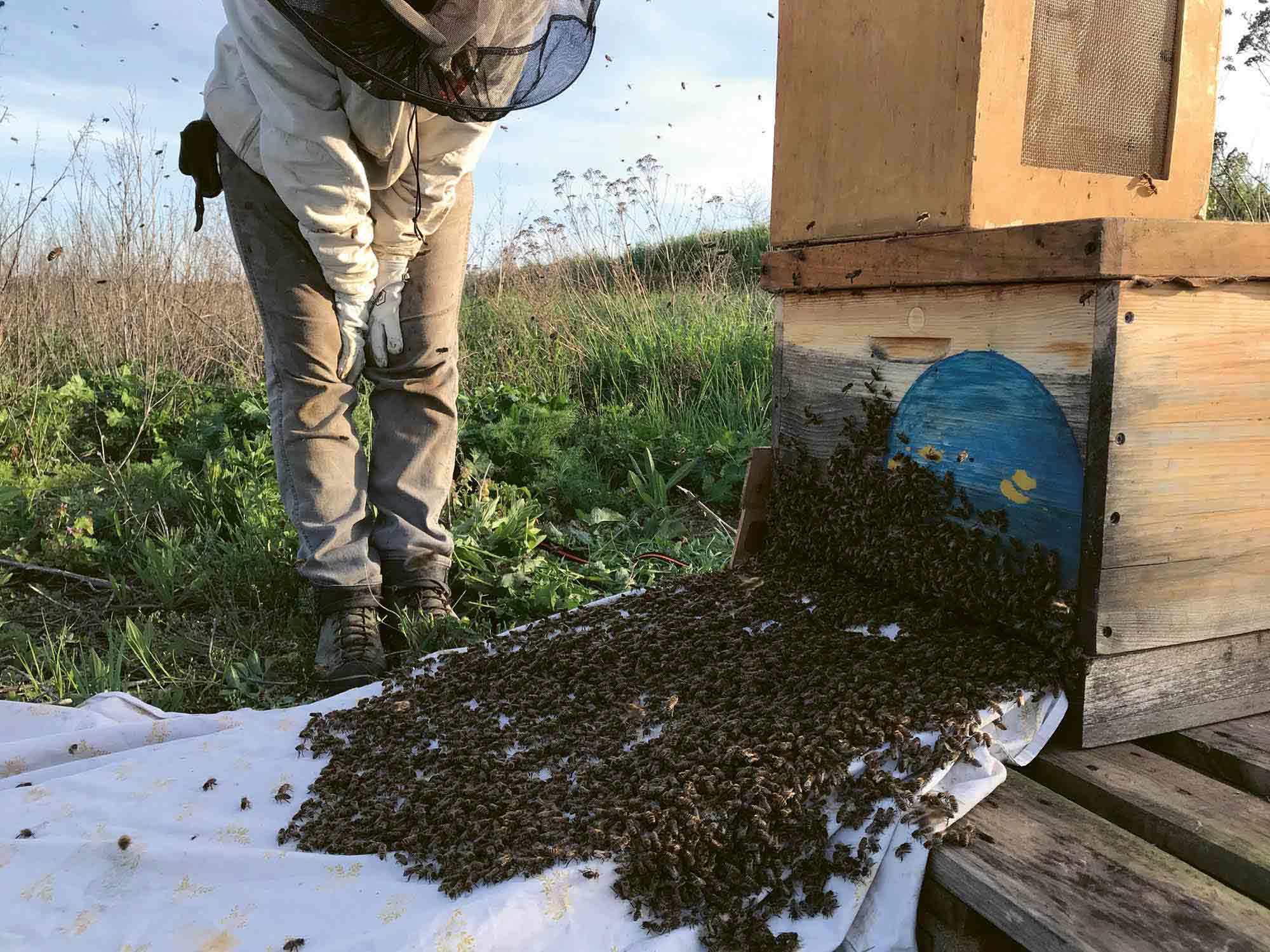
Last spring, I caught and provided many swarms with a new home. I also formed some swarms myself before the capping of the first queen cell and the so-called queen splits afterwards. In the days that follow, a new young queen hatches. She matures for a few days, then she is ready for her nuptial flight. After she returns home, she starts laying eggs, and a young colony is born. This new unit will behave like a real swarm, and the bees will build honeycombs, maintain a brood nest, collect pollen and nectar, and store provisions for the coming winter.
Whether this happens or not depends upon many variables. The swarm may leave the home I prepared for it for unknown reasons. Or the young queen may not return from her nuptial flight, or she may not live very long because the weather during her nuptial flight was too cold and rainy. It’s just like in our own lives: even with the best motivations and intentions, some actions just can’t be carried out because the world that’s supposed to undergo some change or transformation as a result of our actions will not allow them to occur in the first place—or only allows them too early or too late. More is possible in spirit than can be realized in the sensory world!
Bee and Human Communities
This also applies, of course, to prophecies or “images,” as I prefer to call them, in the way I assume Rudolf Steiner must have experienced his predictions, like the threefolding of the social organism and the “birth” of the Michaelic age. He believed that if only forty people could truly think the idea of the social organism, it could be realized in the world. Or if a similar number of members would think and act in a “Michaelic” way, the Michaelic age could unfold in our time. Neither has happened. Whether this is due to idleness, inability, or insufficient work in rigorous thinking and meditation remains to be seen. Steiner also gave a similar image in regard to bees. He was convinced that the bee colony is an image, a metaphor for our future social communities.
What characterizes the social life of a bee colony? They live on the basis of love and work on the basis of trust. An older sister bee never checks whether her younger sister is doing things correctly. They are unconditionally committed to sharing, and they always decide together on the central task of finding the best possible home. In doing so, they avoid the vexing problem of unanimity and proceed according to a quorum decision: if seventy percent of all bees involved in the process decide on an option in their search for a new home, the swarm moves in that direction. The social community of the future, and thus the survival of humanity, needs love, trust, sisterhood, and respect. In humans, these abilities need to be developed through free choice. I am convinced that they would give wings to the members of all communities!
There is also a dimension of depth here. Rudolf Steiner told the workers that the swarming process of bees is actually a dying process. Strange. For us humans, it is one of the most beautiful and happiest things we can experience. Perhaps the paradox encourages us to concern ourselves not only with dying but also with birth. Bees, as sun beings, are only guests upon the Earth; their true home is the sun. In their main task, the pollination of flowering plants, they connect the cosmically invisible above with the earthly visible below—and thus they ensure the continuing life of the world of plants. When the plant dies after pollination, it produces seeds wherein a new, small plant is already living, invisibly, and calling to begin its process of development. For us humans, the Earth is our home. Unlike bees, our task is to connect our beloved planet from below to the cosmos above, so as to preserve and nurture the seeds of spiritual life that are alive in human beings. This is the second dimension of Steiner’s call: become like the bees.
Translation Joshua Kelberman
Photo Gilda Bartel

Footnotes
- Karl von Frisch, Bees: Their Vision, Chemical Senses, and Language (Ithaca, NY: Cornell University Press, 1950); Die Bienen: Ihre chemischen Sinne, ihr Farbensinn und ihre Sprache [Bees: Their chemical senses, their color sense, and their language] (Berlin: Springer, 1949).
- Rudolf Steiner, Bees, CW 351 (Great Barrington, MA: Anthroposophic Press, 1998), lectures in Dornach from Nov. 26–Dec. 22, 1923, and Feb. 3, 1923.
- This is a common quotation with no known source. It may be a paraphrase of the following: “Here, it is beneficial to first focus on the functions and not on the finished form” [Heilsam ist hier der Zwang, sich zunächst mit den Funktionen zu befassen und zunächst nicht mit der fertigen Form], in Paul Klee, “Exakte Versuche im Bereich der Kunst” [Exact experiments in the realm of art], Bauhaus: Zeitschrift für Gestaltung [Journal of design] 2, no. 2/3 (1928), p. 17; see Paul Klee, Creative Confession and Other Writings (London: Tate, 2013), p. 18.
- See footnote 2, lecture on Feb. 3, 1923.





