

The most significant change in human history was the transition from a hunter-gatherer culture to agriculture. Archaeologist Gordon Childe refers to this upheaval in the way of life as the ‘Neolithic Revolution.’ Humans stopped taking lives and began cultivating them: domesticating sheep and then goats, and growing wheat and spelt. We domesticated life. In terms of our lives, we became sedentary, but what about our minds? We gather the wisdom of the ancestors and spirits who lived before us and hunt down ideas and solutions to problems. “We stand on the shoulders of giants,” Bernard of Chartres noted almost 1,000 years ago, and after him, many others, such as Isaac Newton, have said the same thing. We are hunters and gatherers of the spirit. Where we hunt and gather, we sit on the shoulders of Kant and Steiner, of Buddha and Jesus, and we are wise and far-sighted because we have their knowledge and abilities.
Now we are building machines that are far better at hunting and gathering than we are. Instead of looking for good words and sentences, they take in the entire past at once and then hunt down the best from this incomprehensible collection. Artificial intelligence (AI) is the ultimate gatherer and hunter of thoughts. Currently, it still makes mistakes; it hallucinates, as AI scientists and developers describe it. But because the development of AI is exponential, these missed shots by the AI hunter will likely soon disappear. At that point, it will become a little silly for us to continue playing hunter and gatherer.
Let’s settle down—spiritually! Just as hunters and gatherers 12,000 years ago—first in Göbekli Tepe and later throughout the Middle East—domesticated sheep and goats, cultivated fields, built hearths, and took life into their own hands, we too must settle spiritually. We must tame the spirit; we must take spirit in our own hands. This cannot be achieved by hunting and gathering, but calls for the creative spirit in all of us. Hunting and gathering the spirit is different from cultivating it, as a gardener would, or domesticating it, as a farmer would. I suspect that we have yet to fully grasp the profundity of this difference. Those who hunt and gather the spirit have it outside themselves. Those who cultivate and nurture it have it within themselves.
“Free from what? Free for what?” seems to be the slogan for the advent of new technology. Whether cars or telephones, the internet or airplanes—every new technology liberated us from something and for something. If we are too lazy to take up the “for,” cars become a source of unhealthy lack of exercise, the internet becomes a source of loneliness and alienation from nature, and the technology that was supposed to liberate us becomes a shackle. If we enthusiastically take up the “for,” airplanes become a source of worldliness, and the internet becomes a source of education and new encounters. If AI is the new hunter-gatherer, then the call—much like during the Neolithic Revolution when we domesticated plants and animals—is to give the spirit a home with the digital revolution. How can this be done? By finding it within ourselves, by no longer being satisfied with hunting and gathering—by becoming creators. AI gives us the gift of the presence of old knowledge, and the spirit within us gives us the gift of the presence of future knowledge and experience when we transform from hunter-gatherers to gardeners and farmers. Let us stop chasing the spirit, stop trying to collect old spirit, and learn to cultivate it instead, like artists teach us. Then the division of labor between the mechanical hunting and gathering of ideas and the human generation and creation of ideas will succeed. Let us become spiritually settled!
Translation Laura Liska
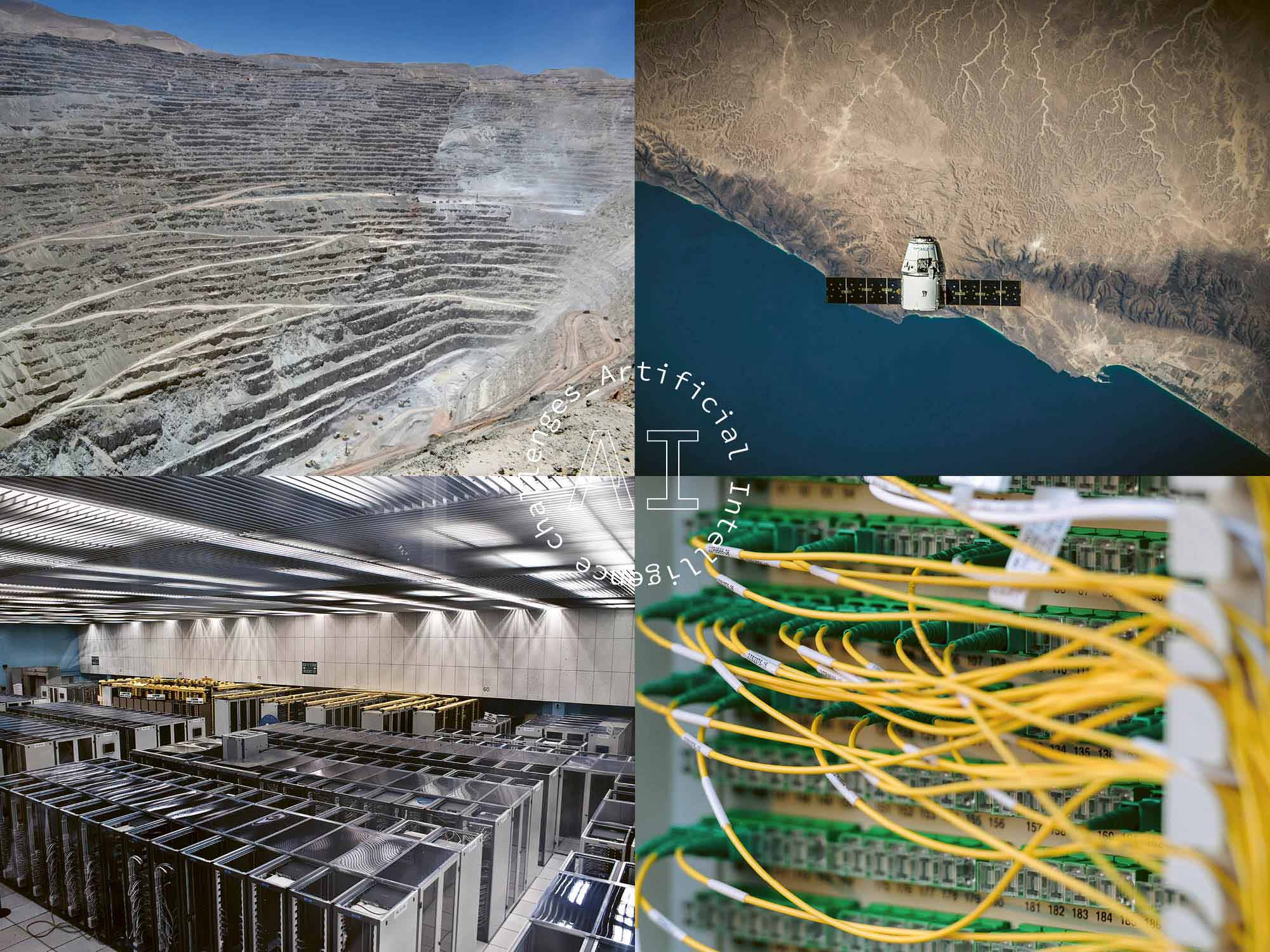
Image We are drilling deeper into the Earth’s crust and leaving our planet, both with and for artificial intelligence (AI). We humans remain at the center. With the selection of images for our AI focus, we ask: What is the body of artificial intelligence? Top left: one of the world’s largest copper mines in Chuquicamata, Chile (photo: Bruna Fiscuk). Copper has high conductivity and is used in cables for power supply and data transmission. Top right: SpaceX satellite (photo: SpaceX). Bottom left: CERN data center in Bern, Switzerland (photo: Florian Hirzinger). Bottom right: Fiber optic connections in a server room (photo: Albert Stoynov/Unsplash).






Laura Liska: ”Let us stop chasing the spirit…as artists teach us to.” The sentence begins with a metaphor, and closes as a statement, not a metaphor. I believe, but of course it depends on the German form as well.
being “settled down” is a wonderful suggestion .. but the constant noise frequency volume etc creates an hypnotic buzz that is hard for human minds to resist .. especially youthful ones! unless the counter current of SILENCE becomes more prevalent we could drown ..
excellent article Dr Held and translation Laura !