


Marginalia on Rudolf Steiner’s Life and Work No. 37.
After months of isolation in Weimar, in 1891, Rudolf Steiner found someone who understood him: Pastor Max Christlieb. But when they met again in 1906, their once-intimate soul connection had grown distant.
During his first months in Weimar, Rudolf Steiner felt lonely because he had no one with whom he could discuss his deeper concerns. He missed the conversations he’d enjoyed in Vienna with Rosa Mayreder, Pauline Specht, and Friedrich Eckstein. He also soon realized that the type of publication planned for the Weimar Goethe edition did not correspond at all with his own concerns and interests. In May 1891, however, a week of celebrations was held in Weimar to mark the 100th anniversary of Goethe’s taking up the directorship of the theater. It attracted a large number of visitors and brought “some life to the city,”1 and Rudolf Steiner experienced his most beautiful days in Weimar to date.2 He met old acquaintances from Vienna and made new friends.
The most significant encounter for him was with Max Christlieb (1862–1914), who was almost the same age: “I was delighted when, at the Goethe Festival, I finally found someone—after eight months—who understood my entire tragic situation here in Weimar. A Württemberg pastor—who further had attended Tübingen Stift3 and thus acquired the high intellectual abilities that Germans in better times still valued—introduced himself to me at the Goethe dinner and more and more revealed himself to be someone who followed and understood my ideas.”4
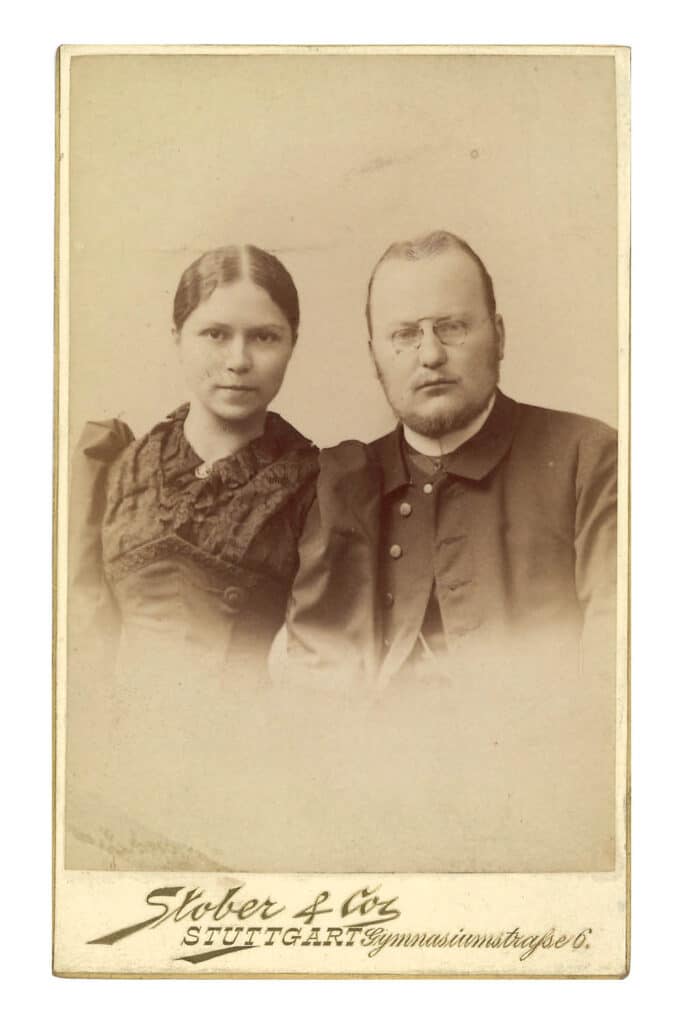
née Donndorf, ca. 1891 © Rudolf Steiner Archive Dornach
Christlieb—married to Käthe Donndorf, the daughter of the sculptor Adolf von Donndorf—was a pastor in Wenkheim, Baden, at the time, but was aiming for a doctorate at the University of Leipzig in order to then go to Japan “for a kind of missionary service.”5
Christlieb had come across Rudolf Steiner’s writings, had “read everything thoroughly”—and was enthusiastic about them. As Rudolf Steiner later wrote in The Course of My Life, the young theologian understood “how to live in the spirit, how to live in pure ideas, and—since the whole of nature must light up as knowledge in the world of pure ideas—how in all matter, we have only appearance (illusion) before us, how through ideas all physical Being discloses itself as spirit. It was deeply satisfying for me to find in a personality such a near-perfect understanding of spiritual beingness. It was an understanding of Spirit-Being in the ideal.”6
Thus, the men became close friends at their first meeting and began a correspondence, of which, however, only Christlieb’s letters remain.7 In Rudolf Steiner, he experienced “a personality who expresses thoughts in such perfectly simple, transparent speech—the depth of which I hope to be able to grasp completely; thoughts that correspond to everything in me that struggles for clarity, that are still the key to Goethe’s views, which I hold in reverence as the highest; thoughts which I must confess I am eternally incapable of grasping so deeply and expressing so clearly on my own—you cannot form any conception of how much the thought of such a personality must have lived in my soul. For as I imagine you, you have never needed to make use of outside thoughts for your own development; rather, your spirit works strictly synthetically and follows its own course toward or away from ideas, and you work through outside thoughts only as a marginal trim of your cloth in relation to your own [thoughts], which admittedly no one ought to go without. [. . .] Your spirit is like a wellspring that bursts forth from inexhaustible depths, while mine is like a clear lake in which the world is mirrored. Therefore, allow me to channel the stream of your thoughts into and through my lake, thereby deepening it and giving it your unique movement and direction.”8
In his letter of November 11, 1891, Christlieb confesses that there are “not too many things in the world” that “could make me as happy as you have by calling me your ‘friend.’”
The World and Back
Christlieb completed his dissertation in the summer of 18929 and then set off for Japan. He planned to promote Rudolf Steiner’s ideas about Goethe there: “The Steinerian philosophy (or should I say the Steinerian school?) has thus conquered at least one chair, even if it is still a little far away, though distances have ceased to exist. Seriously, give me a place to stand, and I will lift the materialism of the Japanese from its hinges when I have your thoughts as the lever—I will then add my two cents and thus be of the greatest use. [. . .] I do represent your thoughts with a feeling of complete independence; it is as if they were my own, because I recognize them as the only ones that correspond to my nature.”
He wrote this from London on August 12, 1892—his last known letter to Rudolf Steiner. But his mother informed Steiner that the couple had arrived safely in Tokyo in October 1892. Christlieb worked there as a missionary for the General Evangelical Protestant Missionary Society [Allgemeinen Evangelisch-Protestantischen Missionsvereins], as a teacher of philosophy and theology at the Society’s school, and as a pastor for the German community.
Seven years later, the family returned to Germany, and Christlieb took up a parish post in Freistett near Kehl. But, in 1905, he left the ministry and, after passing the librarian’s exam, became a research assistant at the university library in Marburg. For a time, he was also editor of the journal Christliche Welt [Christian world] and ultimately went to work as an assistant librarian at the Königliche Bibliothek [Royal library] in Berlin. According to indications from family members, his departure from the church was not voluntary. His sister-in-law, Fifi Donndorf (1880–1953)—a member of the Christian Community—wrote to Emil Bock:
“As for my brother-in-law, I cannot refrain from giving you an indication of his enigmatic character, so to speak, lifting a veil that concealed the undercurrents of his life. Favored by destiny, with extraordinarily talented abilities, the finest sensitivity to spiritual values, and an exceptional memory—all of this together promised great things. However, he was confronted with a demonic power that repeatedly dragged him down and ultimately destroyed him. [. . .] The whole of human tragedy could overwhelm you when you saw his spiritual forces succumb to evil.”
Christlieb thus led a kind of “double life”10 with many affairs, which was difficult for his wife to bear.
In 1905, Ludwig Kleeberg (1885–1972), a philology student interested in theosophy, met Christlieb in Marburg and was questioned by him about theosophy, which the now former theologian had criticized. Christlieb told the student “how he had known Rudolf Steiner personally and had often visited him in Weimar,” but Steiner had “greatly disappointed him with his statement on Haeckel.11 Still, this didn’t prevent him from admiring Rudolf Steiner and calling him ingenious on more than one occasion. He asked me to convey his regards to Rudolf Steiner. [. . .] We met often and talked about Rudolf Steiner. But the sacrificium intellectus that Steiner had made when he swung over to mysticism always seemed incomprehensible to him.”12
Reunion
When Rudolf Steiner came to Marburg on January 20, 1906, to give a lecture on “The Concept of the Spirit in German Philosophy,” there was a reunion of old friends after 14 years. Christlieb and Kleeberg picked Steiner up together at the train station. A conversation about theosophy ensued in Christlieb’s study. The theologian criticized above all that “the English theosophists placed Jesus 105 years earlier [. . .]. In reality, according to Rudolf Steiner, Jesus Christ lived in the time we have assigned to him.”13 The three of them then visited St. Elizabeth’s Church and the castle:
“Christlieb was tireless in his questions, and Rudolf Steiner answered just as tirelessly. Christlieb asked about the written sources. Rudolf Steiner showed him that much could be achieved through the expansion of knowledge—that some things had been written down, though symbolically—and that even more had been preserved in tradition. Thus, what Kant suddenly put forward in 1755 about the planetary system was based on a Rosicrucian tradition, as was Descartes’ teaching on the pineal gland.”14
Rudolf Steiner later recounted this conversation in a lecture: “We talked about how the true concept of Christ has been increasingly lost in modern theology [. . .]. Then this well-traveled Protestant theologian, who’d seen something of the world, said to me: ‘Yes, our younger theologians no longer really have Christ; they could no longer call themselves Christians or followers of Christ. If the name were not already taken, they would actually have to call themselves Jesuits, because they only have Jesus!’ That’s not my opinion, but one that came from the mind of a well-traveled Protestant theologian.”15
Max Christlieb then came to the lecture. Rudolf Steiner told Marie von Sivers about the meeting in a letter dated January 25, 1906: “He showed me a review of Esoteric Christianity by A. Besant, which he’d written for a Protestant church journal. His review concludes with the charming words, ‘It seems to me that the old woman is talking in her fever.’ That is the judgment of a liberal Protestant scholar who, moreover, translates Trine16 into German. He seems to have gained slightly better conceptions of theosophy through the Marburg lecture.”17
“I often spoke with Max Christlieb about Steiner,” reports Ludwig Kleeberg, “who was unable to detach himself from him as a scientific and human problem.” He lent Christlieb the book Theosophie [Theosophy, CW 9], about which Christlieb expressed his “satisfaction.” “But he refused to accept that the colors of the aura were real colors; he believed that only those colors produced on the corporeal retina could be called colors [. . .]. Christlieb also felt that “The Path of Knowledge,” [CW 9, part IV] was not clearly enough defined. [. . .] [But Christlieb’s] criticism of Rudolf Steiner’s lecture “Erziehungsfragen” [Educational questions] in Lucifer was downright devastating. He constantly described the theosophical explanations of the Bible as contrived and artificial [. . .].”18
In 1906, Rudolf Steiner told Ludwig Kleeberg that “Christlieb has no idea how close he is to theosophy”19; a year later, though, he said, “Dr. Christlieb will not come to theosophy.”20
In 1914, Christlieb died of a stroke in the Berlin underground. Two years later, Rudolf Steiner mentioned him in a lecture: “I knew a very dear person—he died recently here in Berlin—who, when I first published the writings I’d devoted to an interpretation of Goethe, was enthusiastic about them at the time. Then he grew older, and now—you can see from this that his enthusiasm was only a flash in the pan—he has recently translated a whole lot of these kinds of gushy soul works [. . .] by Ralph Waldo Trine [and] others from American English into German.”21
This had already struck Rudolf Steiner as strange at the meeting in Marburg, as is evident from his letter to Marie von Sivers. Through his translations, Christlieb had championed Trine’s “mystical babble,” which, “compared to what exists in the Central European spiritual substance,” was only “an egoistic soul-striving for inner well-being, not for a real spiritual upswing.”22
Translation Joshua Kelberman

Footnotes
- Rudolf Steiner to Richard Specht, May 20, 1891, in Sämtliche Briefe [Collected letters], vol. 2, GA 38/2 (Basel: Rudolf Steiner Verlag, 2023), 214.
- Rudolf Steiner to Helene Richter, June 19, 1891, in ibid., 228.
- “A Protestant theological seminary founded in 1560 and housed in a former Augustinian monastery. Among famous alumni were Hauff, Hegel, Hölderlin, Mörike, Schelling, and the astronomer Johannes Kepler. It is associated with the University of Tübingen, founded in 1477,” “Tübinger Stift,” Oxford Reference; accessed 14 Jan. 2026; cf. Das Evangelische Stift Tübingen.
- Rudolf Steiner to Rosa Mayreder, May 20, 1891, in ibid., 219.
- Rudolf Steiner, Autobiography: Chapters in the Course of My Life, CW 28 (Great Barrington, MA: SteinerBooks, 2006), 155.
- Ibid.
- In the Rudolf Steiner Archive, Dornach, RSA 086.
- Max Christlieb to Rudolf Steiner, June 8, 1891, RSA 086. Only in his stance on Christianity did Christlieb see “the only thing on which I seem to disagree with you” (Max Christlieb to Rudolf Steiner, September 24, 1891).
- In a letter dated August 12, 1891, Max Christlieb reports that he took his doctoral examination on August 4; however, his doctoral thesis is not listed in the Jahresverzeichnissen der an den deutschen Universitäten erschienen Schriften [Annual directories of publications at German Universities] for either 1891/92 or 1892/93.
- Fifi Donndorf to Emil Bock, December 20, 1948, Nachlass Bock, Zentralarchiv der Christengemeinschaft, Berlin [Bock estate, Central Archives of the Christian Community].
- Rudolf Steiner, “Haeckel and His Opponents,” in Two Essays on Haeckel (London: Rudolf Steiner Publishing, 1930).
- Ludwig Kleeberg, Wege und Worte. Erinnerungen an Rudolf Steiner aus Tagebüchern und Briefen [Paths and words: Memories of Rudolf Steiner from diaries and letters]. 2nd edn. (Stuttgart: Mellinger, 1961), 77.
- Elsewhere, Ludwig Kleeberg adds, “Incidentally, the event just reported is instructive because it proves that Steiner had been preoccupied with a question long before he spoke about it publicly, i.e., only when the time had come to talk about it. The research on Jeshu ben Pandira was already being discussed in Max Christlieb’s study in 1906.” (Ludwig Kleeberg, “Rudolf Steiner: Wie er als Mensch war” [What he was like as a person], Blätter für Anthroposophie und Mitteilungen aus der anthroposophischen Bewegung [Pages for anthroposophy and communications from the anthroposophical movement], no. 2 (1956): 64.)
- See footnote 11, p. 93.
- Rudolf Steiner, Polarities in the Evolution of Humanity, CW 197 (Forest Row, East Sussex: Rudolf Steiner Press, 2022), lecture in Stuttgart, Sept. 21, 1920.
- Ralph Waldo Trine (1866–1958) was a popular American writer at the time and a representative of the New Thought Movement, which continued its influence through to the New Age movement of the 1980s. See also footnote 20 and the conclusion of the article.
- Rudolf Steiner to Marie Steiner-von Sivers, Jan. 25, 1906, in Correspondence and Documents 1901-1925, CW 262 (Forest Row, East Sussex: Rudolf Steiner Press, 2020).
- See footnote 11, p. 170.
- See footnote 11, p. 85.
- See footnote 11, p. 163.
- Rudolf Steiner, Toward Imagination: Culture and the Individual (Hudson, NY: Anthroposophic Press, 1990), lecture in Berlin, June 13, 1916. The printed version reads: “Not Ralph Waldo Trine, but others.” Corrected by the author to reflect the intended meaning.
- Rudolf Steiner, The Hour of Decision: Human Responsibility for World Evolution through Our Spiritual Connection with the Earth and the World of the Stars, CW 203 (Spencertown, NY: SteinerBooks, 2025), lecture in Stuttgart, Jan. 9, 1921.





