

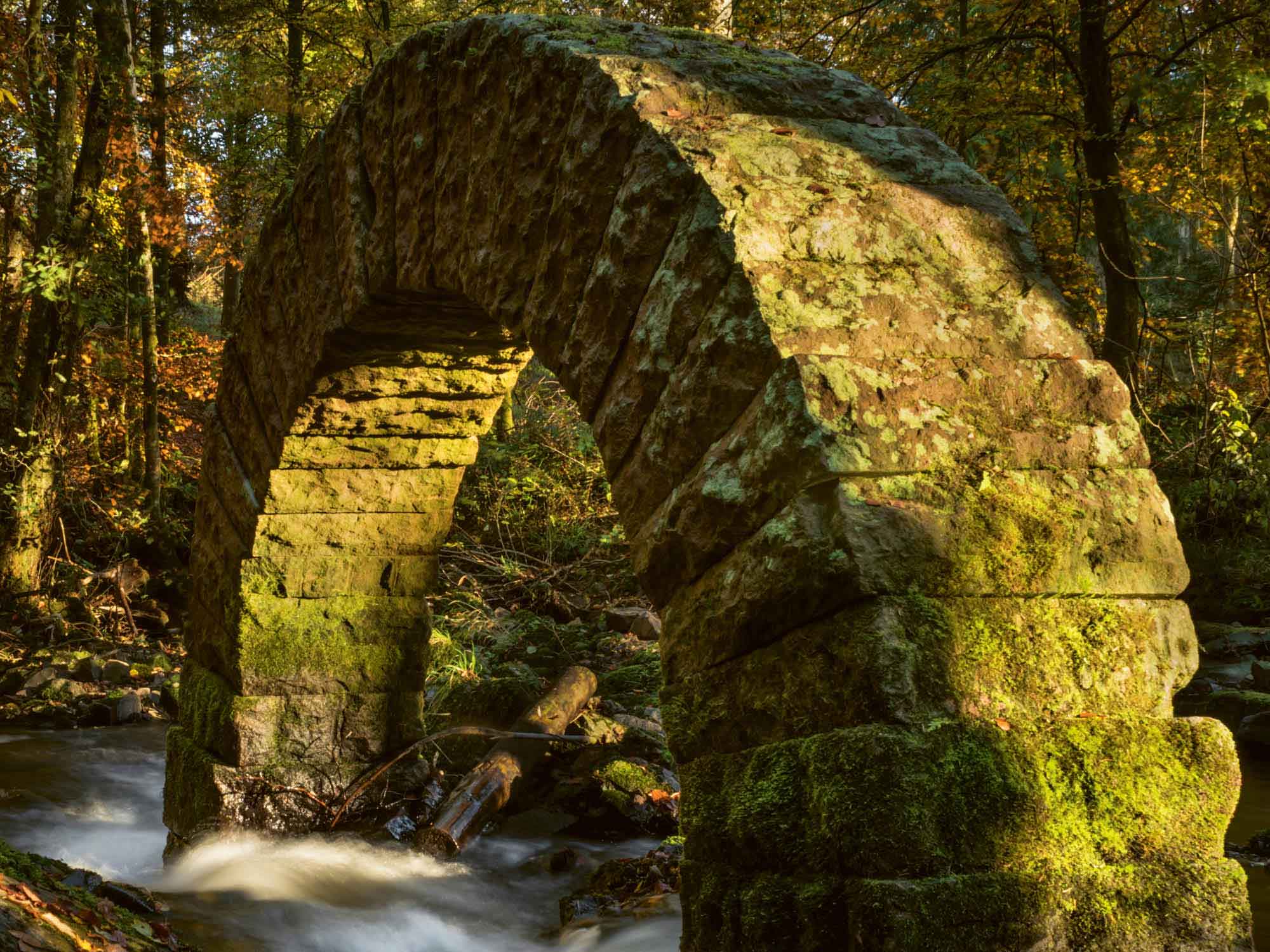
An artistic look at the four elements leads us to the point where sensory perception and spiritual experience become one. We hold together the “what” and the “how” in our cognition.
Twenty-five years ago (2001), the award-winning documentary Rivers and Tides1 was released; today, it still retains its aesthetic appeal. The film centers on the Scottish land artist Andy Goldsworthy and his work, mainly with and in nature, and increasingly with and in the elements. On the occasion of this anniversary, the following essay is dedicated to the four elements and attempts to narrow focus to their sensible-suprasensible nature. The elements emerge from the spiritual, but in order to do justice to their earthly existence, their sensory manifestation must not be regarded as a metaphorical image for a spiritual gesture. This would create a dual reality: here a sensory image; there, in the spiritual realm, the essence. Instead, the goal is to hold both sides together in such a way that they form “one”—a new intermediate realm, the realm of the elements. Almost as an afterthought, this activity transforms nature observation into art.
In the film, Goldsworthy says, “The river is not dependent on water, we’re talking about the flow.”
“The ‘what’ remains sensory, but the ‘how’ of its emergence becomes ideal. Where this ideal form of manifestation appears most clearly in the sensory realm there the dignity of art also appears at its highest. Goethe says, ‘The dignity of art is perhaps most eminently evident in music, because it has no substance that needs to be accounted for. It is wholly form and content, and it elevates and ennobles everything it expresses,’” writes Rudolf Steiner, quoting Goethe in “Goethe as Father of a New Aesthetics.”2
All three quotations draw attention to the heart of the matter: the impossibility of the four elements. This “impossibleness” must not be overlooked, for only by taking it into account—as this essay argues—can we gain the perspective needed to experience the elements appropriately.3 Goldsworthy, Steiner, and Goethe seek a conceptual formulation of what they experience in the flow of a river, in music, and indeed in art in general. Goldsworthy exaggerates: flow without water; Goethe overstates: music without matter. Steiner strikes a balance: something sensory that appears like an idea. In doing so, he ascribes to the sensory-material a spiritual mode of existence.
Spiritual Substance
“Whoever thinks of water in a mountain brook as H₂O is, proverbially speaking, out of their mind”—so goes an apt saying by the Bernese essayist Eduard Kaeser.4 Water does not consist of H₂O. Or, more generally: sensory appearance is not underpinned by any particle-like matter that exists in and of itself.5 Sensory experience is spirit in a form of appearance that is foreign and dissimilar to it.6
Were we to take Goldsworthy’s statement too literally, we would have to forget every earthly, sensory phenomenon of a river. All that would remain would be a purely spiritual flow. And were we to take Goethe’s statement about music too literally, music would be soundless, for it is precisely sound that is the “substance” of music (not some kind of particle vibrations). Strictly speaking, Goethe’s art would end up as mere spirit and would thereby no longer be art. That would not be in line with either of their views. In art and science, Goethe and Goldsworthy are passionate advocates of gazing into the sensory and of working with and within it. Both, however, also want to point to the wondrous fact that something sensory-real meets us as though it were spirit. For a way of comprehension, however, that seeks to underpin sensory phenomena with an everlasting, particulate “matter in itself,” this is simply an impossibility, if not an imposition.

Sensible-Suprasensible: Art
A sensible-suprasensible reality is accessible to a contemplative posture. It knows how to experience, in a living way, the essence of the world in spirit and soul without needing to leave the realm of the sensual-real [Sinnlich-Wirklichen]. A reality beheld in this way is not dual; it is, to quote Goethe, “wholly form and content” in one. In short: It is a realm that does not belong to a world understood in an overly earthly and materialistic sense. The world of art.7 As the poet Rilke writes,
“Not to regard art as a selection from the world, but rather as its complete transformation into the magnificent. The wonderment with which it throws itself upon things (all of them, without exception) must be so impetuous, so strong, so radiant that the object has no time to reflect on its ugliness or depravity. There can be nothing in the terrible that is so rejecting and negating that the manifold action of artistic mastery would not leave it behind with a great, positive surplus—as something that affirms existence, that wills to be: as an angel. […] For the utmost and deepest, out of which the great things of art are made, is in all of nature; it grows with every field; all larks know of it; and nothing other than this brings the trees to bloom” (Rilke).8
Beyond the Shores
To look at water through Rilke’s artistic gaze means neither “there, a sensory image” and “in the spiritual, the real essence” nor a cluster of water molecules rushing down into the valley. Rather, here, at this very spot where our gaze strikes the bubbling, gurgling water of a mountain brook, we encounter, sensible-suprasensible, the never-ending, ceaseless, and uninterrupted stream of what flows from inexhaustible springs.
Goldsworthy’s statement, quoted earlier, poignantly highlights that the essence of the river is its flow. It is movement itself (not “in itself”). It cannot be defined, retained, or analyzed. It cannot be spatially confined; it has an indefinable extent; it eludes any kind of definition; it is—impossible. Every form of water or liquid that can be experienced by the senses is a phenomenon of this impossible, this eternally fluid. It is something ideal, spiritual, that we come to “see” through water.9 We experience this suprasensory within ourselves as a streaming. It seizes the sensible in such a way that the latter transcends itself. The sensible relinquishes its mere sensoriality in favor of the streaming; it yields to the flow. The flow is present in such a way that we can hold our hand where it is present: in the water. Through its sensory experience, water tells us of its flow—even when it seems not to be flowing. Even in still water, the hand feels washed over and played with by something full of movement, something caressing, something that strokes the skin. Liquid is eternally flowing and streaming. The flow of the river extends far beyond its shores into the breadth of the valley. The whole valley is embraced by the river, is permeated by its flow—over and beyond the water of the river into which we can dip our hand. This streaming is not the result of matter or “materialistic forces,” but arises from the suprasensible and goes into the sensoriality of the water. The river water is like an earthly concentrate of the spiritual streaming within its river valley.
The streaming is the suprasensible, etheric flow that encompasses the whole valley; the river is the streaming where it incarnates in water, and there it flows. If the streaming is the etheric, then water is the element that makes itself available to this streaming so that it can be present in the sensible. Water is the mineral representation of the etheric that interweaves and uplifts earthly reality. Water is not based on any particulate, atomistic “matter-in-itself.” Water, flowing, river, and streaming—their realm is not that of being pinned down to a “thing-existing-in-itself” reality. It is not of such a reality; it is impossibly real.

Anticipating Becoming a Thing
To perceive the streaming of water means to look at a mountain brook in such a way that neither the brook nor our experience is obscured by a materialistic type of conceptualization. Such conceptualizations would cause both to fall out of their true Being in the realm of the sensory-suprasensory. This should not be read as an “aesthetic” allusion to the first of the two aforementioned Rilke quotes, but rather as an indication of the experience that matters here. The basis of the fluid cannot be found in something external and solid. It is found when, in the face of its sensory, real representations, we look into our own inward experience. This applies to all four elements: they are sensible-moral experiences.10 In the face of a granite rock, we have the experience of “solidifying” within us. In the face of a mountain brook, the flowing; in the fresh spring forest, the “airing,” breathing; and in the torch, the experience of the fiery, inspiring. Through this inward experience, we meet with the essence of the solid in the granite, with the essence of flowing water, with the breath-freeing air, with the inflaming fire.11 This does not refer to the gestures experienced or comprehended within the soul, but rather concerns an experience with the etheric body.12 When we behold the sensible, we have the state of our own life body in view. To experience water through sight—that alone already bestows vitality. The sight of the flowing, of the stillness of the water’s surface, or in the depths of the body of water can also captivate us; we begin to dream. We are drawn into its depths according to our consciousness. We are subject to a similar pull when we are involuntarily lured into a mountain brook, into its cool, enlivening water; we want to surrender ourselves entirely to it, dive in completely, lose ourselves in it. If the stream bed dries up, life is absent. As soon as we think of the liquid element as if it were composed of solids, when we want to hold it still or define it—which is the case when we have mental pictures of water as H₂O—the sensory phenomena also dry up. We deprive them of their true testimony. Water then no longer bears witness to itself, but to something like solid particles. Thereby, we reduce the element of water to the element of the solid.
This is what happens when we ask ourselves what this or that is made of. For example: What is salt made of? And the answer is right there: NaCl. And pyrite? FeS₂. Fluorite? CaF₂. With this way of seeking answers, we unknowingly drift beyond the “carpet of the senses” with our familiar conceptions of objects—to put it in the words of Steiner.13 The questions “What are the elements made of? What is water made of?” are better answered by reversing our view: not from H₂ and O, etc., but rather from the experiences we can have of water or the elements. The elements consist of our experiences with them. They are characterized by their various sensory types of manifestation; that is what they consist of. Their essence is present wherever I can sensorially detect them.
To return once more to Goethe, Goldsworthy, Rilke, and Steiner: The four elements are four fundamentally different states of existence of the earthly realm, which do not belong to the “material world in itself”—as it is all too often conceptualized in purely earthly terms. They belong to art. A work of art can be viewed in three ways: One can encounter it as a sensory pleasure; one can comprehend it as an image of the non-sensory; and one can behold it as simultaneously sensible-suprasensible—as a suspended state that is constantly in danger of plunging into the all-too-earthly or evaporating altogether into the realm of refined aesthetics; or, rather, as a suspended state to which we must repeatedly refocus our view.
Fire
We say that something catches fire. So there is a “something” and, in addition, fire. The fire comes from the surroundings or from the sky and strikes the “something.” If you hold a lit match in the smoke rising from a freshly extinguished candle flame, the match flame jumps along the trail of smoke back down onto the candle wick and reignites it. It is not the “something” that produces the fire, but rather it draws the fire to itself. So there is this “something” into which the fire strikes, which catches fire—the so-called fuel or combustible material. Its heat value does not result from the amount of energy supposedly contained in its molecules, but from its “gift” of catching fire. The more “gifted” it is, the more fire energy it can catch. The fiery enters earthly reality charged with energy and reveals itself as a hot flame and blazing light. It seeks out a substance through which it can manifest itself. The energy, in the form of warmth and light, released from the surrounding area during combustion can then be measured in kilocalories. Catching fire is not without danger. Once something has caught fire, it is not so easy to release it—it is consumed. Fire is the element in which all other elements dissolve into the spiritual—fire consumes the sensible-earthly, the matter. It does not consume some kind of “kilocalorie” in the fuel (solid wood, liquid oil, airy gas, hot warmth, etc.), but rather its earthly existence. Fire is a spiritual flame that passes from the beyond into this world and carries warmth and light into the earthly-sensible; through heat and radiance, we experience fire’s power of presence.
This makes it all the more admirable to see the strong and courageous men who carry enormous torches on their leather-covered shoulders through the historic part of the city during Fasnacht [Carnival] in Liestal, Switzerland. They identify themselves as bearers of the flaming fire essence; they prove themselves worthy of the blazing fire of the spirit. They are permitted to carry it through the alleys on their shoulders like a child—albeit a fiery one. They withstand the overwhelming heat and light—springing out from the spiritual realm—of the flaming torch. The image of Saint Christopher comes to mind.
One might also think of the midsummer heat over a landscape. This does not refer to the sun’s heat on the skin, but rather to the atmosphere charged with the heat of embers. This “fiery air”14 is just waiting to ignite, to discharge itself as a flame. It is thereby the archetype of the etheric: a present, invisible “energy,” “force,” that dwells atmospherically in the Earth’s surroundings. Such heated air seems to hold its breath to prevent the impending conflagration from breaking out. The heat trembles, knowing it may not be able to contain its destructive force. Everything around is in danger of becoming spontaneously combustible, a Phosphoros (Greek, for light bearer), of surrendering to the overwhelming power of the divine fire,15 and thus of being withdrawn from sensory phenomena and subjected to spiritualization.

Air
The heat takes our breath away; the air becomes unbearable. Fresh, cool mountain air, however—what a delight to breathe it in! It revitalizes us. Fresh air is associated with life, but also with cooling—which, in turn, implies a distancing from that fire—so closely linked to the spirit—that can press in upon us and constantly threatens to consume us. The cooling of the air brings with it a drawing closer to the life-giving element of water. Just as water is the element into which the etheric aspect of sound, music, transformation, and flow enters, so too does the invisible, light-etheric surrender itself to the element of air, and the non-sensory warmth of the warmth-ether to the sensorially perceptible element of warmth.16 Air allows us to see and breathe on Earth (not only physically, but also in soul and spirit). Air—breath—breeze—pneuma (= spirit): The solid stands opposite us; water takes us in; and we take in air. Air has to do with us as spiritual beings existing on Earth. Air gives this being sight and breath upon the Earth—if something has breathing room, then it has space. Things are then not packed tightly together but maintain a proper distance from one another. If this distance is taken away from before our eyes, it becomes dark. If it is taken away from our mouths, we suffocate. Air without our breathing seems almost unimaginable.
Fresh air gives us a vital, free feeling of life. Air thrives on stepping back to make room for life and light (our consciousness). Air emerges from this selflessness when its force unfolds (in a storm), when it is heated to incandescence, when it is saturated with water to form mist and steam, or when it is laden with dust, smoke, or similar substances. All of this robs us of light and breath, steadily sapping our life forces. Without breath, we lose our consciousness—and yet it is precisely those situations that proceed toward taking our breath away that awaken us to consciousness. We sleep well with the window open, when cool, fresh air flows into the room; however, the more stale the air becomes with the window closed, the sooner we awaken from sleep. On one side, air borders on water, on life. On the other, it borders on consciousness, light—indeed, warmth. For in precarious situations, our will—our own fire—takes action. It prompts us to open the window at night and, in a critical moment, extinguishes an external fire.
Earth, Conclusion
Nor is the solid composed of particles. We encounter it through its power to support, resist, and hold things together (there is hardly anything more devoid of vitality than the sight of a dry scree slope in the high mountains). The solid encompasses experiences such as immovability and resistance; one can bump up against it. Thereby the solid also encompasses the tangible proximity of bodily accessibility. The aura of tangibility remains even when we can only see the solid from a distance (such as a steep rock face). If we go there, we can touch it; yet we cannot bodily penetrate the solid—it remains separate from us. The solid can block us in our horizontal orientation as we walk: an insurmountable wall forces us to stop. But it can also support us in terms of our vertical orientation like solid ground beneath our feet. The solid is the element in which the will to earthly existence is proclaimed most strongly. The element of the earthly-solid is the place where the suprasensible life-ether is mirrored. The life-ether accompanies the solid. The solid is the outermost conclusion of the gradual descent through fire, air, and water into the earthly. It is the ultimate end of the universe. It conveys the maximum of sensory-material, earthly-objective reality. It thus runs the risk of falling out of its spiritual origin (that is, of no longer being perceived as a sensible-suprasensible phenomenon) and instead degenerating into a material reality-in-itself, thereby dragging the other three elements with it into this abyss of an atomistic worldview.
From the perspective of the history of consciousness, this is what has happened to humanity: it has slipped too far into the realm of the fixed. With our conceptions of “matter in itself” and “things in themselves,” we roll unnoticed beneath the carpet of the senses. Remaining in front of it, observing both it and our inward experience, and holding the two together in unity, lifts us into a sensible-suprasensible reality—one that does not belong to a world that has become all too earthly: into the world of art.
Translation Joshua Kelberman

Footnotes
- Rivers and Tides: Andy Goldsworthy Working with Time, directed by Thomas Riedelsheimer (Mediopolis Film, 2001); the following quotation at 48:49.
- Rudolf Steiner, “Goethe as Father of a New Aesthetics,” in Art and Theory of Art: Foundations of a New Aesthetics, CW 271 (Hudson, NY: SteinerBooks, 2021), 20; first given as a lecture in German, 1888; published 1889. Johann Wolfgang von Goethe, Maxims and Reflections (London: Penguin, 1998), maxim 488; first published in German, 1833.
- See, among others, Jochen Bockemühl, “Elements and Ethers: Modes of Observing the World,” in Jochen Bockemühl et al., Toward a Phenomenology of the Etheric World: Investigations into the Life of Nature and Man (Spring Valley, NY: Anthroposophic Press, 1985), first published in German, 1977; Georg Maier, “The Classical Four Elements as Different Ways of Approaching Nature,”In Context, no. 55 (Spring 2026), first published in German, 1970; Olaf Oltmann, ed., Elemente und Ätherarten, Wirksamkeiten und Erscheinungsformen [Elements and ethers, their workings and manifestations] (Stuttgart: Pädagogische Forschungsstelle beim Bund der Freien Waldorfschulen e. V., 2008); Ernst Marti, The Etheric: Broadening Science through Anthroposophy, vol. 1, The World of the Ethers (Forest Row, UK: Temple Lodge, 2017), first published in German, 1989; Iwar Thor Lorenzen, Elemente, Äther und Ätherleiber [Elements, ethers, and etheric bodies] (Basel: Archivverlag Agraffe, 2015). See also Gernot Böhme and Hartmut Böhme, Feuer, Wasser, Erde, Luft: Eine Kulturgeschichte der Elemente [Fire, water, earth, air: A cultural history of the elements] (Munich: C. H. Beck, 2014).
- See Eduard Kaeser, “Ethos des Stoffes” [The ethos of matter], in Der Körper im Zeitalter seiner Entbehrlichkeit: Anthropologie in einer Welt der Geräte [The body in the age of its dispensability: Anthropology in a world of devices] (Vienna: Passagen, 2008), 138.
- See, among others, Martin Rozumek and Hans-Christian Zehnter, “Matter Isn’t Made of Matter,”Das Goetheanum: English Edition, no. 9/2025, February 26, 2025; first published in German, July 2025. Further literature cited there.
- Cf. Pseudo-Dionysius, The Celestial Hierarchy, chap. 2, in Pseudo-Dionysius: The Complete Works (New York: Paulist Press, 1987); first published in Greek, c. 500: “For indeed theology has quite simply made use of poetic sacred figurations in speaking of the formless intellects [angels], having regard, as has been said, to our own intellect, providing for the way of ascent that is proper and natural to it, and fashioning the uplifting sacred writings to suit it” (chap. 2.1); and: “Therefore the sacred writings of the scriptures also honor the heavenly orders [hierarchies], and do not fill them with disgrace, when they reveal them through dissimilar figurations, and through these show that they transcend, in a manner beyond this world, all material things” (chap. 2.3).
- See John 18:36; cf., among others, Bastiaan Baan, Lord of the Elements: Interweaving Christianity and Nature (Edinburgh: Floris Books, 2013); first published in Dutch and German, 2006.
- From Rainer Maria Rilke, Die Verwandlung der Welt ins Herrliche [The transformation of the world into the magnificent] (Frankfurt am Main: Insel, 2006), 10, 12.
- Time is also part of this realm of flow. Yesterday is no longer sensible, and tomorrow is not yet present for our senses. Something old is constantly flowing away; something new is coming toward us, and in this process, only the present manifests itself in a sensory phenomenon. This is likely why the film’s title, Rivers and Tides, includes the subtitle, “Andy Goldsworthy Working With Time.”
- Johann Wolfgang von Goethe, Theory of Colours (Cambridge, MA: MIT Press, 1970), pt. 6, “Effect of Colour with Reference to Moral Associations,” §758; first published in German, 1810: “Since color occupies so high a place in the series of primordial natural phenomena […], we shall not be surprised to learn that, in its most general elementary phenomena […], it produces on the sense of the eye, to which it is pre-eminently suited, and through its mediation on the soul, an effect that is specific when taken singly, and in combination partly harmonious, partly characteristic, often also inharmonious, but always decided and significant, an effect directly connected with the moral. Therefore color, regarded as an element of art, can be used to contribute to the highest aesthetic aims.”
- Water that roars, rages, overflows its shores, and acts destructively is already permeated by the force of fire.
- Cf., for example, Rudolf Steiner’s verse on the elements for Ita Wegman: “What I speak from my physical body is appearance – / I must speak from my etheric body, to penetrate into true reality.” Rudolf Steiner, Mantric Sayings: Meditations 1903–1925, CW 268 (Hudson, NY: SteinerBooks, 2015).
- See Rudolf Steiner, The Boundaries of Natural Science, CW 322 (Spring Valley, NY: Anthroposophic Press, 1983), Dornach, Sept. 28, 1920.
- “Ether” goes back to the Greek aithḗr, “upper air; bright, purer air; the sky,” from aíthein, “to burn, shine” (Online Etymology Dictionary, s.v. “ether”). In ancient usage it denoted a fiery atmosphere (Cicero, De natura deorum 1.14), the heavens (Aeschylus, Prometheus Bound 88), and the dwelling place of the gods (Aristophanes, Thesmophoriazusae 273). Fiery air stands at the boundary between the world’s appearing and the world’s becoming spirit; cf. Greek mythology: Aither.
- The solid, the liquid, and the airy of the normally tempered state melt away or heat up; they are thus raised toward fire and thereby returned to the spiritual.
- Within the four elements, only warmth is directly perceptible to the senses; it alone has a sense of its own within the circle of the twelve human senses.





