


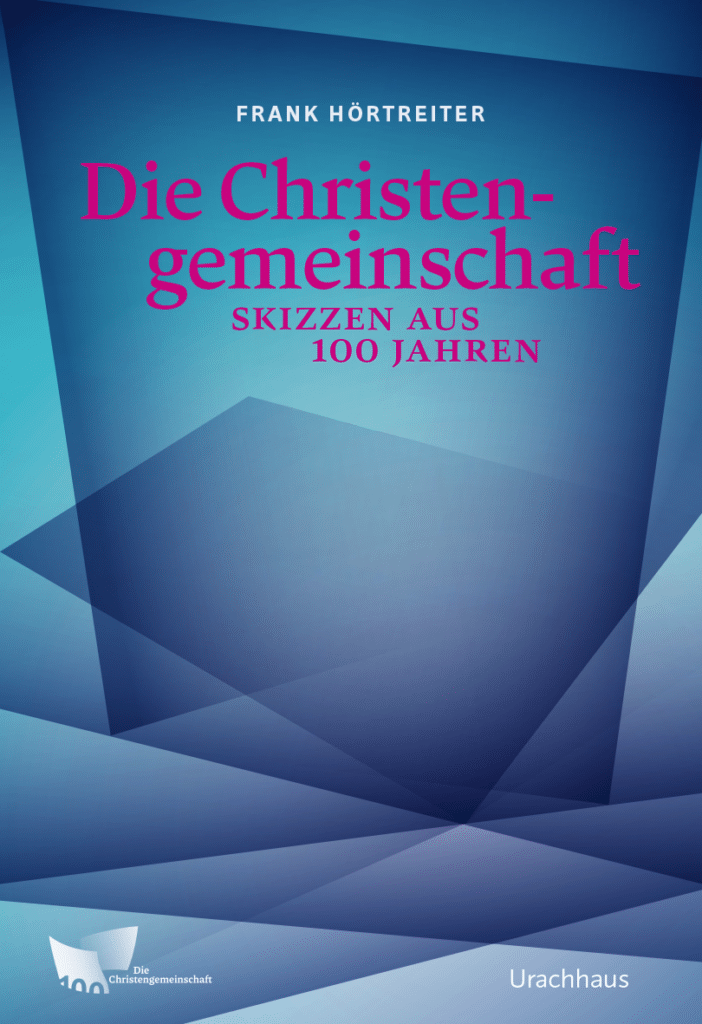
Three years after the publication of his book on the Christian Community during National Socialism, Frank Hörtreiter’s new book, Die Christengemeinschaft: Skizzen aus 100 Jahren [The Christian Community: Sketches from 100 years], was published in the summer of 2025.
In 200 pages (including appendices), the author takes readers on an exciting journey through the hundred-year history of the “Movement for Religious Renewal.” In nine main chapters, the book covers the most important phases in the development of the Christian Community, from its beginnings up to the present day. It highlights topics such as the first church foundations, the pre- and post-war periods, the founding of churches in German-speaking countries outside Germany, the co-workers of the Christian Community, the Christian Community in the GDR [German Democratic Republic (East Germany)], and the period after German reunification. Anyone interested in architecture will also find something of interest.
The book consciously refrains from repeating what’s already been made available elsewhere. Anyone wishing to learn more about the founding of the Christian Community or about a particular country will find relevant references throughout the chapters, as well as a detailed bibliography in the appendix, which also includes periodicals, biographical accounts of priests, and municipal records.
In my opinion, it’s a real treasure to find the sketch-like chapters rounded off with, for example, a portrait by Claus von der Decken or a sketch of a church building. These artistically high-quality images, which the author comments on in a few personal sentences, complement and enrich the text. They give the book a charm all of its own.
The book addresses the complex relationship between the Christian Community and the Anthroposophical Society in several places and does not shy away from pointing out shortcomings on both sides.
I find it especially gratifying that Frank Hörtreiter recognizes not only the work of pastors but also the many (often voluntary and invisible) efforts of community assistants and staff. The author, himself a married priest, expresses his deepest appreciation and gratitude to these many laypeople, without whom the Christian Community simply could not exist: “Before their ordination, priests take a vow: they commit themselves to devoting their work to the Christian Community for life. But there are also people who are just as intensely committed to this community who are not ordained. They occupy no lesser rank in the hierarchy.”
Like his previous book, this opus thrives on the fact that readers gain many insights into priests’ circular letters and thus into key internal sources that are otherwise inaccessible to laypeople. The letters quoted are particularly helpful when they refer to periods before the reader’s own birth. This book, which is reminiscent of a kaleidoscope, is a pleasure to read for anyone who wants to delve deeper into the history of the Christian Community and gain a lively overview of it in just a few hours.
Books
- Frank Hörtreiter, Die Christengemeinschaft: Skizzen aus 100 Jahren (Stuttgart: Urachhaus, 2025).
- Die Christengemeinschaft im Nationalsozialismus [The Christian Community during National Socialism] (Stuttgart: Urachhaus, 2021).
Translation Joshua Kelberman






