


In October 2026, the Natural Science Section at the Goetheanum will hold its autumn conference, titled The Human Constitution as an Instrument of Research. Here is a little “teaser”.
These days, we point to the escalation of AI or to current ecological and social crises as symptoms of our alienation from the world, nature, and each other. But it’s an estrangement that began centuries ago when, with the beginning of science, we started to quest for pure objectivity with what we observed in nature. We began to exclude the inner activity and experience of our soul and developed abstract thinking. On that path, the human being as a research instrument isn’t needed anymore. Machines can do it better. But now we feel as if we’ve lost something, some connection or understanding that used to be available to us. It’s as if we lost touch with the essence of nature and of ourselves.
Have we discarded our most significant research tool: the human mind and body? What does a Goethean scientific approach offer to help us out of this estrangement? Can we learn to use our thinking activity in a new way?
Participatory Consciousness
Owen Barfield begins his book Saving the Appearances1 by contemplating a rainbow and remarking that there is no rainbow present without the person perceiving it. Does this apply to all phenomena? Is there no tree or stone unless there is someone there to perceive it? It’s an age-old philosophical question. Barfield then directs the reader’s attention to the significance of consciousness for the way phenomena appear. For a different consciousness, he concludes, the phenomena will also be different. This gets interesting when we consider whether human consciousness has transformed over the centuries. We usually imagine that human beings in ancient times saw the same “things” we do but could not yet understand them as well as we can today.
But Barfield proposes that people in earlier times had a different, more participatory consciousness and therefore perceived something different than we would in the landscape, their sacred sites, and the world. The transition to the modern age and the scientific revolution that began with Copernicus, Galileo, Newton, and others displaced this participatory consciousness; we became detached “spectators” of the world, with all the well-known damage this “spectator consciousness” brought upon the Earth.
So we ask: is there a way to develop a new form of participation that can overcome and heal this damage without abandoning scientific consciousness? Barfield saw such a path in the works of Johann Wolfgang von Goethe and Rudolf Steiner. Since Barfield’s concept emphasizes the significance of human consciousness for doing research, we’ve given him a place in our conference. Johannes Kühl
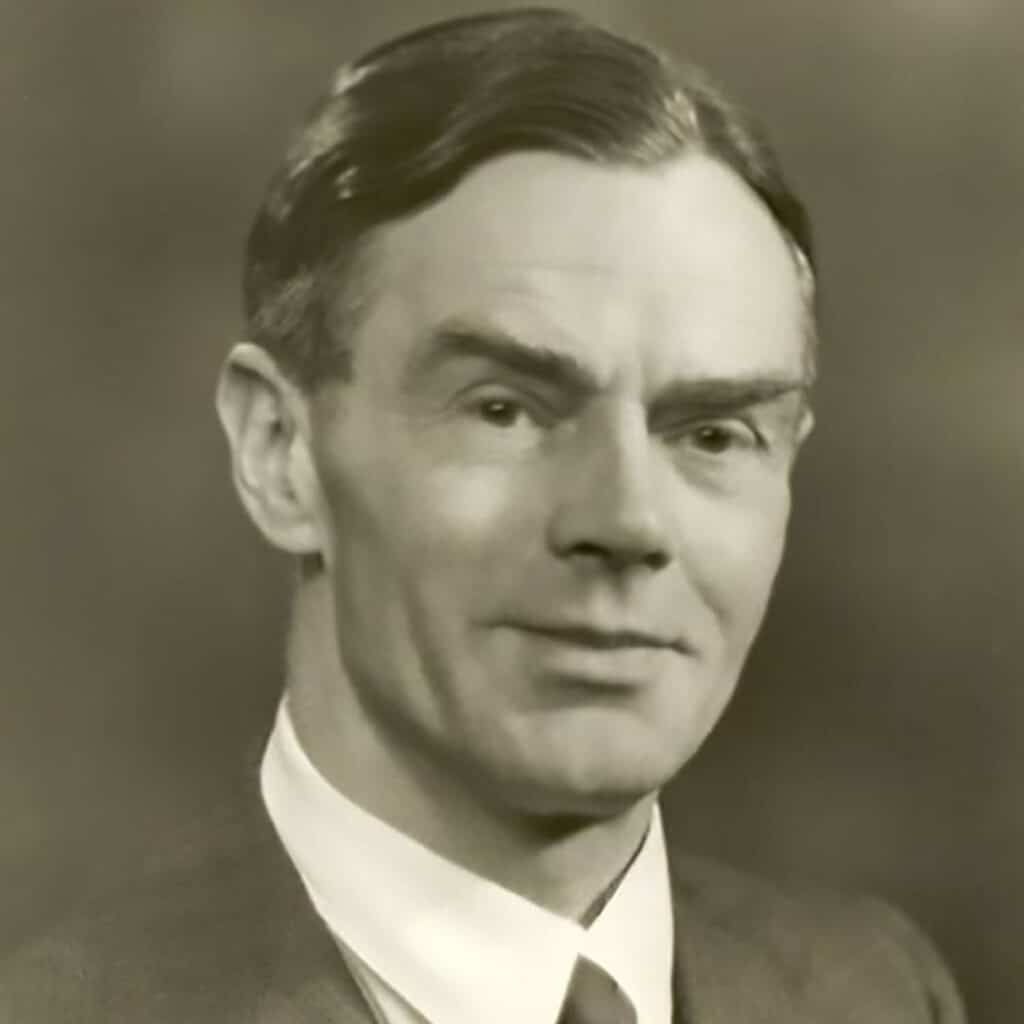
Owen Barfield (1898–1997) was a literary scholar, linguist, and lawyer in England. He was friends with C. S. Lewis and J. R. R. Tolkien since his time as a student at Oxford. Later, he became chairman of the Anthroposophical Society in England. His works, though scarcely known in the German-speaking world, introduced many English-speaking readers to anthroposophy.

Consciously Participating in the Invisible Reality of What Is Perceived
Experience has two halves: on one side, what the world offers us (for example, the physical conditions for a rainbow); on the other, our own inner activity, with which we respond to this offering.2 It is only through this inner activity that the world becomes a phenomenon (such as a rainbow) for us. What a rainbow “is” has to do with the cultural context of those who observe it and put it into language and concepts. But everyone knows it, so our inner share of the phenomenon is not only subjective but also collective. This is not surprising since the development of our senses is a collective enterprise. No child learns to use its twelve senses all on their own. Surrounded by other human beings, a child acquires their senses from the bottom up: first the sense of life, then the senses of balance, proprioception, and touch. As their hands become free, the child begins to comprehend the world in the truest sense of the word. The sense of warmth, sight, smell, and taste open up a multifaceted world. And, finally, the child learns to engage the senses of hearing, speech, concept, and the ‘I’-sense. Every perception only acquires meaning when the child adds something “from within.” Simultaneous with the organization of the senses, soul and intellectual capacities develop through interaction with the community. Culture, society, our circle of friends, family, and what we bring with us as an individual all influence how we see the world. How, then, are scientists supposed to discover universally valid laws?
Goethe was familiar with this problem: “With deeper study we also see how the subjective element plays a true role in the sciences.” To foster an attitude grounded in reality, he believed it was part of a researcher’s education “to know ourselves and our own character.”3 For him, a multifaceted sensory encounter with the object of research was indispensable for an adequate search for truth. It is precisely perception itself—which assures us of our participation in a world to which we ourselves belong—that he places at the center of the scientific process. On the other hand, he urges restraint and examination when we add to sensory experience from within. “We can never be too careful in our efforts to avoid drawing hasty conclusions from experiments [. . .],” says Goethe, “for here at this pass, this transition from empirical evidence to judgment, cognition to application, all the inner enemies of man lie in wait [. . .].”4 The cultivation of self-reflection and self-education, and the willingness in every moment to set aside prejudices and preconceptions, are essential components of a training in Goethean science. Goethean researchers dedicate themselves to the task of giving meaning to the expressions of mute nature. But if we take the problems of subjective involvement seriously, this is not enough. It is also our task, through reflection on our own existence, to make our biography and state of mind accessible to alert observation. We must learn to consciously set them aside and make our inward activity available to the object of research. Then we become the “platform on which the world is communicating with itself.”5
Practicing Goethe’s scientific method entails inwardly reenacting and bringing to life innumerable observations of plants, including those made under experimental conditions. According to Steiner’s interpretation, this allows us to immerse ourselves, through our own activity, in the invisible reality of what we perceive. Researchers move from the external experience they have of the plant in the sensory world to an inner experience. Jochen Bockemühl described this as follows: “When I realize that the content of perception is always activity, then I am no longer outside, facing the object, but rather, through movement in my thinking, I probe and sense the relationships between things. The thought activity I engage in is part of the reality of the growing organism under observation.”6 “The sensory world becomes more and more transparent to the spiritual force at work within it, in which we ourselves have a share.”7
The spirit of the world is thus contained within sensory experience; it can become an experience for us through perception. And we can know it by keeping as close as possible to our perception and becoming attentive to what is included, though unnoticed, in our thoughts. Ruth Richter

Will Activity as an Organ of Perception: The Spirituality of the World Manifests Itself Within Us
Human beings incarnate on Earth through their sensory perceptions. The process of vitally integrating ourselves into the sensory world by way of our senses is given to us from the outside through biological development and our culture. In anthroposophy, we strive to further develop our perception into other realms of reality. Every human being takes their own development in hand. Human beings are capable of developing new sensory organs with which they can perceive other worlds.
For natural scientists, this development of new senses begins by immersing themselves in natural processes whose wisdom goes beyond intellectual knowledge. For example, they can track the growth of a plant. Every day, they observe its development. Through drawing, they grasp and deepen their understanding of its forms. After some time, it becomes evident that the plant’s growth and development are not objects that one simply stands in front of. Thinking first enters into the pictorial realm of nature and then, drawing on many observations, recreates an inner image of the forces at work in living plants. We call the living consciousness that perceives this vitality—since it experiences it within itself, in its own etheric organization—“imaginative consciousness.” Just as we become conscious of the sensory world and the physical body through the senses, so too do we first become conscious of the etheric world and our etheric body through these new senses. The sense organs in this first layer of the suprasensible are formed through intensive work with nature. For example, four formative movements from Jochen Bockemühl’s research can be cited as an example of such organ formation. In the development of leaf metamorphosis, four qualities can be observed imaginatively: sprouting, spreading, articulating, and tip formation. These are the etheric formative movements of the leaves. Each of these forces, which are able to be experienced inwardly, seizes upon one aspect of leaf metamorphosis.
Unlike the physical senses, which are constantly active as soon as we open our eyes, the suprasensory organs are perceptive only as long as we actively bring forth their contents. The sensory world surrounds us in an active form. It actively streams toward us. When I open my eyes, I immediately see the world. I smell the aroma of food without making any effort. It is different with the suprasensible world. It, too, surrounds us unceasingly and is full of life. But in order to be able to see, hear, smell, touch, and taste within it, we must develop an uncommon inner activity. Suprasensible perception is a willed activity. Only through a resolution of will can we begin to perceive in the higher world. We activate our will by striving toward the spirit of the world. The human will becomes a sense organ. It becomes capable of seeing. We pass through the gateway of the sensory world, which is reflected in our consciousness, and enter a world of differentiated, essential forces that give rise to the living foundation of the world. As long as we sustain this activity, we bring about suprasensible perception.
We do not develop a universal imaginative organ and then see everything in the imaginative world. For each realm of the imaginative world, I must work out suprasensible perception anew. For every plant species with which I work, I must begin by observing its appearance in the sensory world, tracing its scent and taste, and examining its environment. There comes a moment when I can bring all these observations together and fuse them inwardly, as in a mathematical function. I experience it as if I were then immersing myself in a world of substance that feels fluid. In this world, I experience within myself the being of the plant with which I am working. I experience the archetype. Through the way our will must nestle into the life processes, we grasp their quality. Our will becomes an organ of perception. We do not express ourselves; rather, we allow the world to express itself within us. Torsten Arncken

From the Imaginative to the Intuitive in the Plant Kingdom
In his work The Metamorphosis of Plants, Goethe describes three stages of expansion and contraction during the development of a plant’s above-ground parts.8 In the green vegetative phase, we observe the first expansion from the cotyledons to the stem leaves and then a gradual contraction into the sepals. During the expansion, a leaf metamorphosis takes place. We can exercise our imaginative faculties if we inwardly immerse ourselves in the transformations of the form of the green leaves as the plant develops from leaf to leaf. Steiner fundamentally broadens our understanding of these processes by placing the plant in relation to earthly and cosmic forces. He thus connects the plant’s development to the elements and types of ether acting within it.
When the plant reaches the point of flowering, we can observe an important qualitative enhancement in the plant’s processes of leaf metamorphosis. The forces that previously carried the plant toward the light, leaf by leaf, converge to a now-visible point in the flower. Steiner describes this as a kind of “astral touch from without,” whereby “the plant grows toward its soul-like part, its astral part.”9 The theoretically never-ending growth and formation of substances through photosynthesis come to an end. The plant’s development is compressed, as if from outside, so that all the different parts of the blossom seem to grow “with one another” rather than “one after the other.” The forces now acting on the plant from the outside and halting any further vegetative growth intervene in the entire chemical organism. Substances previously built up are broken down and transformed into secondary metabolic products. This manifests as colors, odors, and flavors, and even influences the shape of the green bracts beneath the flower. These bracts prepare for the coming flowering impulse and are already more or less absorbing its forces. However, the flower cannot be predicted on the basis of the green bracts. The instant the flower appears, the observer experiences an “aha moment”—it awakens various inner responses; it addresses their soul. If the phenomena and the previously acquired abilities are retained in wakeful consciousness, this event can lead to inspiration knowledge.
As the plant’s development expands into petals then contracts into stamens, the metamorphosis transitions into the third stage: the development of the carpels, which appear as if growing into one another. After pollination, they enable the further development of ovules. At this point, earthly and cosmic forces unite once more, creating within the seed an essence that sustains the plant’s continued existence. Through an understanding of these processes and the forces at work, the observer’s capacity for true intuition can mature.
More The Human Constitution as an Instrument of Research, Autumn Conference of the Natural Science Section at the Goetheanum October 8–11, 2026
Our conference offers multifaceted experiences of the human organization as an instrument of research. Twelve speakers from various natural scientific disciplines will shed light on the relationship between perception and consciousness through observing plants, animals, landscapes, minerals, and water currents. We will focus on specific aspects through hands-on practice in smaller working groups. In the evenings we will explore our senses through art and eurythmy. As researchers, we will take our own soul organization into account and enhance our cognitive capacities as well, to help develop new organs for expanded perception. We extend a warm welcome to all who are interested.
Translation Joshua Kelberman and Laura Liska
Drawing Jochen Bockemühl, Lebenszusammenhänge. Natural Science Section at the Goetheanum, Dornach 1980

Footnotes
- Owen Barfield, Saving the Appearances: A Study in Idolatry (Middletown, CT: Wesleyan University Press, 1988); first published 1957. See also: Max Leyf, “Owen Barfield and the Evolution of Consciousness,” Das Goetheanum: English Edition, December 8, 2022; Ashton Arnoldy, Crossing the Threshold with Owen Barfield, Part I, Das Goetheanum: English Edition, December 15, 2022 and Crossing the Threshold with Owen Barfield, Part II, December 23, 2022.
- Cf. Ronald Brady, Stephen Edelglass, and Georg Maier, Being on Earth: Practice in Tending the Appearances, Phänomenologie in der Naturwissenschaft 5 (Berlin: Logos Verlag, 2008), ch. 9.
- Johann Wolfgang von Goethe, “My Relationship to Science and to Geology in Particular [Outline for an Autobiographical Sketch],” in Scientific Studies, ed. and trans. Douglas Miller, vol. 12 of Goethe: The Collected Works (Princeton, NJ: Princeton University Press, 1988), 138; first published in German, 1893.
- Johann Wolfgang von Goethe, “The Experiment as Mediator between Object and Subject,” ibid., 14.
- Ronald Brady, Stephen Edelglass, and Georg Maier, Being on Earth: Practice in Tending the Appearances, Phänomenologie in der Naturwissenschaft 5 (Berlin: Logos Verlag, 2008), ch. 9, p. 138.
- Jochen Bockemühl, private communication.
- Jochen Bockemühl, Lebt die Welt in mir? Wahrnehmungs- und Besinnungsübungen zum Entwickeln von Verantwortungsfähigkeit im täglichen Leben [Does the world live within me? Exercises in perception and reflection for developing a sense of responsibility in daily life] (Dornach: Forschungsinstitut am Goetheanum, 2010), 5.
- Johann Wolfgang von Goethe, The Metamorphosis of Plants (Cambridge, MA: MIT Press, 2024); first published in German, 1790.
- Rudolf Steiner, Disease, Karma, and Healing: Spiritual-Scientific Enquiries into the Nature of the Human Being (Forest Row, East Sussex: Rudolf Steiner Press, 2013), lecture in Berlin, Oct. 21, 1908.





