

How can we establish universal values when power itself has become an ideology? On the Pilgrim Fathers of the Mayflower, mothers who don’t want to sacrifice their children to big business, and a prime minister who spoke angelic words.
Over dinner one night, after the U.S. president landed in Davos, a friend of my son said that power itself had become an ideology. It no longer hides behind a democratic sense of mission (despite being obvious, they were also after oil in Iraq), nor behind communism, Christianity, Islam, a belief in the master race, or the acquisition of knowledge. Through the power of the strongest—or rather the richest—power has blatantly placed itself at the top. It no longer needs to promote values that are then perverted into ideologies. The ego has empowered itself and placed itself at the center, even though it is devoid of any real meaning or sense. Once this is accomplished, it’s not difficult to convince oneself that one can simply lay claim to Greenland. It’s like walking into my neighbor’s yard and laying claim to their house. How absurd this seems when we consider it on a small scale!
But this is exactly how European powers have proceeded in their conquest of the world since 1492. Columbus planted the Spanish flag in the Caribbean soil before his scouts had even looked for islanders. We all know that the wealth of the Western world rests on the fact that our ancestors took what they wanted without asking. Is Trump now looking back at us, as if from a mirror? Is he an “afterbirth,” a long-term effect of our own actions, a supposedly antiquated way of exercising power that has been reduced to total absurdity? Europe and the US must reevaluate and update their values in light of this Hephaestus of capitalism, who thunders through the world’s network of relationships with the force of a hurricane. I see this moment as an opportunity.
That same day, I’d been asked what I thought about the relationship between Europe and the US. Oof—well . . . The first European settlers to arrive in North America were displaced persons or refugees who were no longer tolerated because of their beliefs. Pietists, Quakers, Evangelicals—people who were looking for a new beginning because they couldn’t realize their visions of communal life at home. The Mayflower set sail from England on September 6, 1620, with the Pilgrim Fathers and Mothers on board—102 passengers and 31 crew members. One child was born during the crossing, and two people died. Not too bad, considering how many “pilgrims” searching for a new home in the Mediterranean today—400 technological years later—meet their deaths.
Philadelphia, originally a city in Lydia, modern Turkey, means “brotherly love,” after the nickname of the Lydian king who was very close to his brother. So, this is what they wanted to create in North America with their departure from Europe. And now a defiant, professional teenager is running around the world, not giving a damn about the Old World’s dusty cabinet of values, which has been rendered obsolete by the conditions of the global market, leaving chaotic vigilante justice in his wake. And we’re simply not sure: Is he crazy? Is he serious? Will he get away with it? Do we now have to find a way to embody liberty, equality, and fraternity on a deeper stratum of the world? And who will take up this stewardship, and how?
When the German Bundestag [Federal Parliament] voted two months ago to recruit 300,000 soldiers, there was a huge outcry, as well as fear, among my friends who are mothers: “I will not sacrifice my sons for a war, on whatever front, that will make big capitalists and arms companies incredibly rich,” or, “My children will not become cannon fodder for these Trumps, Putins, Netanyahus, Nasrallahs, Kassims, Merzes, Macrons, Kim Jong-uns and whatever else they’re called, who play Risk with the world as if it were game night.” I’m almost tempted to say: Parents of the world, unite! Life is life. So, what do we want to say no to, and what do we want to say yes to, and how? How do we establish “universal” values that globalized people feel responsible for sowing, nurturing, and preserving? I hope Europe finds a way—and extends a sisterly hand to the “other” America.—Gilda Bartel
Angelic Words at Davos
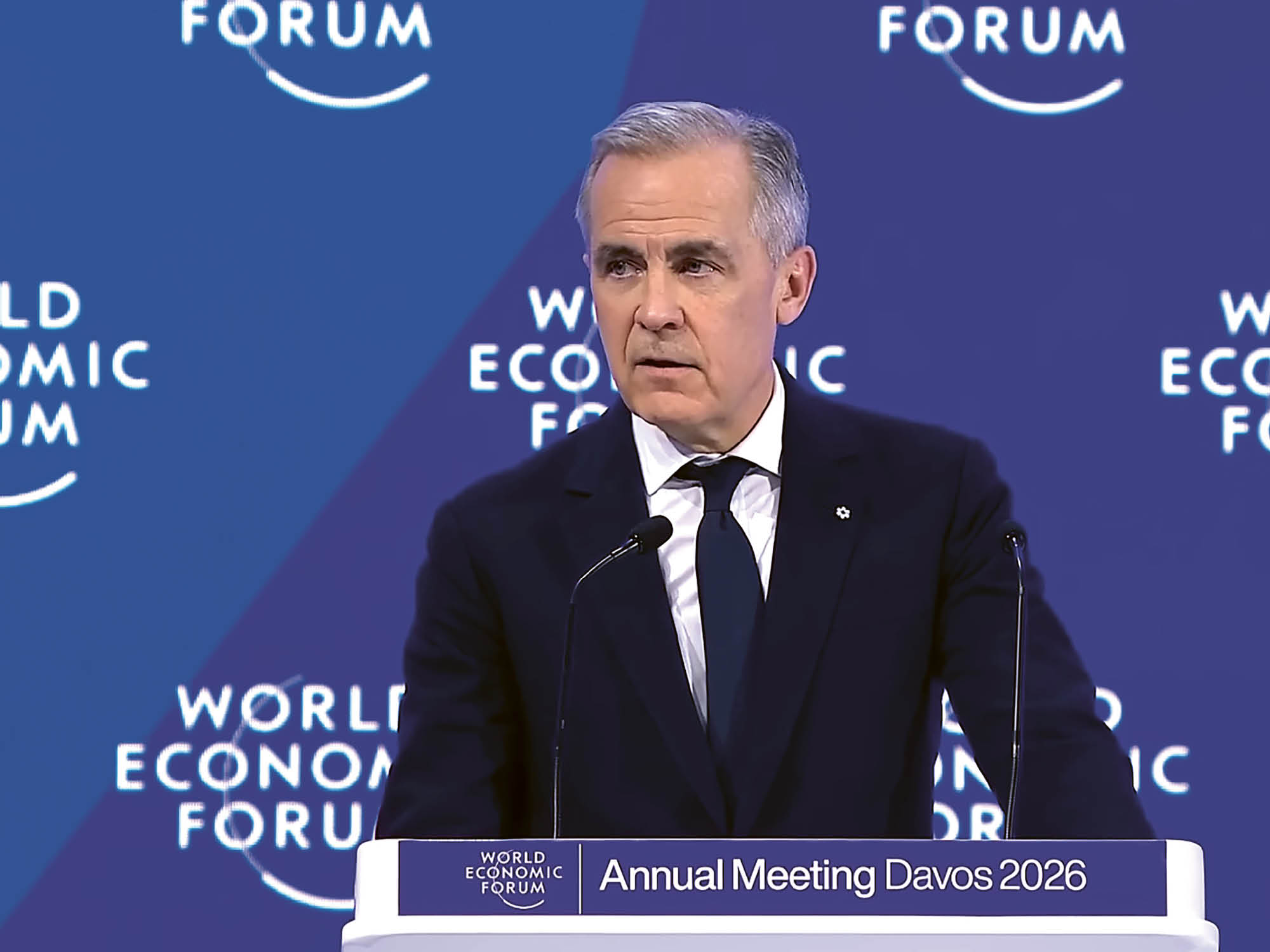
Hidden conflicts have to be brought out into the open in order for them to be resolved. Everyone comes to this realization at some point in their lives. Conflict researcher Friedrich Glasl used the metaphor of temperature: cold conflicts need to become warm conflicts. This releases emotions and enables a shared view of reality. The Canadian prime minister, Mark Carney, struck the same note in his highly acclaimed speech at the economic summit in Davos. He quoted from Václav Havel’s essay “The Power of the Powerless”—the story of a greengrocer who puts a sign in his shop window saying, “Workers of the world, unite!” The shopkeeper doesn’t believe in this slogan, and his customers don’t take it seriously. But still, it’s there, and it’s in other shops, too. According to Carney and Havel, power has been established because everyone sells lies as truth—until some decide to take down the sign. Carney says we’ve reached that moment of decision. With Russia and now the U.S. breaking down the world order and reverting to the law of the strongest, what was previously a veiled lie is now being revealed. Whereas power games and interest politics were previously fought out under the table, now they’re out in the open.
So, according to Glasl’s conflict theory, we are living in a good time, because conflicts can now be resolved. Carney called for us to remove the imaginary signs from our shop windows and abandon all these lies of mutual agreement. What a moment at the economic summit! Carney encouraged us to take on the major powers with two virtues: we should leave the false truths behind, and we should not offer ourselves as separate individuals to those in power, but join forces. “If we’re not at the table, we’re on the menu,” was his appeal. There were three virtues he impressed upon the world public: “truthfulness,” “fellowship,” and “readiness to act,” or in short: wisdom, love, and strength—the three virtues of the Angel in the fight with the dragon.—Wolfgang Held
Image Speech by Mark Carney at the 2026 World Economic Forum Annual Meeting, CC BY 4.0.








I find it very interesting to ponder, ‘at what point does an idea become an Ideology?’
Hannah Arendt gave an interview in 1964 and said: “My god, we didn’t need Hitler to come to power to know the Nazis were our enemies! That was completely clear for at least 4 years to anyone who was not an idiot! We also knew a large number of Germans were behind them. That couldn’t shock or surprise us in 1933”.
I’ve started to ponder on how activists do things outside of the democratic processes within a country and more in the very Democratic Switzerland where it is part of the constitution to allow change through citizens voting directly for these changes. Is it an Ideology when activists destroy personal property, just like the communists took over peoples hard earned property after the revolution in Russia! The Russian/American philosopher, Ayn Rand, tells the story many times of how her fathers chemist shop was taken off him after the Russian revolution, without compensation.
Many lands were colonialised by our ancestors, who didn’t ask the inhabitants what they wanted. I see a repeat of this in our times with many NGO’s entering countries to do ‘good work’. My question is, ‘did those citizens vote or even ask for those NGO’s to enter their country? Where an NGO barges into a country without being invited, isn’t that also a form of Ideology based on the Ego?
Rudolf Steiner said the following on Oct. 28th 1917 (GA 177): “It is interesting that the excellent statement was made in 1910 [by Francis Delaisi, La Démocratie et les Financiers, 1910]: ‘… that big capital has succeeded in creating out of democracy the most wonderful, the most effective, the most flexible instrument for the exploitation of the population as a whole.
We usually imagine that the men of finance are opposed to democracy – the author in question says in his book – but this is fundamentally mistaken. On the contrary, they lead it and consciously promote it. For it is this – meaning democracy – that provides the screen behind which they conceal their method of exploitation, and they find in it the best means of self-defence against any popular resentment that may arise.’ This shows how someone who has woken up sees that the main thing is not to make loud speeches proclaiming democracy; the main thing is to see clearly the reality of the situation … namely, from how few centres of command events in the world today are steered and directed … [The average person] cannot attend [to these things], because they are smothered and buried under the – well, the same public life that is ruled over by the press …”
One thing I’ve also noticed is when the word Capitalism is thrown around that people imagine the worst scenario’s ever. It is my understanding that not one country has lived under pure Capitalism for any great length of time. Maybe, the USA between the end of the 1800’s and 1920/1930’s but then it was corrupted with the Government of the day forcing people to pay taxes [previously not being forced to pay] and then the money handed out to projects that no-one voted on or was given to friends of poltiicians.
In Rudolf Steiner’s lecture GA23 ‘Basic Issues of the Social Question’ he says: When capital and capitalism are spoken of today, they refer to what proletarian humanity considers to be the causes of its oppression.
I’m cherry picking here, but, it strikes me that the two words have different meanings. When I have money in the bank, then isn’t that labelled ‘capital’. There are also different versions of Capitalism just as there are different versions of Socialism/Communism, but the association in one’s mind lives on without much conscious thought. That was my own experience until I read some of Ludwig von Mises and Ayn Rand and their philosophy regarding ‘capitalism’.
Rudolf Steiner speaks a lot more about capitalism and the healthy administration of ‘capital’, in his other works involving the subject of Threefolding.
I have found over the years that trying to get one’s head around some of Rudolf Steiner’s concepts is very difficult. Then the arguments about what he means ensues and then to be told by someone else ‘we should not offer ourselves as separate individuals to those in power, but join forces.’ Yet, strangely enough, there is no society without Individuals. There are only individuals. Don’t we need to develop our way of living together based on this mutuality, or, did I miss the point?
Who decides what the Universal Values are and how they are brought into being is a very good question.