Lars Krüger visits Hannes Weigert in his studio. They spend several days observing and discussing Weigert’s paintings. Joachim Eckl joins them. Why do they sit there searching for words to describe these pictures? Do words help in the attempt to fathom the wordlessness of images?
Hannes Weigert: . . . a gray image. (1) Actually, just primer. I like spending time there at the moment. I really like that I don’t feel the urge to paint anything on the gray background.
Lars Krüger: When I look at it for long, my eyes become like hands that seem to stroke the canvas. I can surrender myself. I can wait for something to begin to reveal itself within me. A slight expectation arises, an inner hint of something that could enter the emptiness, a connection to something. Something is getting ready.
The color seems to crystallize upon the surface. This gives the surface a three-dimensional quality. Through my eyes, I’m inside this space. And it’s not disrupted by any other elements. I enter the pictorial space through my eyes. It’s a weaving together of what’s out there with what’s inside me. I see what’s out there as my own inner event. Through the image, I’m taken into myself. This is a special kind of pictorial experience or pictorial knowledge. No conception arises. Pure pictorial space.
Hannes: I painted something here—and then painted over it again. (2) It’s like erasing, except that you can still see something of what was there before. I didn’t want to paint images, but to erase what was already there, or simply create a background for an image yet to be created. In both cases, however, I unexpectedly felt a sense of satisfaction at being able to look at something that, according to my understanding, is not an image. I’ve contemplated this act of destroying, painting over, and washing away what I’ve painted for many years, as well as the act of priming, coloring, and tinting. It’s a very pleasant sensation to apply paint to a surface completely unintentionally, without the intention of painting an image. But most of the time, something’s missing. I’m curious to see how I’ll feel later with these gray ones—whether I’ll be able to just leave them as they are.
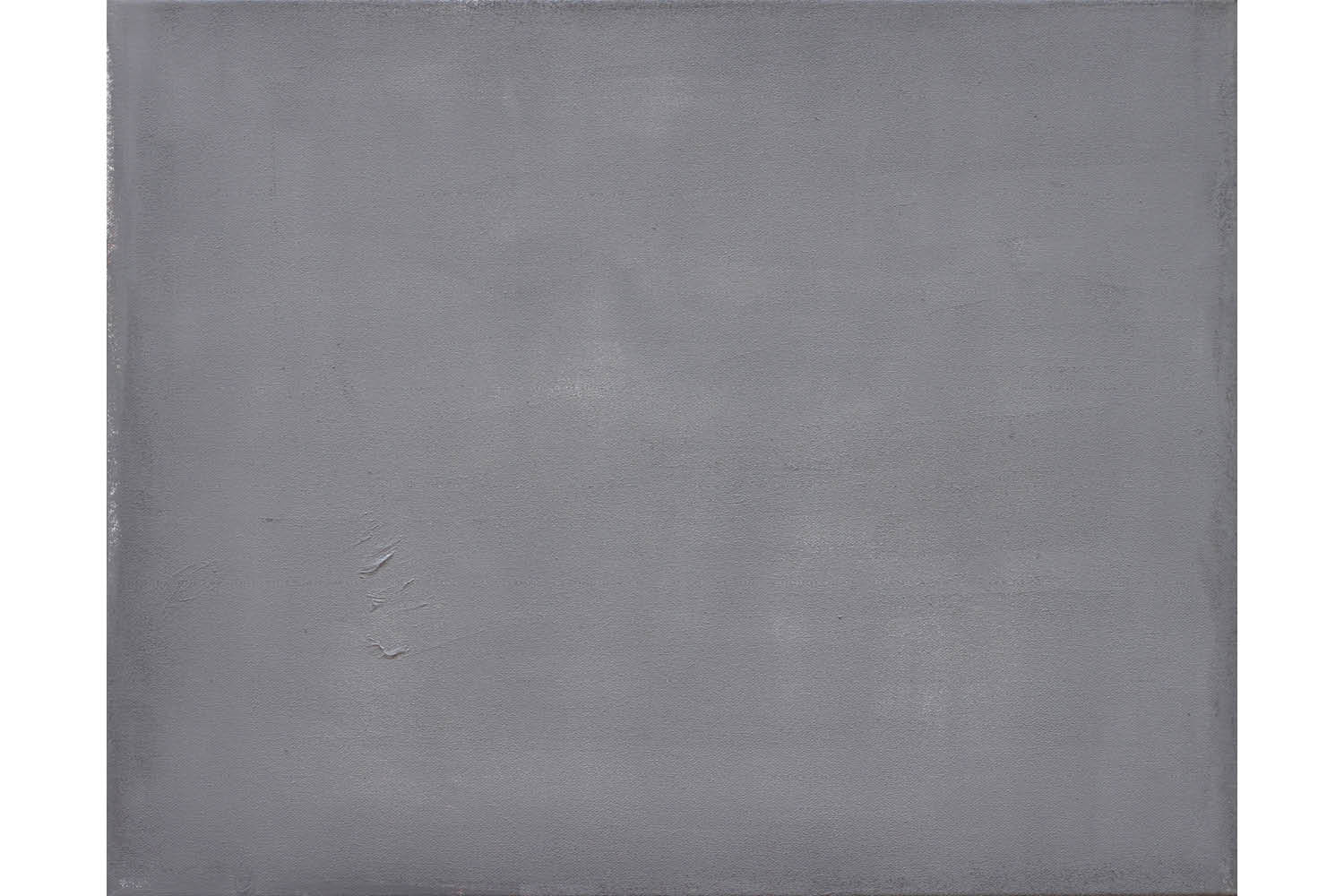

Image 1 and 2
(3) Once I’d drawn half the head and was just about to place the brush on the part of the hair to paint the other half, I felt a slight resistance. I paused and looked at the image. I noticed that the purple base coat on the left is slightly more bluish than on the right. The image surface is not flat; it creates a space within itself. It recedes slightly on the left and comes toward me on the right.
Lars: Left and right are also front and back here. The outline of the head lies between the cool rear space and the warmer front space.
Hannes: (4) Something is being erased again. But not by covering it with paint, but by erasing itself as I look at it.
Lars: Like a sunset: the sun makes itself disappear. When I move closer to the image, I can’t see anything anymore. But it becomes enormous, spatially. I can just look at the colors or view it as a mood of nature, an impression. It’s objective and non-objective at the same time.
Hannes: The red is kind of erased at this point—in the middle. The light red from the front comes really close to the red. It erases the red. The erasure itself becomes visible. The visible erases itself, evaporates, melts away before my eyes. Earlier, you made a double movement with your hands: something comes from you and goes toward the red, and something comes toward you from there at the same time, approaches you and envelops you, and you try to catch it with your gaze, but it eludes you. You only see or feel the dissolving.


Image 3 and 4
Lars: This image has a great depth that reaches behind me. It becomes a perimeter. When I become aware of it, the center of the image begins to pulsate. Space emerges from it. It creates space, it streams space out. And I look deep into this movement, which seems to come from infinity, as if into a shaft or a tunnel, into the deepest depths.
Hannes: When I painted over the image underneath, it became very foggy. So, I went into this fog with the red. But it was as if the red was now coming towards me. As it emerges, the red becomes a surface, spreads out, and disintegrates. And I don’t just look at it, but rather the act of looking itself, my seeing as an activity, comes into view.
Lars: With this image, you actually enter the scene yourself. (5)
Hannes: The yellow steps forward in front of the black. But my feeling is that I’m stepping into it. Yet I remain conscious that I’m in front of it. I look at how I am in there. Sometimes, however, the figure appears to me as if it were turned into the pictorial space. Then it is as if I were looking at myself from behind.

Lars: How do I manage to get into the surface? And what happens there? That’s almost intangible for me. I enter into a soul movement that expresses itself in the front-back. A soul weaving into the surface. But there’s something else, something mysterious, something that can overwhelm me again and again: that something is there! And—I am that, there! At that moment, something could open up.
Joachim Eckl: I notice how the images challenge me. They have something demanding about them. And if I don’t engage with them, nothing happens. I have to make a decision. That’s a huge hurdle. You have to get over it first! You have to want to get in there! I feel it inside me: I don’t want to do this right now. It’s too much for me, it’s too intense, it’s exhausting. It’s actually this effort itself that sometimes gets on my nerves! Then I ask myself: Why do I have to push myself so hard right now?
Lars: Where is the image? Out there or inside me? Or somewhere in between? I’m in a space that doesn’t exist without me. That makes me awake. But when experiencing these images, being awake is somehow connected with sleeping.
Hannes: When I immerse myself in seeing and notice how there is a latent liveliness in the surface that I first have to awaken in my vision, it is as if something awake within me touches something dormant.


Image 6 and 7
Joachim: The black hole is insane! (6) I feel like this image is an offering to me. You can live with this image. I don’t want an image to just give me a task or pose a riddle; I want it to give me something in return! It invites me in!
Hannes: This image was created later. (7) At that time, painting became a bit like immersing myself in painting itself, in the life of painting.
Lars: Again, this looking through or looking into. But this image is more two-dimensional. The space is moving, it’s undulating. A wavy surface. A sense of space and surface. I step inside, and as I do, it becomes warm.
For me, all these images belong together. (8) Only together do they seem to take on the character of a work. This is not a weakness of the images. On the contrary, it is peculiar how they enter into conversation with each other. Your images increasingly awaken in me the desire to say something about them. It seems to me that the longing for reality turns to the image and remains there without words.

Images
- (1) February 11, 2025, acrylic on canvas, 40 x 50 cm
- (2) February 20, 2025, acrylic on canvas, 40 x 50 cm
- (3) October 10, 2024, acrylic on canvas, 50 x 40 cm
- (4) February 18, 2025, acrylic on canvas, 40 x 50 cm
- (5) November 5, 2023, acrylic on canvas, 50 x 40 cm
- (6) November 10, 2021, acrylic on canvas, 60 x 80 cm
- (7) March 27, 2023, acrylic on canvas, 50 x 60 cm (based on a sketch by Rudolf Steiner)
- (8) Ensemble (21 images), 2019–2021, acrylic on canvas, each 50 x 40 cm
Translation Joshua Kelberman