

Why was betrayal necessary? Is the Church’s view correct—that Christ became human to the point that he feared his own death? Did Pilate have a chance to do the right thing? What does the cry from the cross mean: “My God, my God, why have you forsaken me?”
Judas
Judas’s day was Palm Sunday. The prophecy was finally being fulfilled—the people of Israel recognized the Lord of the world and paid homage to him by lining his path with palm branches. Judas had an eye for the exercise of power. But in the days that followed, he witnessed Christ commit nothing but grave errors, in Judas’s view, by handling this power idiotically (to borrow a phrase from Dostoevsky). Christ made no effort to live up to Judas’s conception of a Lord of the world. Judas, in a different way than Peter, yet still a fighter for his Lord, could not accept this and wanted to test whether his worship was right. He knew that Christ could speak through each of his disciples as if it were himself. Outside the circle of disciples, it was unclear which of them was actually the Christ. This protective circle of the disciples could only be broken from within. So, if the Christ was the Lord of the world, he must be able to deal with the worldly powers (the Pharisees and scribes). If he could not defend himself against them, he was a charlatan, and that must be proclaimed. Today, this might be called acting on the basis of a conspiracy theory.
We are faced with the fact that the central event of Christianity—the Mystery of Golgotha—depends on betrayal for its fulfillment!
John describes Judas’s relationship with Christ in detail. To the disciples’ dismay, Christ mentioned that one of them would betray him; each wanted to know if Christ could possibly suspect him. Christ answered indirectly: “‘It is the one to whom I dip the morsel and give it.’ And he dipped the piece of bread and gave it to Judas Iscariot, son of Simon. And after the piece of bread, Satan entered into him. Then Jesus said to him, ‘What you are going to do, do quickly!’ [. . .] So when he had taken the piece of bread, he went out immediately. And it was night” (Jn. 13:26–30).
Thus Judas also took part in the Last Supper—and acted, as it were, on a mission: “What you are going to do, do quickly.” With this quasi-mission, he went out—and it was night!
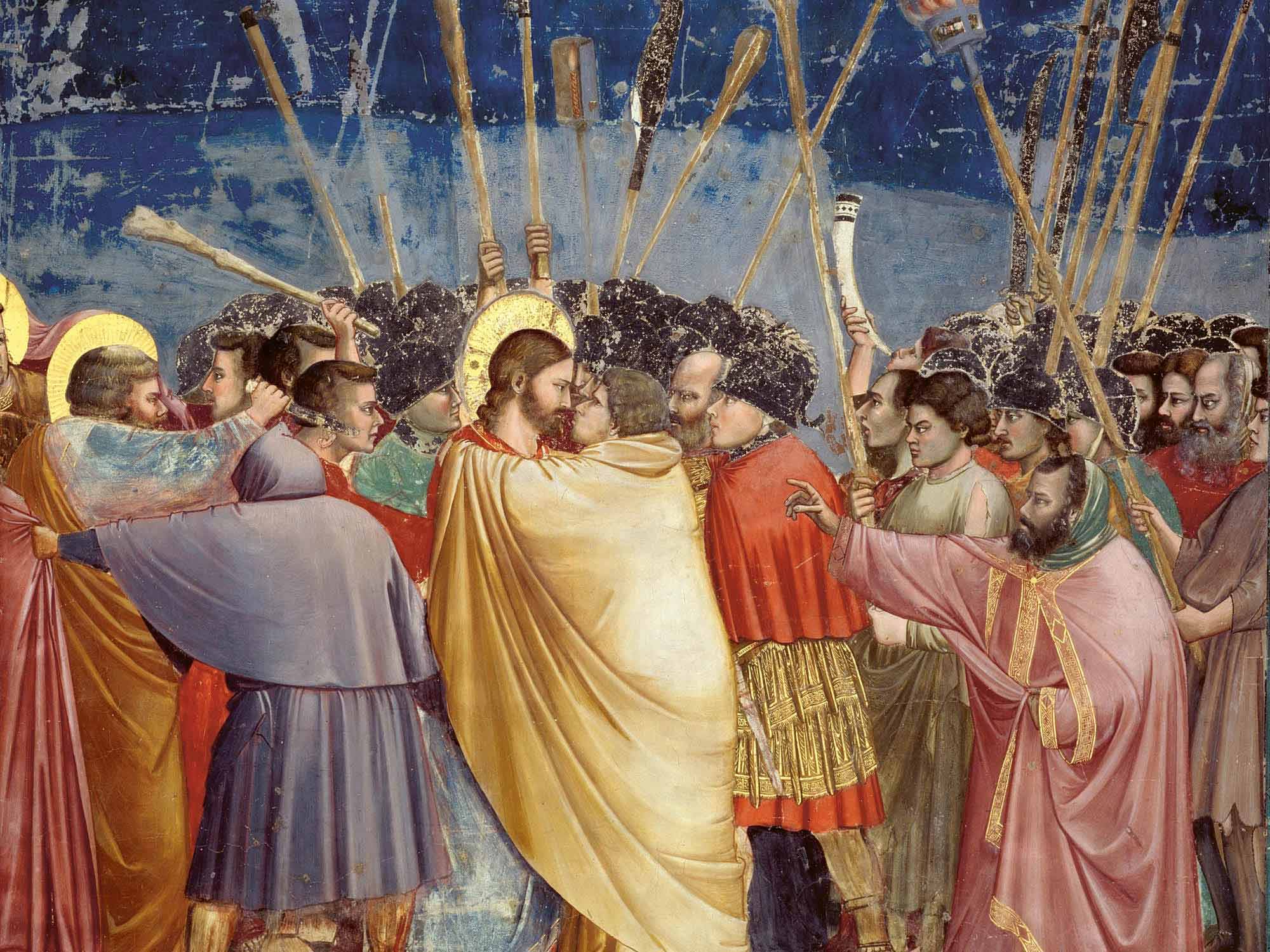
After betraying Jesus with a kiss, Judas returned the eighteen pieces of silver he received from the rulers for his betrayal and saw that he was the one who was mistaken; yet, through his error, he played a decisive role in bringing the Mystery of Golgotha to completion. In his despair, he hanged himself and thus became a spiritual witness to the death on the cross.
After death, he experienced that Christ did not condemn him. In a subsequent life, as a Church Father (Augustine), he became a zealous seeker of divine grace, yet—sensing his Judas-destiny—he also became a proponent of predestination: we are entirely in God’s hands and thus cannot act freely. Nevertheless, he also became a church figure far ahead of his time. He was the first to write an autobiography. In it, the capacities of the consciousness soul emerged when he reproached the Stoics: “You doubt everything, but that you doubt—that you cannot doubt.”
Gethsemane
The events in Gethsemane are often interpreted by the Church as meaning that Jesus, too, was afraid of death, and that this weakness was an expression of his humanity: even he was afraid in the face of death! But was this really about a human fear of death? After all, Christ is (still) a god here and knows that he will rise again after three days. Mephisto would ask: “Why all the fuss?”1
A closer look reveals that this passage refers to the cup as a symbol of death. Christ Jesus was already so weakened that there was a danger he might not be able to make it to the cross. Could this weakness have been accompanied by a vision? Did he see how much suffering would be inflicted in his name over the next millennia? Luke, the physician, describes this precisely: He fell into agony (γενομενος εν αγωνια, Lk. 22:44) and sweat blood and water. Christ Jesus struggled with this premature death. If he had died in Gethsemane, it would have been a cosmic failure. Scripture would not have been fulfilled. There would have been no death on the cross. Hence, his prayer that this cup pass from him. Today, we might speak instead of a magical act or meditation. But even here, “Not my will, but yours be done” (Lk. 22:42). And behold: an angel strengthened him.
Immediately following this was Judas’ kiss. This, too, helped Christ to take hold of Jesus’ body once more and thus endure the ordeal that now lay ahead.

Peter
He apparently intended to split the soldier’s skull, but the soldier moved his head slightly at just the “right” moment, so that Peter struck only his ear. Christ healed this wound—his final healing. For Peter, this behavior was presumably difficult to understand at that moment. But this, as well as his sleep in Gethsemane (“Watch and pray, lest you fall into temptation,” Mt. 26:41), shows that he was increasingly becoming a shadow of his former self. As himself, he still struck out and followed Christ all the way to Caiaphas, the high priest, but as his shadow, he slept through the spiritual dynamics in Gethsemane and ultimately even denied his allegiance to his Lord three times. The crowing of the rooster, foretold by Christ, triggered a threshold experience in him that shaped the rest of his life.
The Unclothed Youth
After the kiss, Mark (14:51–52) wrote: “And a young man followed him, his naked body wrapped in a fine linen cloth. And the young men seized him, and he left the linen cloth behind and fled naked.” Rudolf Steiner described this enigmatic young man as the Christ impulse. This description triggered a serious crisis in me. The Docetists, who were regarded as heretics, claimed that a God does not die as a criminal on the cross. The one who died there was a substitute. This view called into question the entire fact of Christ becoming a human being. So if the Christ impulse withdrew before the crucifixion, who then died on the cross? It was only a preparation for an Easter festival2 that shed light on this for me: can one view the Mystery from Michael’s perspective? Here, Michael appeared to me as one who, like a spiritual regent, accompanies the events. This young man appeared as a spiritual figure who ran toward Michael and united with him. This elevated Michael to a new level of being—he became the (temporary) guardian of the cosmic forces that Christ had renounced in his act of becoming a human being (for example, in the fact that there would be no more healings after that point). With this, the connection to the Father was also (more and more) torn away. This ultimately culminated in the desperate cry on the cross: “My God, my God, why have you forsaken me?” (Mt. 27:46). Was Christ not succumbing here to a primal human error? Should he not have cried out: My God, why can I no longer reach you?
In my view,3 Michael was the temporary guardian of this “youth.” After death, Christ returned to his cosmic grandeur, or more precisely, He reunited with the “youth” preserved by Michael and was now able not only to incorporate the wholly human experience of death into the divine world, but also—on the basis of this experience—to intervene with healing for earthly affairs (the Descent into Hell).
Pilate
After the high priests’ condemnation, the scene shifts to Pilate, who was responsible for passing judgment and carrying out sentences. Here, too, it is worth considering his inner perspective. Pilate had been warned by his wife: “Have nothing to do with this righteous man!” (Mt. 27:19). He intended to heed this and hoped that he might gain something from his conversation with Christ Jesus that could exonerate him. But in this conversation, his dilemma became clear: for the crucifixion to take place, Christ could not accommodate him. Everyone was against his stance: the “evil” and the “good.” It is individuality versus providence. Whatever he did (exchanging Christ for a criminal, Barnabas, washing his hands in innocence), he ultimately succumbed to the mob that had gathered outside his building: “Crucify him, crucify him!”—and became the executor of providence (Mt. 27:22-23, Mk. 15:13-14, Lk. 23:21).
He is not merely remembered for the German idiom “von Pontius zu Pilatus”4 or for his mention in the Apostles’ or Nicene Creed (“suffered under Pontius Pilate”). His question to Christ—“What is truth?” (Jn. 18:38)—has occupied philosophers ever since. He posed this question to the one who said of himself, “I am the truth” (Jn. 14:6).
On This Side of and Beyond the Cross
There are differences in the depiction of the Crucifixion between the Synoptic Gospels (Matthew, Mark, Luke) and John. In the Synoptic Gospels, the focus is on God, who became human in death and who ultimately even erred: “Why have you forsaken me?” (cf. Ps. 22:1), instead of “Why can I no longer reach you?” In John, Christ died as the King of the Spirit: “It is finished!” (Jn. 19:30). My impression is that John views the event from a post-mortem perspective: death as a transitional stage to the Resurrection. He was struck by the post-mortem spiritual power with which Christ orders and illuminates the chaos of the human spirit that had arisen through evolution. This event, too, was unique; that is to say, there were no rehearsals to see if it would all succeed. Humanly speaking, there was exactly one attempt! The greatest mysteries are touched upon here: physical resurrection—what was required, in terms of spiritual “technology” and the articulation of being, for this to succeed?
From the Risen One’s prohibiting Mary Magdalene from touching him, we can see that these events were complex. This apparently changed, for later he told Thomas, “Put your hand into my side” (Jn. 20:27), and even later he broke bread with the disciples and ate with them—stages of reincarnation. The fact that even a meal is possible shows, if the tradition is taken seriously, that there must have been a sensory dimension to this encounter, and yet he came to the disciples through the closed door.
Translation Joshua Kelberman

Footnotes
- Goethe, Faust I, line 137.
- Andreas Heertsch, “Michael und das Mysterium von Golgatha” [Michael and the Mystery of Golgotha], audio recording, 16 min.
- Andreas Heertsch, “Aus der Perspektive des Anderen” [From the perspective of the other], Korrespondenzblätt für Geistesforschung [Correspondence sheet for spiritual research], June 29, 2024, last modified January 12, 2025.
- Literally, “from pillar to post,” meaning to be sent back and forth, from one authority to another, without any purpose; usually combined with a verb, such as: von Pontius zu Pilatus gehen (to go); laufen (to walk); rennen (to run); schicken (to be sent) – Trans. note.





