

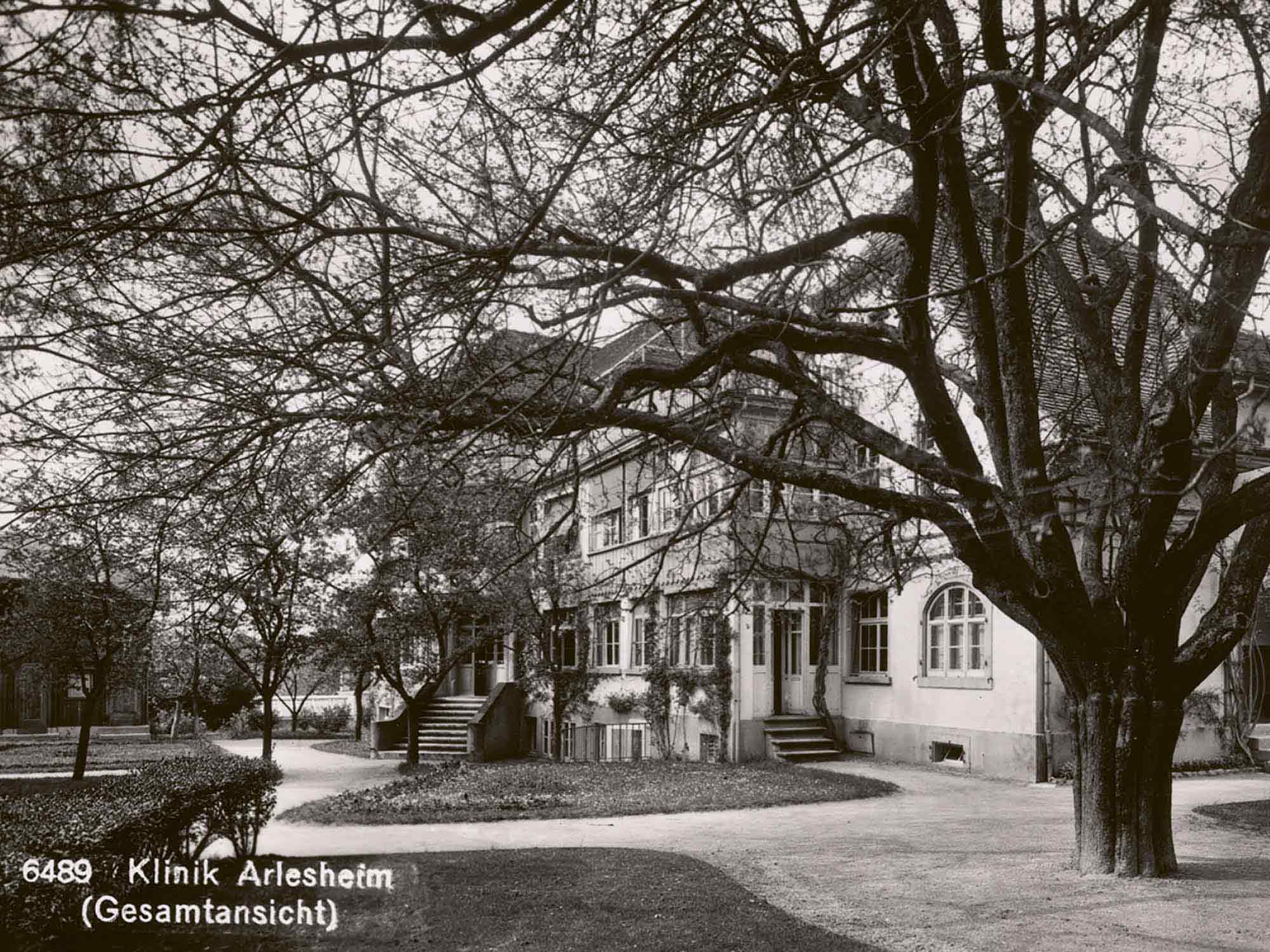
Ita Wegman’s address at the opening of the Arlesheim Clinic extension, one hundred years ago (1926).
When human beings, who adhere to a worldview in which the suprasensory plays a role, undertake to do something, then this deed will always have a twofold character in this worldview.
When the deed is directed outward, it will have an exoteric stamp, that is, it will be so that anyone who thinks differently will be able to understand it, that it does not fall outside the scope of what already exists. But in this worldview, there is another kind of deed, one that is aligned with and oriented toward suprasensible laws.
We must think upon this when we come together here today to perform a deed that has a great significance both toward the inner and the outer. It is the day on which we give to the public a place from which our medical work is to unfold, full of force, toward the outside—a place where the sick and weary in body and soul are to find rest and healing.
This side of our outer deed will be observed with interest by the outside world. It will also be met with criticism. And the more brilliantly we initiate these deeds, the better it will be; then will this, our first step outward, be crowned with success. The more worldly we behave, the more affirming will be the echo from outside. The more assured the disposition of those who carry out the deed, the more it will be accepted by such outsiders who otherwise have only criticism and a negative position toward new ideas.
But, at the same time, what must be the inner side of our deed? As the same human beings who know how to behave in a worldly manner toward the outside, who can encounter human beings with an assured disposition, who, through their knowledge, draw people’s attention to themselves; as the same human beings, we must be conscious that another kind of deed is required of us, a deed that is no longer directed outward, but rather must be born in our hearts, a deed that no longer orients itself toward human beings or concerns itself with them, but rather positions us as members within the spiritual world.
As such human beings, we want, on the one side, to have wholly real communication with human beings and the world, and, on the other side, to cultivate contact with the gods. If we take the spiritual world seriously, if we take it as real, then it is self-evident that a wholly different mood of soul, a wholly different soul comprehension must prevail at the moment when we will to turn our inner eye, our inner ear, our soul to what the spiritual world has to reveal. Instead of a self-confident and proud disposition, a humble, modest disposition must come, a disposition in which one wants to receive rather than give. This transformation must be accomplished right down into the gestures and movements; the head bows as if listening inwardly, the gaze no longer clings to the splendor of external objects that otherwise awaken our interest, but instead turns itself inward; the hands fold in expectant contemplation, and the soul becomes still, letting go of what otherwise moves it emotionally. This transformation, this turning inward, must be accomplished if we want to hear our inner voice, the voice of conscience.
And what does the voice of conscience say when we listen quietly, modestly, and humbly within ourself, how does it reveal itself? When we hear this voice in the soul, we are initially frightened; we feel small, ever so tiny, too weak to bear what it tells us. The voice of conscience calls; it calls relentlessly; it calls us not to waver in our trust in the spiritual world, not to slacken in the fulfillment of our duties; it demands that we courageously accept the blows of destiny, no matter how hard, no matter how incomprehensible they may be.
And if we listen even more intimately to this voice of conscience, it says again in all severity: There is still too much personality in you. The spiritual world cannot be reached with so much egoism in you; give up your ‘I’. This call to give up our own ‘I’ is of enormous weight. At first, we lose all comprehension. According to ordinary consciousness, giving up one’s own ‘I’ would mean becoming a weak person. But then it resonates within us: Michael dwells within you, you see with his eyes, you have the force of Christ, you have the might of consecration.1
To the extent that we can extinguish our own ‘I’, it becomes bright and light within us, and the sensation clearly arises in us that our own ‘I’ can never be there when Michael’s forces, when Christ’s forces, when the might of consecration overshadow us or want to unite spiritually within us. The personality must be pushed back; self-love must be killed.
And when this is accomplished within us, one can have the image of the conquered, bleeding serpent transforming into the cross, and the forces of the blood transforming into shining stars. Seven stars shine around the cross, and one feels the force of seven shining stars in one’s heart; they radiate so strongly in all directions that it becomes inner light. We must strive to feel this within ourselves. In this way, we will become vessels and mediators for the deeds of the spiritual world.
During the hours of consecration, with humility and all modesty, we must sacrifice our ‘I’, thereby allowing gods to dwell within us and seize our thinking, feeling, and willing. In this way, we also obtain the right force for our outward deed; the ‘I’ thus receives the right support; the ‘I’ is strengthened in such a way that one obtains the right self-consciousness, which permeates from the head to the feet and right down to the fingertips. The physician who does not follow this path will not be able to fulfill their world task.
And when we, my dear friends, have gathered together here for the festive opening of the clinic, all the festivities planned for this opening would have no meaning, no matter how splendid they may be; they would fade away and be forgotten if, alongside the exoteric outer activity, an inner esoteric life were not cultivated in the hearts of those bound up with the work of this clinic.
And so it is to be full of meaning for us when the words of our teacher Rudolf Steiner, with which he bound himself to us when he still spoke to us in his physical body, are now spoken here in this room for the first time at its consecration, the words that were given on the occasion of the laying of the Foundation Stone of the Anthroposophical Society in Dornach, which are to perpetually renew us from within our hearts: “Human soul, you live in the limbs . . .” (here followed the entire Foundation Stone Meditation).2
Translation Joshua Kelberman
Image Arlesheim Clinic. Source: Ita Wegman Archive, Arlesheim (IWA)

Footnotes
- Cf. Rudolf Steiner, Rudolf Steiner, Briefe und Meditationen für Ita Wegman [Letters and meditations for Ita Wegman] (Arlesheim: Verlag des Ita Wegman Instituts, 2018), 76 f.
- Ita Wegman, Mysterien und Heilkunst: Aufsätze und Ansprachen 1925–1933 [Mysteries and the healing arts: Essays and addresses 1925–1933] (Arlesheim: Verlag des Ita Wegman Instituts, 2024), 201f. For the Foundation Stone Meditation, see Rudolf Steiner, The Christmas Conference: For the Foundation of the General Anthroposophical Society 1923/1924, CW 260 (Hudson, NY: SteinerBooks, 2020), Dornach, Dec. 25, 1923, 10:00 a.m.





