


Nicanor Perlas, an anthroposophical civil rights activist and environmentalist born on January 10, 1950, passed away on August 15, 2025. This review of his last book is a tribute to his work.1
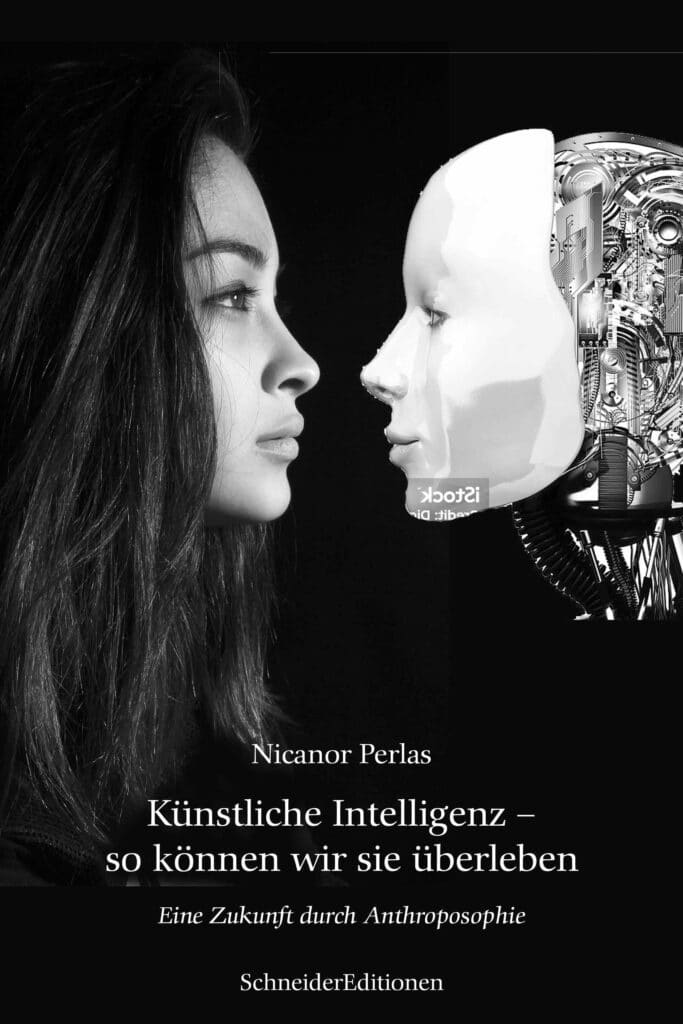
Published in English in 2018, Humanity’s Last Stand: The Challenge of Artificial Intelligence. A Spiritual-Scientific Response is both informative and encouraging. Perlas spent a long time living in Silicon Valley during his research. His book provides an outlook on one of the pressing tasks facing humanity in the future and, at the same time, offers help in mastering new challenges using the tools of anthroposophy. Seven years after its first publication, it’s more relevant than ever.
We encounter artificial intelligence (AI) every day, often without being sufficiently conscious of it, for example, when calling call centers or searching the internet. All predictions about AI’s progress have been confirmed; in fact, they’ve even come true much earlier than predicted. In his book, Perlas characterizes this artificial machine world: its combinations of mathematical operations map reality in mathematical algorithms. It’s based on “big data,” the maximum collection of data. Huge servers contain the contents of many of the world’s libraries. In the future, they’ll be able to record and evaluate all this data in seconds. At the highest levels of logical permutation, AI can combine statistical probabilities and logical combinations.
But the result is a caricature of humanity. Instead of living concepts arising from engagement with the future, instead of human impulses full of feeling and will, an inner, mechanistic logic of past knowledge prevails. There is always a lack of assurance. Certainty has its corporeal basis in the rhythmic system of human beings and in our feeling life. Through our living thinking, human beings can establish a relationship with the spiritual sphere of “moral fantasy” and “moral technique” as described in Steiner’s Philosophy of Freedom. Perlas also references Sergei Prokofiev’s work on evil in the age of the consciousness soul.
The so-called “Alignment Challenge,” how human values and laws can be ensured through the processing of these algorithms, remains completely unresolved. In fact, it is quite the contrary that occurs: algorithms combine with other algorithms and create an image of “reality” that is no longer comprehensible even to their programmers. Today, AI can still be considered “weak,” but a development toward Artificial General Intelligence (AGI) is foreseeable. If these “strong” intelligences then join forces (perhaps within the next twenty years), it would not be a far leap to the so-called “self-aware” Artificial Super Intelligence (ASI). There is a danger that AGI or ASI will dominate life on Earth through its “own” decisions, in place of human beings. This would result not in human world domination but in that of an abstract machine intelligence.
Social Consequences
Perlas realistically describes the far-reaching economic and social consequences of AI. On the one side, immense wealth is created for the owners, who also gain political influence. On the other side, large sections of humanity are threatened with impoverishment because their work becomes superfluous. Many jobs in call centers are increasingly being replaced by AI. Mass unemployment threatens many countries in Asia and Europe. Economies such as the Philippines will lose considerable amounts of national income. Even today, the ecological consequences of AI can only be roughly estimated. Extensive queries to AI servers consume more energy and water than a letter sent by post. The huge energy requirements of the servers already necessitate additional power plants, mostly nuclear. For Perlas, the culmination of anthroposophy is still pending, despite the spread of its movement. He develops perspectives for further spiritual struggle. To this end, anthroposophists must take action and not stay merely with a practice of study alone. Historically, the task has been to collaborate with non-anthroposophical communities that have similar humanistic goals. Perlas speaks from his rich experience in the civil rights movement and ecology. He sees a realistic opportunity to counter artificial machine intelligence with “collective human intelligence” (CHI). This means engaging with the sphere of Ahriman while also encountering Christ in the etheric.
Nicanor Perlas’s seminal book is written in a flowing, easy-to-understand style and is accessible to lay readers. It describes the problems without over-dramatizing the situation and suggests future developments instead of succumbing to fear and resignation. Perlas trusts in humanity’s potential to shape the future and appeals to the common good. He is thus able to conclude the book with the hope that humanity will achieve a breakthrough in collective and social human intelligence—but this requires an active awakening.
Translation Joshua Kelberman
Book Nicanor Perlas, Humanity’s Last Stand: The Challenge of Artificial Intelligence. A Spiritual-Scientific Response (Forest Row, East Sussex: Temple Lodge, 2018).






The review of Nicanor Perlas book arouses, among others, two thoughts: 1. “Fahrenheit 451” by Ray Bradbury, in which secret rebels learn forbidden books by heart, and 2. Perhaps when the power system collapes ( Berlin this week!) The only people who will be able to read, and write with pencil and paper and to calculate without a computer will be Waldorf School alumni.