

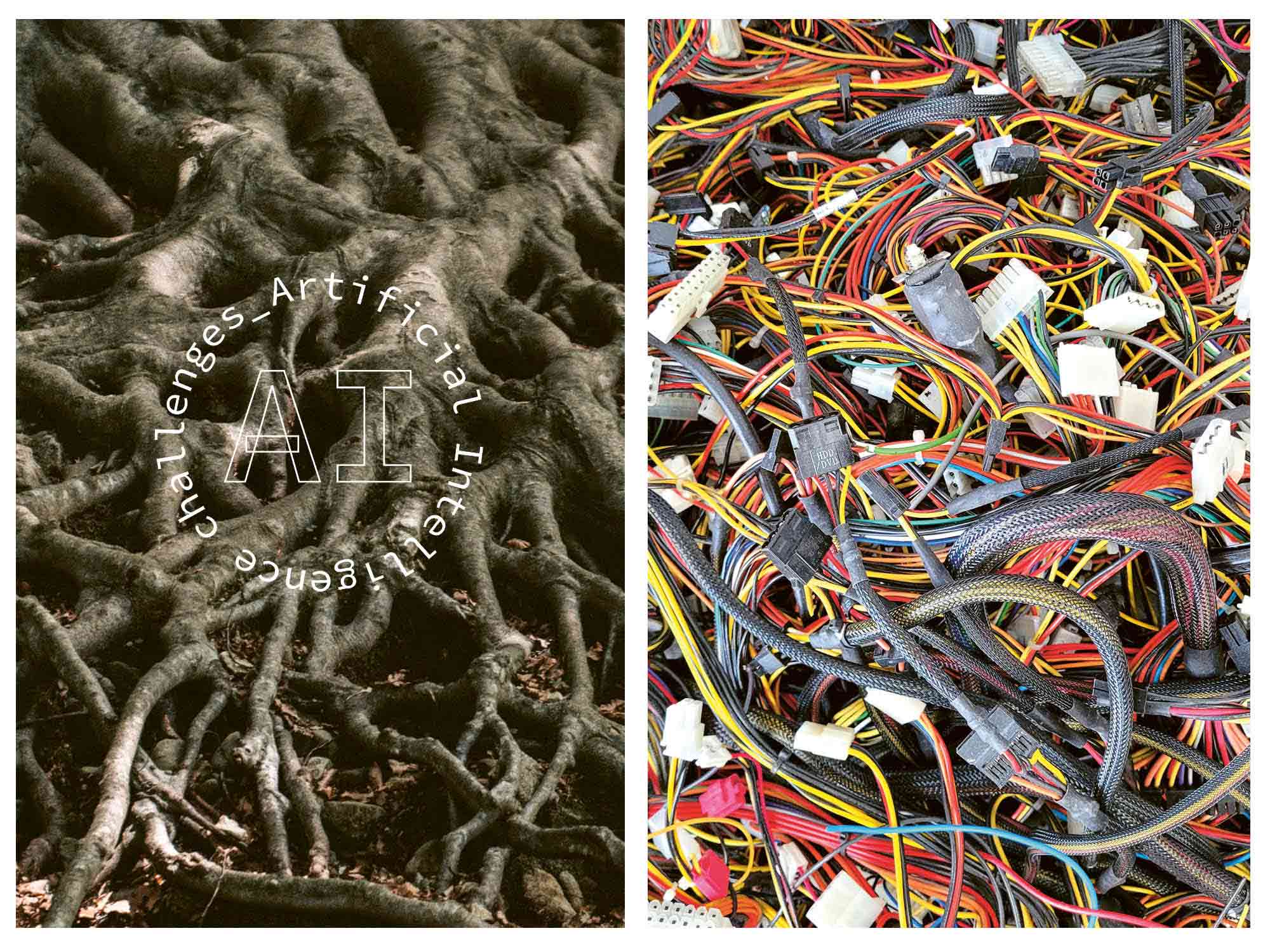
In our time, the proliferation of language and messaging in artificial intelligence and social media have separated us from authentic meaning. They have crowded out and contributed to the atrophy of human thinking. John Bloom ventures an antidote to this condition called wild thinking. Wild thinking helps regenerate a sense of spiritual freedom and the possibility of a renewing culture.
Think past the thought.
Such wildness will free us to meet
the bewildering truth of the not yet known,
loved but not yet lived.
– JB
These times demand wild thinking, not wild thoughts. Wild thinking is the heart and will poured into imagination and shepherded by angelic beings who bathe us in a moral atmosphere of love. Wild thinking manifests spiritual freedom and derives meaning from individual and mutual responsibility to and for the wellbeing of human-becoming in an age of anguish.
Such thinking expresses courage accompanied by the need for positivity in a field of thought fraught with artificialization, commodification of everything, and political agendas, real and imagined. The push to return to old ways, centered on monoculture and imperial domination, is accompanied by an intent to shape thinking by infusing it with ideology. The longer-term purpose is to separate the flow of thinking from that which has always called it forward: the necessities of human and natural realities. These necessities include the will to know the world, freedom to know the self, and the recognition that we co-create an ever-changing understanding of how the world works and why each of us is present in it. There is an essential connection between wild thinking and the destiny of human relationships and culture, and between wild thinking and the necessity of cultivating and protecting spiritual freedom.
So much in our culture feels like it is working against that freedom. One telling example is the degree to which the artificialization of intelligence seems to be paralleling an accelerating atrophy of thought capacity. Artificial intelligence, in its operations, cannot fathom the origin of thinking; its content is composed of pre-existing digital sources taken with or without copyright permission and recombined via algorithm into what appears as coherent thought. As such, it is self-referential and self-enclosed. As we celebrate a certain victory over information, we seem to be ignoring and even attacking the processes and places that encourage renewal and co-creation of thinking on a deeply personal and human level—the energetic or spiritual-cultural fields that make the origin of thought and thinking possible.
As I write this, I am mindful that my words are subject to capture as soon as they are published online. The words will be absorbed into a too-big-to-fail and too-resourced-to-hold-accountable system engaged essentially in the mega-act of plagiarism—a word whose origin means kidnapping. Any “thoughts” or words generated by artificial intelligence are generated in captivity and, thus, isolated or disconnected from the wild instincts and deep discipline of human knowing and expression. Shakespeare recognized this potent disconnection, even at the turn into the seventeenth century. In Hamlet (Act 3; Scene 3), King Claudius has a moment of honest reckoning during prayer: “My words fly up, my thoughts remain below.” Shakespeare identified the distinction between thinking, feelings, and words. Artificial intelligence engages us with language constructed from words without the living thought attached.
Freehood
While my words may be captured, my thinking remains free. Thinking’s genius is to protect itself—because it is no thing—from the imposition and delimitations of digital dimensions. Wild thinking calls us to tend to the meanings of our thoughts, words, and language, with a consciousness of their poetic character along with their linguistic one. Wild thinking carries within it a quality of discernment that transcends the literal to a capacity for living into one’s own thoughts and those of others.
Word separated from thought-meaning is endemic to the digital age. However, one could make the case that mistaking the representation for what it represents has a centuries-long history in the world of art. The capacity for crafting realistic illusions has fostered a persistent flaw in our perception of how we know. Given the representational ethic and aesthetic that make this substitution possible (think screen time), we are losing our capacity to observe in real time and real space, along with our capacity to discern truth because its origin has become opaque. Thus, our higher moral being, which flourishes in wild thinking and spiritual freedom, needs to be active more than ever. Cultivating the sense for truth through wild thinking is an essential part of the educational processes for the rising generations. We have to recognize that this sense for truth comes naturally for the young child who still has their spirit intact. Without this process of cultivation, we risk losing the thread of how we make meaning that passes from one generation to the next through warmth and relationship—neither of which are characteristic of digital platforms.
In writing, the impulse that gives rise to the words is still a “free being” within me, despite the cultural and commercial impulses working to eliminate it today. Freehood, the social field which recognizes and values “free being,” needs remediation. It will take collective social will, innovative agreements, and compassionate governance to do so. We will need each other to navigate the kingdoms of wild thinking, to stimulate a culture of spiritual insights and practical applications, and to co-create the new agreements that will both free us up and keep us honest in light of shared intentions and values.
Beyond the Material
An antidote to a culture that capitalizes on the instantaneous convenience of commoditized thought, as found in social media and AI, is a capacity to govern our chosen communities out of the guiding principle of love. It seems simple because love bridges interiority and exteriority. Love is not real without this pulsing bridge, except as an abstract concept. It’s also complex because it requires a profound sense of self-knowledge and an equally profound and shared sense of love’s source. At-scale operating systems for this are not particularly visible in the world right now—though there are communities of practice from which we can learn.
Such a practice requires awareness that we are but one part of a world that reaches significantly beyond the material world that we can touch and measure. This participation makes it possible to directly experience love as embedded in the world, and to be responsible for it and practice in such a way that it and we do not fall prey to the materialistic forces. It is an ever-present field, a moral atmosphere that can, with consciousness, infuse individual experience and social practices selflessly.
Unlike the language of artificial intelligence, which is entirely attached to the past, love is only present when it is present. And yet it has within it all of time, both past and future. Such an understanding of time gives permission to slow things down and de-industrialize time, in order to engender the heart space needed to find each other and form new agreements.
A New Wilderness
How we govern ourselves, inwardly and in groups, is critically essential work in need of committed attention. We have an indication of the social soul flexibility needed to move in this direction in Rudolf Steiner’s concepts of social threefolding. If we take threefolding seriously as practice, we can change culture, making it then possible to engage in a co-created field of agreements. This work lands us at the brink of the economic world—the one that brought us the brilliance and convenience of artificial intelligence driven by those who appear to thrive at the nexus of money and power. Wild thinking can break through this nexus. Through the inevitable chaos that wild thinking engenders, a new sense of social cohesion can emerge. We will find that we have, through our individual endeavors together, generated a new wilderness of possibility with a broadly social rather than a limited political foundation. This is the shift in spiritual and social consciousness that makes social threefolding possible.
My fear is that until we embrace discovering a new inner wilderness together, we will continue to consume our material wilderness for the sake of money and power. It will take a lot of wild thinking and social will to reconnect with our past while inviting an ethical and aesthetic future. We just need to be mindful that the powers of convenience and addictive algorithms do not dominate the experience.
Image Roots and cables. Photos: Matteo Grando, Nathan Cima/Unsplash






