Many of us know Rudolf Steiner as a great teacher and spiritual scientist, but do we know him as a humorist? According to several personal reports, the Herr Doctor had a warm and lively sense of humor. Numerous anecdotal histories indicate that he could be a very playful and spontaneous comic.
I recall as a young Waldorf teacher in the 1980s, when lightbulb jokes were in fashion, another teacher asked, “How many anthroposophists does it take to change a lightbulb?” The answer: “We don’t know because Rudolf Steiner never gave any indications for that.”
“You will see that often, when the highest spiritual connections are to be discussed, I mix into the contemplation something which is not intended to bring us out of the mood, but only to drive away the egoistic sentimentality […] which can never be without humor.” –Rudolf Steiner1
One such humorous incident took place on the muddy Dornach hill, the worksite of the First Goetheanum, when a photographer had come to take pictures of Rudolf Steiner and the progress of this unique new building. As Steiner was literally hopping into his boots and the photographer was adjusting his camera, Steiner reportedly exclaimed jovially, “Don’t take my photograph now or tomorrow, all the anthroposophists will be hopping up and down on one foot!”
Although utterly serious in regard to his anthroposophical teachings, he had no difficulty in bringing lightness to a situation when the occasion called for it. Although his written works carry a profoundly serious message, one sees that in his lectures to the workmen, for instance, there is humor openly sprinkled throughout his responses to their questions.
In fact, humor was a theme about which he could be quite serious. Lectures on the nature and importance of “Laughing and Weeping” and pedagogical talks to teachers make it abundantly clear how important humor is in the life of the human being and in the education of the child. “Laughter on the one hand signifies a raising of oneself, a setting up of the ‘I’ above its environment; that is, the victory of the higher over the lower.”2 On the other hand, laughter is a subtle breathing process of the soul. “Laughter is actually a process that makes us organically healthy. It acts like a proper healthy, undisturbed digestion! Well, here we come to bring the humorous, the cheerful into a relationship with the digestive process.”3
This I learned by way of trial and error from years of high school teaching: confrontations of a will nature are resolved more satisfactorily through humor. Even in a special needs setting, Steiner advised curative educators, “Above all, what does it take to raise such children? Not leaden heaviness, but humor, real humor, the humor of life. Despite all possible clever tricks, you won’t be able to educate such children if you don’t have the necessary humor for life. So there will have to be room in the anthroposophical movement for a sense of flexibility.”4
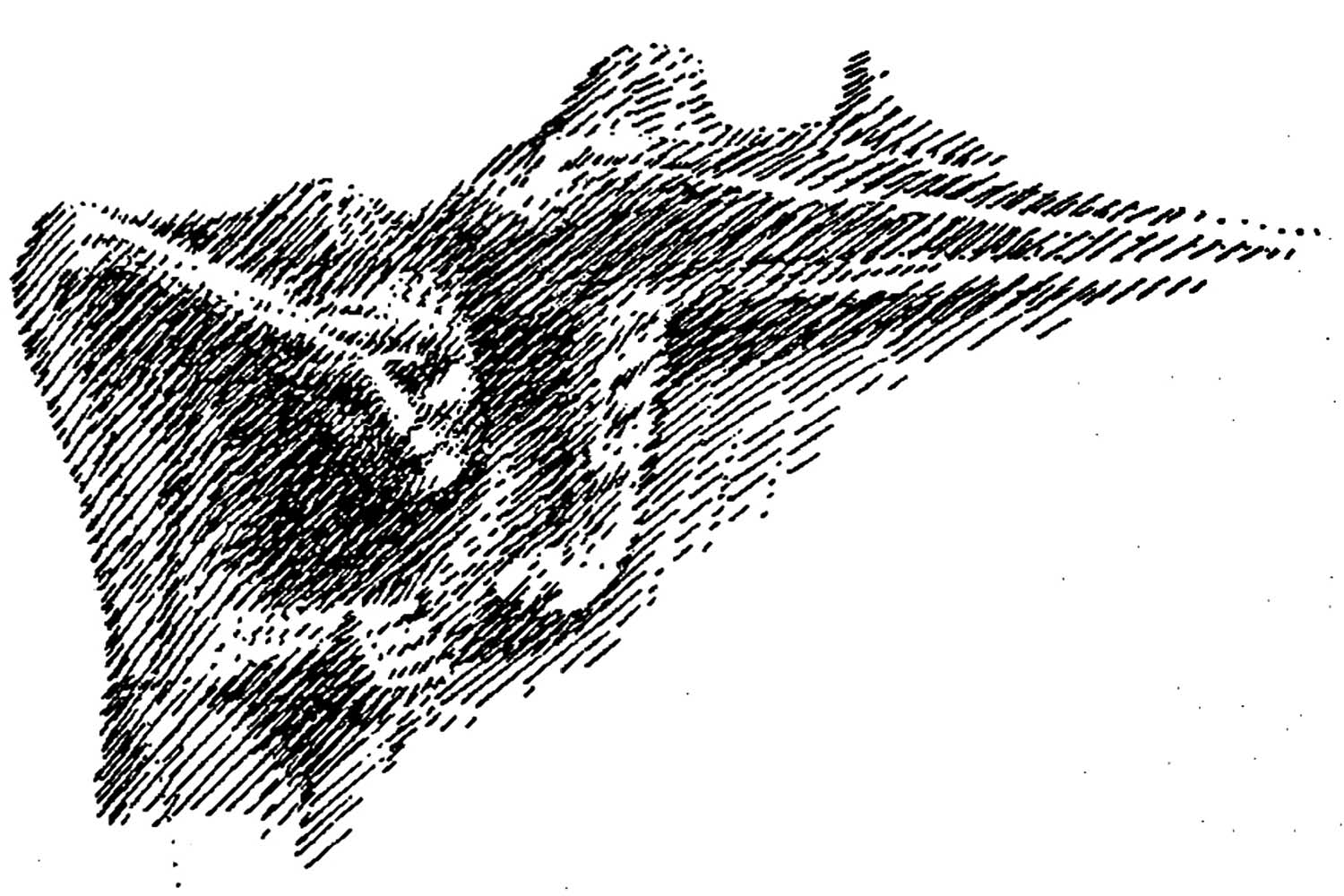
According to Marie Steiner, after mealtimes, another side of her husband would manifest itself in the form of cartoons sketched on paper napkins or random scraps of paper. The Great Philosopher, The Master, The Salesman, and The Artist are some of the many caricature drawings he produced. The cartoon, Two Members [of the Anthroposophical Society], is especially memorable and gives us a wonderful peek into the sort of folks gathered on the Dornach Hill during that time. And one wonders if The Philosopher sketch might just contain something of a younger, reflective self-portrait of the PhD in Philosophy.


Right: Copy made by author of a sketch by Rudolf Steiner: “Two Members.”
But one of the most profound creative statements concerning humor that Rudolf Steiner placed into the historic record of the 20th century is the carved wood figure of an elemental Rock Being, the so-called Spirit of Humor, gazing down upon the great human drama of world evolution. This whimsical figure was introduced to the overall composition in order to bring about a compositional balance—a balance even by way of its own asymmetry. “You can walk around this being, and you will have a different view from every point below. But you will see that the asymmetry works as something necessary, because it is the expression of the gesture with which this being looks over the rock with a certain humor and looks down on the group below. This looking down over the rock with humor has a good reason.”5 In the large wooden sculpture of the Representative of Humanity, a smirking, winged figure peers down on the universal human being, the Christ figure, striding in realized freedom and strength of divine love between the temptations of the inner and outer worlds. A sense of humor above all else appears as the crowning feature within this world drama. “To the question as to what laughter [and humor] fundamentally is, we can reply: It is a spiritual expression of our striving for liberation, in order that we may not be entangled in things unworthy of us but with a smile may rise above things to which we should never be enslaved.”6
It has been significant for me in my search for truth and value in life to discover that one of our era’s greatest thinkers, among so many other accomplishments, was also a humorist.
This year, we bring you a series of articles titled “Rudolf Steiner as…” to honor the 100th anniversary of Rudolf Steiner’s death. These articles are sometimes essays, sometimes simply thoughts or reflections—always an aspect of his being.

Footnotes
- Rudolf Steiner, The Earth’s Death and World Life–Anthroposophical Life Gifts–Consciousness Necessities for the Present and Future, GA 181, p. 316f.
- Rudolf Steiner, Metamorphoses of the Soul II, GA 59, Berlin, February 3, 1910.
- Rudolf Steiner, The Being of Man and His Future Evolution, GA 107, Berlin, April 27,1909.
- Rudolf Steiner, Heilpädagogischer Kurs [Course on Education for Special Needs] GA 317, July 1, 1924, pg. 102f. [In German “Vor allen Dingen, was gehört zum Erziehen von solchen Kindern dazu? Nicht die bleierne Schwere, sondern Humor, wirklicher Humor, Lebenshumor. Man wird trotz allen möglichen gescheiten Kunstgriffen solche Kinder nicht erziehen können, wenn man nicht den nötigen Lebenshumor hat. Also es wird schon Platz greifen müssen in der anthroposophischen Bewegung, dass man Sinn hat für Beweglichkeit.”]
- Rudolf Steiner, The Earth’s Death and World Life–Anthroposophical Life Gifts–Consciousness Necessities for the Present and Future, GA 181, p. 316f.
- Rudolf Steiner, Metamorphoses of the Soul II, GA 59, Berlin, February 3, 1910.